
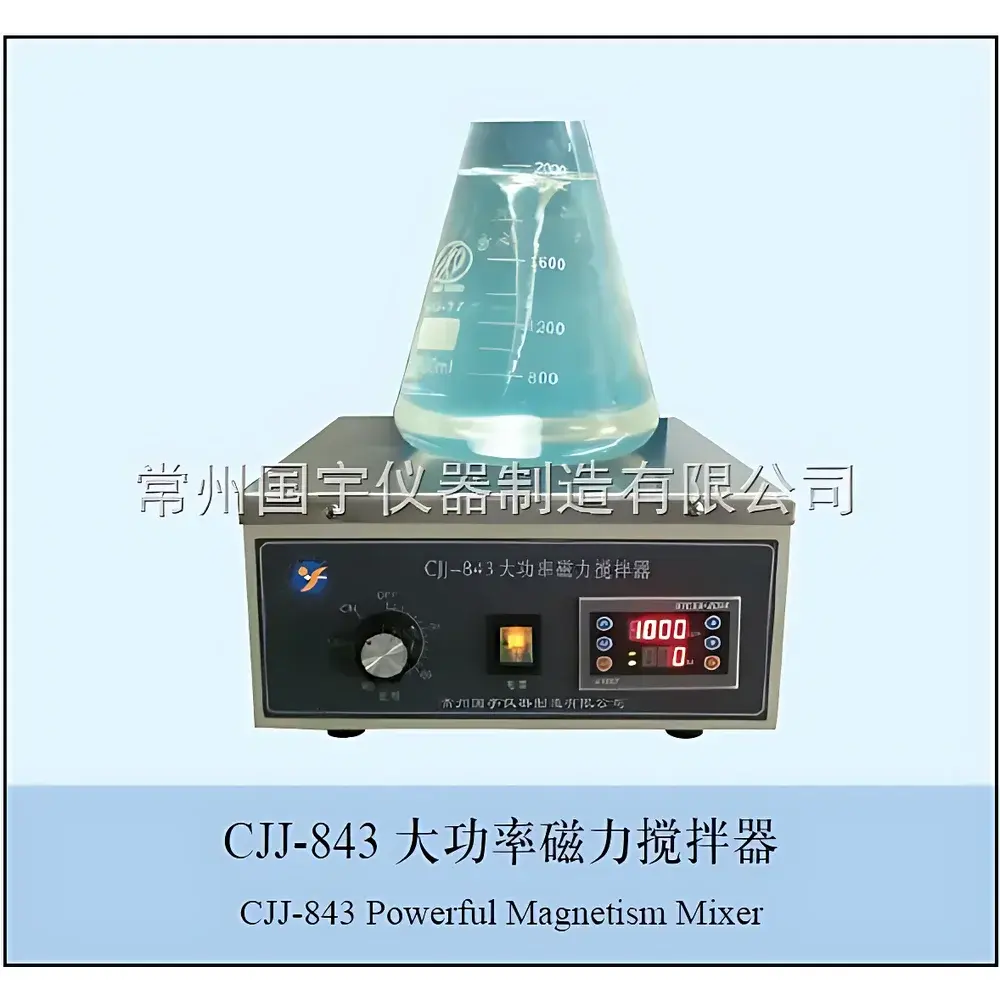
CZGY CJJ-843 Plus High-Power Constant-Speed Magnetic Stirrer
| Brand | CZGY |
|---|---|
| Origin | Jiangsu, China |
| Manufacturer Type | Direct Manufacturer |
| Product Category | Domestic |
| Model | CJJ-843 Plus |
| Instrument Type | Magnetic Stirrer |
| Max. Stirring Volume | 30 L |
| Speed Range | 200–2000 rpm |
| Power Supply | AC 220 V ±5%, 50 Hz |
| Motor Power | 40 W |
| Speed Display | Digital LED |
| Speed Stability | ±1 rpm |
| Stirring Platform Dimensions | 28 × 28 cm |
| Timer Range (Instrument Panel) | 0–120 min |
| Timer Range (Operation Panel) | 0–999 min |
| Heating Function | None |
| Compliance | CE-marked design principles (non-certified unit) |
Overview
The CZGY CJJ-843 Plus High-Power Constant-Speed Magnetic Stirrer is an engineered solution for robust, repeatable mixing of low-to-medium viscosity liquids in analytical, pharmaceutical, and quality control laboratories. Designed around a permanent-magnet DC motor coupled with a precision electronic speed-regulation circuit, this stirrer delivers stable rotational output across its full 200–2000 rpm range—without mechanical wear from carbon brushes or gear reduction. Unlike variable-speed controllers that rely on phase-angle dimming (which introduces torque ripple), the CJJ-843 Plus employs closed-loop feedback to maintain setpoint accuracy within ±1 rpm under load, ensuring consistent shear input during dissolution testing, buffer preparation, or reagent homogenization. Its non-heating configuration aligns with applications requiring strict thermal neutrality—such as enzymatic assays, cold-chain sample handling, or solvent-sensitive polymer dispersions. The unit operates without open flame, audible gear noise, or electromagnetic interference beyond IEC 61326-1 Class B limits, making it suitable for shared benchtop environments adjacent to sensitive instrumentation (e.g., pH meters, balances, or spectrophotometers).
Key Features
- High-torque 40 W permanent-magnet DC motor optimized for continuous-duty operation at elevated speeds and volumes up to 30 L (using appropriately sized stir bars and vessels)
- Dual independent digital timers: front-panel preset timer (0–120 min) for routine protocols; extended operational timer (0–999 min) accessible via dedicated keypad for unattended overnight mixing
- Corrosion-resistant 28 × 28 cm ceramic-coated stainless steel platform with high magnetic permeability—resists pitting, staining, and chemical etching from common lab solvents (e.g., ethanol, acetone, dilute acids/bases)
- Dedicated speed and time keypads with tactile feedback: left-side keys adjust rpm in 1-rpm increments; right-side keys configure timer duration without interrupting active rotation
- Real-time LED display showing both current speed (rpm) and remaining time (min:sec), enabling traceable process monitoring without external data loggers
- No integrated heating element—eliminates thermal drift in temperature-sensitive protocols and simplifies compliance with ISO/IEC 17025 clause 5.4.2 (equipment suitability verification)
Sample Compatibility & Compliance
The CJJ-843 Plus accommodates standard laboratory glassware including beakers (50 mL to 5 L), cylindrical vessels, and jacketed reactors—provided stir bar geometry (e.g., cross-shaped or fleur-de-lis) and magnetic coupling depth match the vessel’s aspect ratio and liquid height. It supports stir bars up to 80 mm in length and 12 mm in diameter, compatible with PTFE-, PTFE/glass-, or encapsulated samarium-cobalt variants. While the unit itself carries no formal regulatory certification (e.g., UL, CSA, or FDA 510(k)), its electrical architecture adheres to IEC 61010-1 safety principles for laboratory equipment, and its operational stability meets internal validation requirements for ASTM D1298 (density of crude oil) and USP (dissolution apparatus qualification) where mechanical agitation is specified. Users performing GLP- or GMP-aligned work are advised to document speed calibration annually using a certified optical tachometer and retain records per 21 CFR Part 11 §11.10(b).
Software & Data Management
This is a standalone hardware instrument with no embedded firmware connectivity (no USB, RS-232, or Bluetooth interfaces). All operational parameters—including speed setpoint, elapsed time, and timer configuration—are retained locally via non-volatile memory and displayed in real time. For audit-trail generation, laboratories integrate the device into existing electronic lab notebook (ELN) systems by manually recording timestamped settings and outcomes, or by pairing it with external IoT-enabled power monitors (e.g., Kill A Watt units) to log energy consumption profiles correlated with mixing duration. No proprietary software is required, reducing IT validation burden in regulated environments.
Applications
- Preparation of homogeneous aqueous and organic solutions for titration standards, calibration stock solutions, and mobile phase blending in HPLC workflows
- Dispersion of nanoparticles, colloids, or microcrystalline suspensions where shear history must remain consistent between batches
- Stirring during gravimetric analysis, filtration support, or vacuum-assisted degassing procedures
- Long-duration mixing of culture media components prior to autoclaving—particularly where thermal gradients from hotplate-stirrers could induce premature gelation or degradation
- Supporting ASTM E2913-22 (standard practice for evaluating mixing uniformity) through repeatable rotational input across replicate vessels
FAQ
Does the CJJ-843 Plus include temperature control?
No. This model is strictly a magnetic stirrer without heating capability. Temperature-sensitive applications require external thermostatic baths or jacketed vessels.
What is the maximum recommended vessel diameter for stable stirring at 2000 rpm?
For optimal vortex formation and stir bar retention, use vessels ≤18 cm in diameter when operating above 1500 rpm. Larger diameters increase risk of stir bar ejection due to centrifugal forces.
Can the timer function be used while the unit is running?
No. Timer values must be set prior to initiating rotation. Attempting to modify timing during operation has no effect on the active cycle.
Is calibration required before first use?
Yes. Verify speed accuracy using a handheld optical tachometer against the LED display at three points: 500 rpm, 1200 rpm, and 2000 rpm. Document deviations exceeding ±1 rpm in your equipment log.
What maintenance intervals are recommended for long-term reliability?
Inspect the stir plate surface quarterly for scratches or residue buildup; clean with isopropyl alcohol and lint-free cloth. Annually verify motor brushless commutation integrity via no-load current draw measurement (should remain ≤0.18 A at 220 V).



