
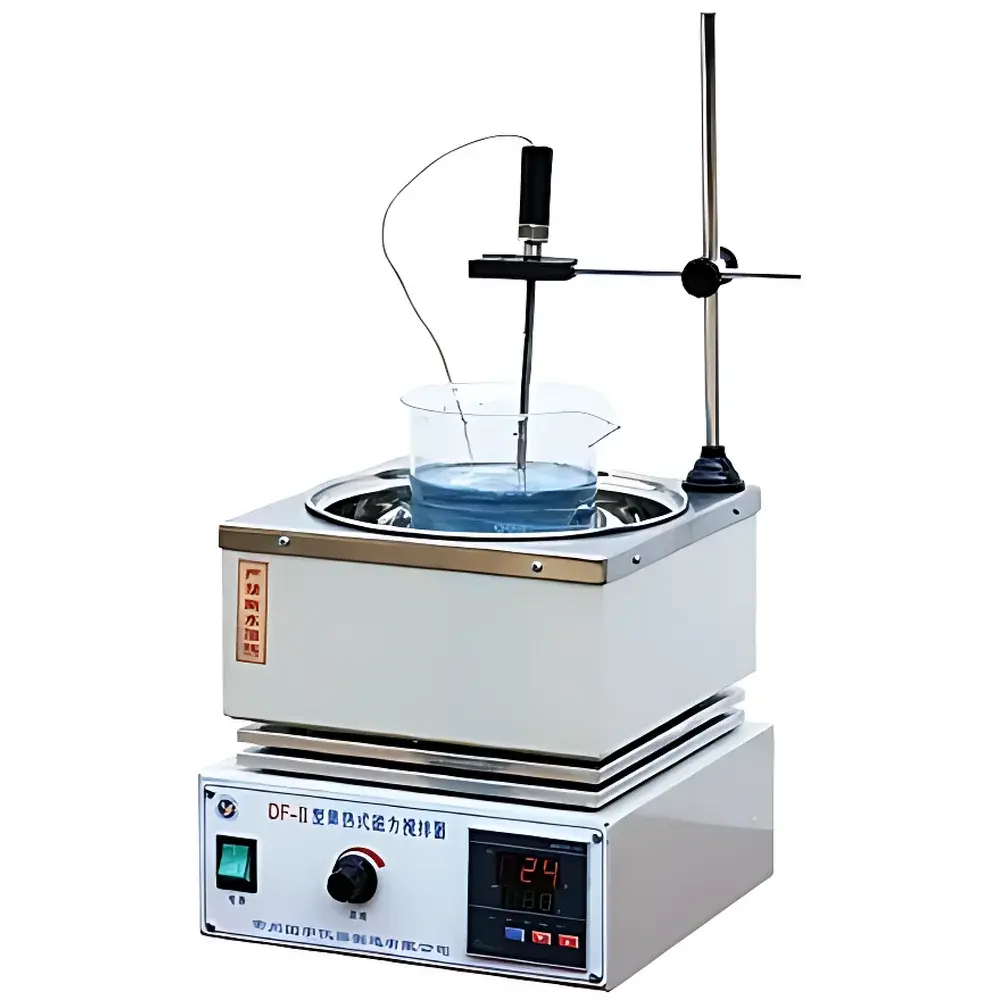
CZGY DF-1 / DF-2 / DF-101S Integrated Heating Magnetic Stirrer
| Brand | CZGY |
|---|---|
| Origin | Jiangsu, China |
| Manufacturer Type | Direct Manufacturer |
| Model(s) | DF-1, DF-2, DF-101S |
| Instrument Type | Magnetic Stirrer |
| Max. Stirring Volume | 2000 mL |
| Speed Range | 0–2500 rpm |
| Temperature Control Range | Ambient to 300 °C |
| Power Supply | 220 V AC, 50 Hz |
| Total Power | 960 W |
| Control Method | PID with Digital Setpoint & Parameter Tuning (P/I/D/t/SC/Lck) |
| Safety Features | Over-Temp Alarm (AL), Output Hysteresis (HY), Grounding Required, Dry-Run Protection Recommended |
Overview
The CZGY DF-1, DF-2, and DF-101S Integrated Heating Magnetic Stirrers are precision-engineered laboratory instruments designed for simultaneous temperature-controlled heating and magnetic agitation of liquid samples in open-vessel configurations. These units operate on the principle of electromagnetic coupling—rotating a PTFE- or glass-coated stir bar within a conductive or non-magnetic vessel via a rotating magnetic field generated beneath a thermally stable ceramic or stainless-steel heating plate. Heat is delivered through embedded resistive heating elements, while digital PID control ensures stable thermal regulation across a wide operating range (ambient to 300 °C). Unlike hotplate-only or standalone stirrers, this integrated architecture eliminates inter-unit synchronization issues and reduces benchtop footprint—making it especially suitable for synthetic chemistry, dissolution testing, enzymatic assays, and routine QC preparations where reproducible thermal–mechanical conditions are critical.
Key Features
- Digital PID temperature controller with programmable parameters (Proportional band: 1–200 °C; Integral time: 0–999 s; Derivative time: 0–999 s; Cycle time: 1–200 s; Sensor offset correction: ±50 °C)
- Stepless speed adjustment from 0 to 2500 rpm, with soft-start logic to prevent stir bar ejection during acceleration
- Stainless-steel heating bath (DF-101S) or flat ceramic plate (DF-1/DF-2), rated for continuous operation up to 300 °C with thermal uniformity ≤±3 °C at setpoint
- Integrated Pt100-compatible temperature probe input with ALM (alarm) output and configurable upper-limit threshold (AL parameter)
- Parameter lock function (LCK: 0 = unlocked; 1 = locked except setpoint; 2 = fully locked) to prevent accidental configuration changes in shared lab environments
- Compliance-ready design: Supports GLP/GMP documentation workflows via manual log recording of setpoints, actual temperatures, and stir speeds; compatible with external data loggers via analog output (optional)
Sample Compatibility & Compliance
These stirrers accommodate standard laboratory glassware—including beakers (up to 2000 mL capacity), Erlenmeyer flasks, and round-bottom flasks—placed directly on the heated surface or immersed within the DF-101S’s stainless-steel bath. The system supports both direct-contact heating (e.g., oil baths, water baths) and indirect heating via secondary vessels. While not intrinsically rated for hazardous area use, all models meet IEC 61010-1:2010 safety requirements for electrical equipment for measurement, control, and laboratory use. They are routinely deployed in laboratories adhering to ISO/IEC 17025, USP , and ASTM D2196 (viscosity measurement preparation) protocols—particularly where controlled heating and mixing precede downstream analysis (e.g., HPLC sample prep, polymer dissolution, buffer equilibration).
Software & Data Management
The DF-series operates via an embedded microcontroller with a 4-digit LED display and tactile membrane keypad. Though standalone (no USB/Bluetooth connectivity), its parameter structure aligns with common laboratory instrument firmware conventions: full access to PID tuning constants, alarm thresholds, hysteresis settings, and sensor calibration offsets enables traceable method setup. Each unit records no internal logs, but operational parameters (set temperature, actual temperature, speed, alarm status) can be manually documented per GLP Annex 11 principles. For regulated environments, integration with third-party SCADA or LIMS systems is achievable using optional 0–5 V or 4–20 mA analog outputs (available upon request). Firmware does not support FDA 21 CFR Part 11 electronic signatures natively; however, audit trails may be maintained externally via timestamped operator logs.
Applications
- Chemical synthesis requiring precise thermal ramping under inert atmosphere (used with sealed flask adapters)
- Dissolution testing of pharmaceutical tablets per USP , including sinker-assisted agitation in 900 mL vessels
- Preparation of homogeneous polymer solutions prior to rheological or viscometric analysis
- Cell culture media pre-warming and pH buffer equilibration in microbiology labs
- Environmental sample digestion (e.g., EPA Method 3050B) using hot acid mixtures in borosilicate containers
- Calibration of temperature probes and viscosity standards across defined thermal gradients
FAQ
What is the maximum recommended continuous duty cycle at full speed and temperature?
For optimal longevity, continuous operation at ≥2000 rpm and >250 °C is limited to 4 hours. At mid-range speeds (800–1200 rpm) and ≤150 °C, uninterrupted operation up to 8 hours is permissible.
Can the unit be used with corrosive solvents such as concentrated HNO₃ or HF?
Only when contained within chemically resistant vessels (e.g., PTFE-lined beakers or quartz crucibles); direct contact between aggressive media and the stainless-steel bath or ceramic plate must be avoided to prevent surface degradation.
How is temperature accuracy verified and maintained over time?
Users should perform periodic verification using a NIST-traceable reference thermometer immersed adjacent to the built-in probe; deviations exceeding ±2 °C warrant SC parameter adjustment or probe replacement.
Is dry operation (heating without liquid or stir bar) permissible?
No. Unloaded heating risks irreversible damage to the heating element and thermal sensor. Always ensure the bath contains sufficient fluid to submerge the heater and maintain thermal mass.
Does the instrument support external temperature feedback for cascade control?
Not natively—the controller accepts only its internal Pt100 input. However, custom integration with external PLCs or DAQ systems is feasible via analog voltage/current interfaces (contact CZGY technical support for pinout specifications).



