
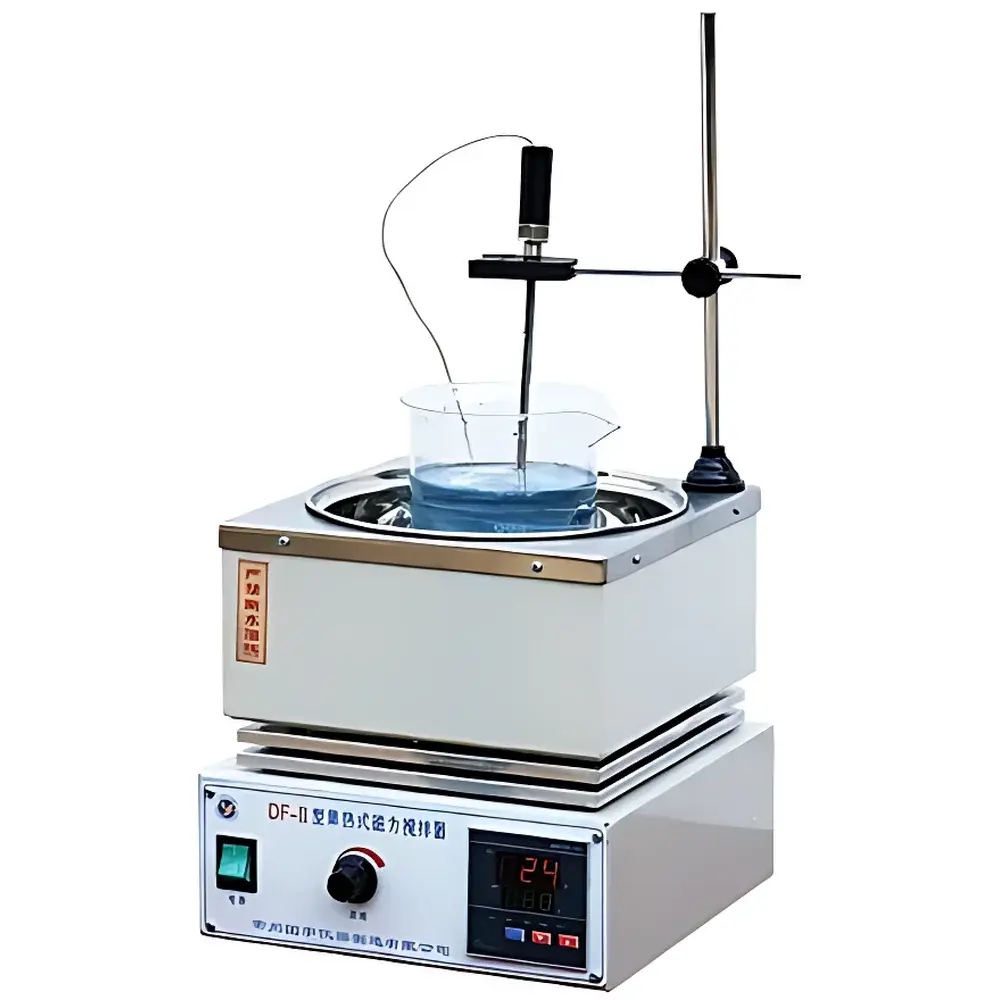
CZGY DF-101S Integrated Heating Magnetic Stirrer
| Brand | CZGY |
|---|---|
| Origin | Jiangsu, China |
| Manufacturer Type | Direct Manufacturer |
| Product Category | Domestic |
| Model | DF-101S |
| Instrument Type | Magnetic Stirrer |
| Max. Stirring Volume | 2000 mL |
| Speed Range | 0–2500 rpm |
| Temperature Control Range | Ambient to 300 °C |
Overview
The CZGY DF-101S Integrated Heating Magnetic Stirrer is an engineered solution for precise, simultaneous heating and magnetic stirring in laboratory environments. Designed around a robust integrated heating bath architecture—featuring a stainless-steel heating vessel with embedded resistive heating elements—the instrument delivers uniform thermal distribution and stable rotational torque across a wide operational envelope. Its operating principle relies on permanent-magnet coupling between the external rotating drive and internal PTFE-coated stir bars, enabling contactless agitation without mechanical seals or shaft penetration. This design eliminates contamination risk, supports inert-atmosphere applications (e.g., under N₂ or Ar), and ensures long-term reliability in aqueous, organic, and mildly corrosive media. The unit complies with IEC 61010-1:2010 safety standards for electrical equipment for measurement, control, and laboratory use, and incorporates dual protection mechanisms: overtemperature cutoff (via independent bimetallic thermostat) and thermal runaway prevention via PID-controlled solid-state relay output.
Key Features
- Integrated stainless-steel heating bath (capacity: 2000 mL) with submersible temperature sensor port for direct medium feedback
- Digitally controlled PID temperature regulation with ±1 °C accuracy (at 100 °C), adjustable setpoint range from ambient to 300 °C
- Stepless speed control (0–2500 rpm) with soft-start logic to prevent stir bar ejection during acceleration
- 960 W total power rating with thermally optimized heat dissipation and low-noise motor design (<45 dB at 1 m)
- Front-panel keypad interface with dual-line LED display: upper row shows real-time temperature; lower row shows setpoint or parameter code during configuration
- Configurable control parameters including proportional band (P: 1–200 °C), integral time (I: 0–999 s), derivative time (D: 0–999 s), and hysteresis (HY: 0–50 °C)
- Three-level parameter lock (LCK: 0 = unlocked, 1 = setpoint-only editable, 2 = full lock) to prevent accidental changes during routine operation
- Factory-calibrated sensor offset correction (SC: −50 to +50 °C) for traceable temperature validation against reference standards
Sample Compatibility & Compliance
The DF-101S accommodates standard laboratory glassware—including beakers, Erlenmeyer flasks, and round-bottom flasks—up to 2000 mL volume when placed directly into the heating bath. It supports both open-vessel and covered configurations, provided vapor management and thermal insulation are maintained per experimental requirements. Compatible solvents include water, ethanol, ethylene glycol, silicone oils, and mineral oils with flash points >120 °C. The unit meets CE marking requirements for EMC (EN 61326-1) and safety (EN 61010-1). While not certified for Class I Div 1 hazardous locations, its sealed electronics and grounded chassis support GLP-compliant workflows where audit trails and instrument qualification (IQ/OQ/PQ) documentation are required. Temperature stability testing per ASTM E2208 confirms ≤±0.5 °C deviation over 30 min at 150 °C steady state.
Software & Data Management
The DF-101S operates as a standalone instrument with no embedded data logging or PC connectivity. All operational parameters—including setpoints, alarm thresholds (AL), and control constants—are retained in non-volatile memory after power cycling. For laboratories requiring electronic records, optional external USB data loggers (e.g., Omega OM-DAQPRO-5300 series) may be interfaced via the analog output terminals (0–5 V DC proportional to temperature) and digital status outputs (relay dry contact). The front-panel interface supports manual calibration verification per ISO/IEC 17025 clause 6.5.2, and all user-modifiable parameters are documented in the supplied English-language operation manual (Revision 3.1, 2023), which includes traceable uncertainty statements for temperature and speed measurements.
Applications
- Synthesis reaction monitoring requiring constant temperature and homogeneous mixing (e.g., esterification, polymerization initiation)
- Standard solution preparation for titration, spectrophotometry, and electrochemical analysis
- Viscosity assessment of thermosensitive fluids using calibrated stir bars and rotational speed correlation
- Cell culture media warming and dissolution of powdered reagents under controlled thermal profiles
- Extraction protocols involving heated solvent reflux setups with condenser integration
- Calibration of secondary temperature sensors (e.g., RTDs, thermistors) against the unit’s reference-grade thermocouple input
FAQ
What is the maximum recommended continuous operating time at 2500 rpm?
Continuous high-speed operation (>2000 rpm) is limited to 4 hours to ensure motor longevity and thermal equilibrium. For extended experiments, use 1200–1800 rpm with intermittent cooling cycles.
Can the DF-101S be used with flammable solvents?
Only solvents with flash points above 120 °C and low vapor pressure at operating temperatures are advised. Never operate without adequate fume hood ventilation or temperature monitoring redundancy.
How is temperature accuracy verified and adjusted?
Accuracy is validated using a NIST-traceable reference thermometer immersed alongside the built-in sensor. Offset correction (SC parameter) allows field adjustment within ±50 °C; factory default is 0.0 °C.
Is the heating bath depth sufficient for immersion of a 1000-mL tall-form beaker?
Yes—the bath depth exceeds 120 mm, accommodating standard tall-form beakers up to 1000 mL when filled to nominal capacity.
Does the unit support RS-232 or USB communication?
No native digital interface is provided. Analog voltage output (0–5 V) and relay status signals enable third-party DAQ integration but require external signal conditioning.



