
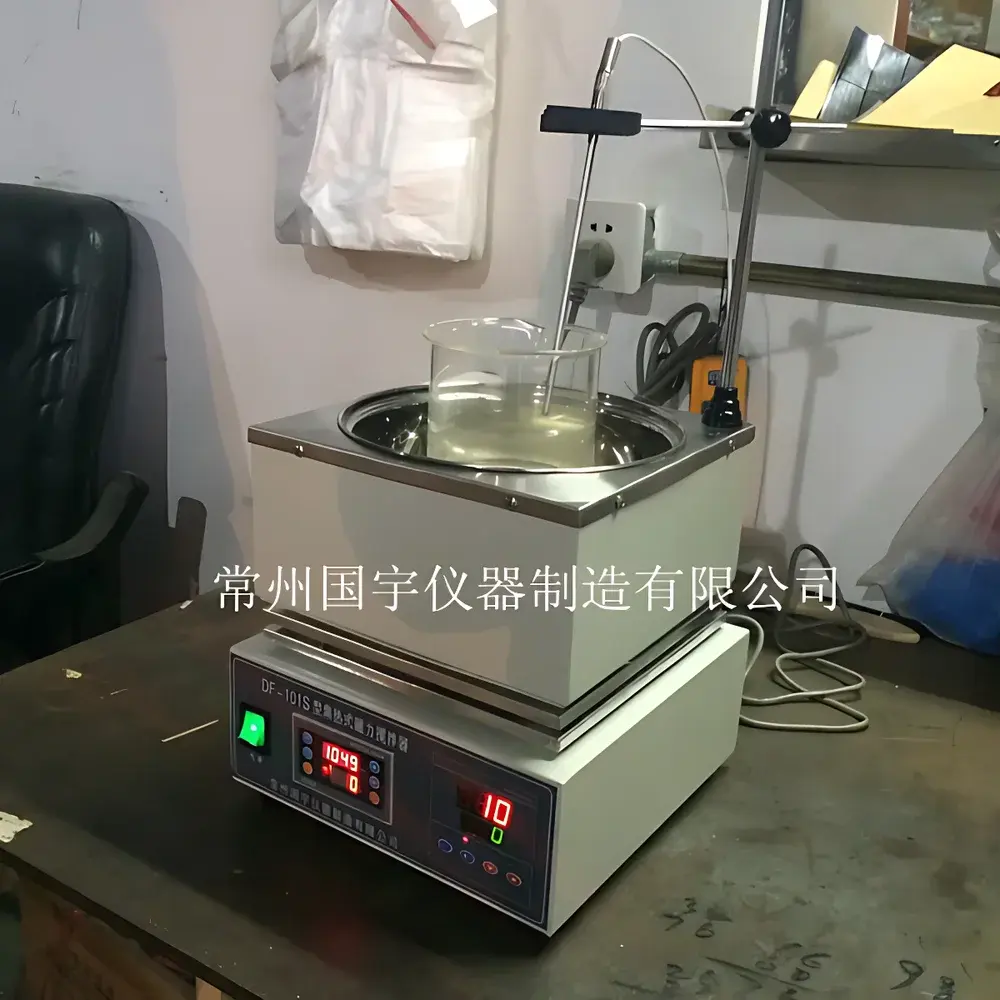
CZGY DF-101SA Digital Display Constant-Temperature Constant-Speed Heating Magnetic Stirrer
| Brand | CZGY |
|---|---|
| Origin | Jiangsu, China |
| Manufacturer Type | Direct Manufacturer |
| Instrument Type | Magnetic Stirrer |
| Max. Stirring Volume | 1000 mL |
| Speed Range | 100–2000 rpm |
| Temperature Control Range | Ambient to 299 °C |
| Power Supply | 220 V AC ±10%, 50 Hz |
| Total Power | 960 W |
| Speed Accuracy | ±1 rpm |
| Temp. Accuracy | ±1 °C |
| Timer Range | 0–999 min |
Overview
The CZGY DF-101SA is a precision-engineered digital heating magnetic stirrer designed for stable, reproducible thermal and mechanical agitation in routine laboratory workflows. It operates on the principle of magnetic coupling—where a rotating permanent magnet beneath a thermally conductive aluminum or stainless-steel heating plate induces synchronized rotation of a PTFE- or glass-coated magnetic stir bar immersed in the sample. Integrated resistive heating elements provide uniform thermal distribution across the plate surface, while a PID-controlled temperature regulation system ensures minimal overshoot and high setpoint fidelity within ±1 °C over the full ambient-to-299 °C range. Unlike basic hotplate stirrers, the DF-101SA features dual independent control loops: one for speed (100–2000 rpm, digitally maintained with ±1 rpm stability) and another for temperature—enabling simultaneous, decoupled optimization of mixing kinetics and thermal reaction conditions. Its all-metal housing, sealed electronics, and grounded chassis meet IEC 61010-1 safety requirements for Class I laboratory equipment.
Key Features
- Dual digital control interface with dedicated left-side keys for speed adjustment (↑/↓) and right-side keys for timer setup (↑/↓), minimizing operational ambiguity during multi-parameter experiments.
- High-torque stirring motor capable of sustaining consistent rotation at up to 2000 rpm without load-induced drift—validated across viscosity ranges typical of aqueous solutions, glycerol-water mixtures, and low-viscosity organic solvents.
- Aluminum heating plate with integrated temperature sensor and real-time feedback loop; achieves <60-second ramp from ambient to 100 °C under standard 500 mL water load.
- Programmable timer (0–999 minutes) with automatic shutdown—critical for unattended synthesis, dissolution testing, or standardized extraction protocols requiring precise thermal exposure duration.
- Adjustable PID parameters (P, I, D, cycle time t, hysteresis Hy) accessible via three-second SET key press—allowing fine-tuning for non-standard thermal masses or high-thermal-inertia vessels such as thick-walled glass reactors.
- Factory-calibrated sensor offset compensation (Sc: −50 to +50 °C) supports traceable temperature verification using NIST-traceable reference thermometers per ISO/IEC 17025 calibration practices.
Sample Compatibility & Compliance
The DF-101SA accommodates standard laboratory glassware including beakers (up to 1000 mL capacity), Erlenmeyer flasks, and round-bottom flasks placed directly on the heating plate. It supports indirect heating configurations—e.g., placing a water or oil bath vessel on the plate and submerging smaller reaction vials—enabling gentle, uniform thermal transfer without direct contact. The unit complies with electromagnetic compatibility (EMC) standards EN 61326-1 and electrical safety standard EN 61010-1. While not certified for GMP production environments, its parameter lock function (Lck = 2) prevents unauthorized changes during GLP-regulated procedures, and its audit-ready timer/logic architecture aligns with documentation expectations under FDA 21 CFR Part 11 for non-critical lab operations.
Software & Data Management
The DF-101SA operates as a standalone instrument with no embedded software stack or data export capability. All operational parameters—including setpoints, actual readings, alarm states (ALM), and timer status—are displayed in real time on a dual-line LED screen. No firmware updates, remote connectivity, or computer interface is provided. However, the device supports manual logging via external recording systems: users may document start/stop times, temperature profiles, and speed settings alongside experimental metadata in bound lab notebooks or validated electronic lab notebooks (ELNs). For regulatory traceability, the instrument’s serial number, calibration date, and maintenance history should be recorded in facility asset management systems per ISO/IEC 17025 clause 6.4.10.
Applications
- Chemical synthesis requiring controlled reflux or solvent evaporation under constant agitation and defined thermal ramp rates.
- Pharmaceutical dissolution testing (USP Apparatus II) where precise rotational speed and bath temperature must remain invariant across multiple vessels.
- Environmental sample preparation—including digestion of soil or wastewater matrices—per EPA Method 3050B and ASTM D5587.
- Materials science workflows involving polymer solution homogenization, nanoparticle dispersion, or ceramic slurry conditioning prior to casting or sintering.
- Microbiology media preparation, where uniform nutrient distribution and sterilization-grade heating consistency are prerequisites for agar or broth formulation.
FAQ
What is the maximum recommended continuous operating time at high speed?
At speeds above 1500 rpm, continuous operation should not exceed 4 hours to maintain motor longevity and thermal stability of internal components.
Can the DF-101SA be used with corrosive or high-boiling-point solvents?
Yes—provided the stir bar is chemically inert (e.g., PTFE-coated or encapsulated ceramic) and the vessel is compatible; however, prolonged exposure to halogenated solvents may degrade rubber gaskets in optional accessories.
How is temperature accuracy verified and adjusted?
Accuracy is verified by immersing the supplied probe in a stirred water bath at known reference points (e.g., boiling point at local atmospheric pressure); deviation is corrected via the Sc parameter in the inner menu.
Is grounding mandatory?
Yes—this unit requires connection to a properly earthed outlet to prevent electrical hazard and ensure stable sensor signal integrity, especially when operating near flammable solvents.
Does the instrument support external temperature probes?
No—the built-in Pt100 sensor is fixed and non-removable; external probe integration is not supported by hardware or firmware design.



