
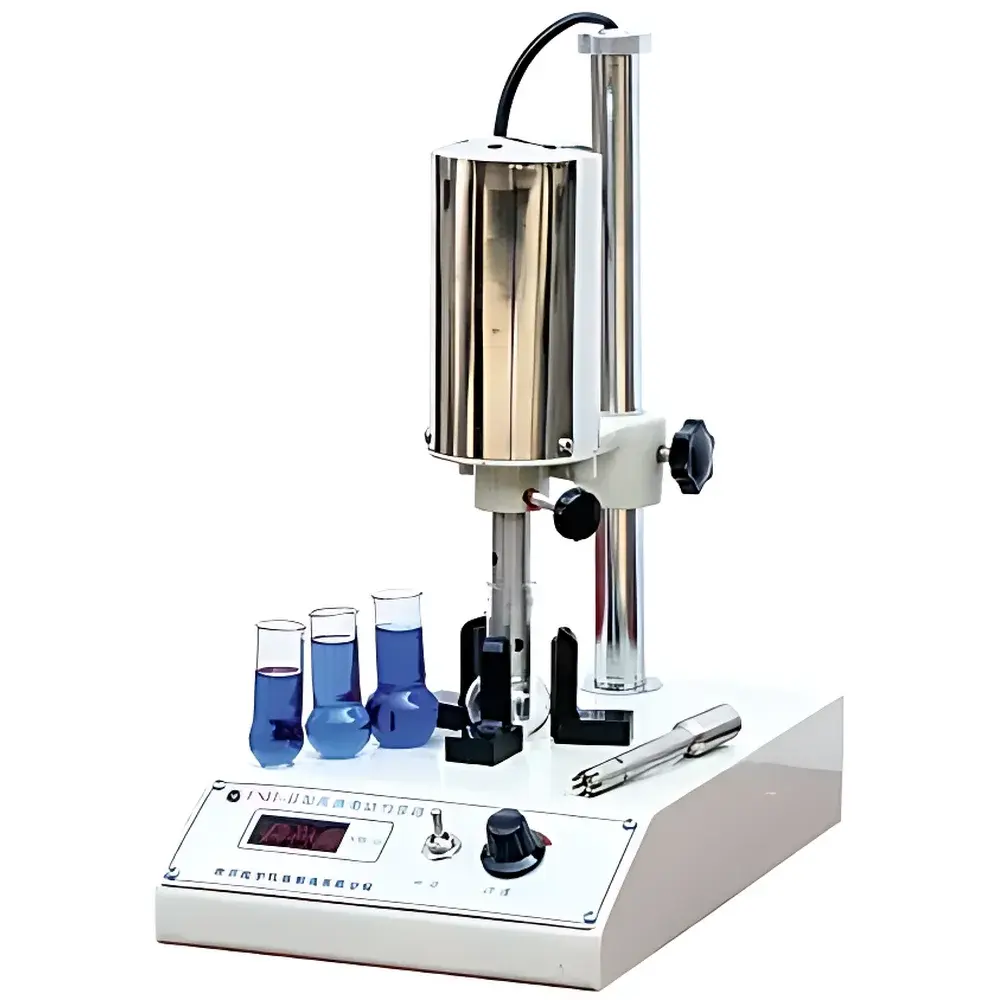
CZGY FS-2 Adjustable High-Speed Homogenizer
| Brand | CZGY |
|---|---|
| Origin | Jiangsu, China |
| Manufacturer Type | Direct Manufacturer |
| Model | FS-2 |
| Motor Speed | 25,000 rpm |
| Small Homogenizing Blade Max Speed | 22,000 rpm |
| Large Homogenizing Blade Max Speed | 20,000 rpm |
| Continuous Operation Limit | <5 min |
| Power | 185 W |
| Voltage | 220 V ±10%, 50 Hz |
| Compliance | Designed for GLP-compliant laboratory workflows |
| Warranty | 24 months limited warranty on materials and workmanship |
Overview
The CZGY FS-2 Adjustable High-Speed Homogenizer is an engineered solution for rapid, reproducible mechanical disruption of biological tissues and soft particulate samples in research and quality control laboratories. Based on high-torque rotary shear principle, the instrument utilizes precision-machined stainless-steel homogenizing blades rotating within sealed glass or polypropylene vessels to generate intense localized fluid shear forces—sufficient to lyse cells, homogenize soft animal tissues (e.g., liver, muscle), and disintegrate plant pulp without significant thermal denaturation when operated within recommended time limits. Its core architecture integrates a silicon-controlled rectifier (SCR) speed control circuit and optoelectronic tachometric feedback, enabling stable, stepless speed regulation across its full operational range. This design ensures consistent energy input per unit mass—a critical parameter for inter-laboratory method transfer and regulatory sample preparation.
Key Features
- Stepless speed control via SCR-based analog circuitry, offering smooth acceleration from low to maximum rotational velocity—eliminating mechanical shock during startup.
- Optoelectronic tachometer with real-time RPM readout on LED display panel; calibrated against traceable reference standards for measurement reliability.
- Dual-blade compatibility: interchangeable small-diameter (optimized for micro-volume tissue suspensions) and large-diameter (for higher throughput homogenization) stainless-steel blades, each rated for defined maximum speeds (22,000 rpm and 20,000 rpm respectively).
- Thermally optimized motor housing with forced-air cooling path; designed to sustain repeated short-duration cycles (<5 minutes continuous operation) without thermal cutoff.
- Robust mechanical coupling between motor shaft and blade hub, minimizing runout and vibration at high rotational velocities—critical for sample integrity and operator safety.
- Compliance-ready construction: non-porous surfaces, chemical-resistant gasket materials (F4-lined blade housing), and modular blade assembly facilitating cleaning validation per ISO 13485 and FDA 21 CFR Part 11–aligned SOPs.
Sample Compatibility & Compliance
The FS-2 is validated for use with soft biological matrices including mammalian liver, skeletal muscle, plant fruit pulp, and cultured cell pellets. It is not intended for fibrous, calcified, or highly viscous samples requiring rotor-stator or probe-type ultrasonic homogenization. Vessel compatibility includes standard 10–50 mL borosilicate glass tubes and autoclavable polypropylene homogenizer cups. All wetted parts meet USP Class VI biocompatibility requirements. The device supports GLP documentation practices through repeatable speed profiles and operator-defined run-time constraints—enabling audit-ready record generation when paired with external timers or LIMS-integrated workflow logs.
Software & Data Management
While the FS-2 operates as a standalone analog instrument without embedded digital firmware, its speed calibration and operational parameters are fully compatible with laboratory data management systems. RPM output signals from the optoelectronic sensor can be interfaced via analog voltage output (0–5 V DC proportional to 0–25,000 rpm) to third-party data acquisition modules (e.g., National Instruments DAQ devices) for real-time logging and trend analysis. All operational settings—including start/stop timestamps, nominal speed setpoints, and cumulative runtime—are manually documented in hardcopy or electronic lab notebooks following institutional GLP/GMP protocols. Calibration certificates for tachometric verification are issued annually per ISO/IEC 17025-accredited service providers.
Applications
- Pre-analytical sample preparation for enzymatic assays, protein extraction, and nucleic acid isolation from fresh or frozen tissues.
- Routine homogenization of food-grade botanical extracts and meat analogs for compositional analysis (e.g., fat content, moisture determination per AOAC 985.29).
- QC batch processing in pharmaceutical excipient development where particle size distribution of suspended actives must remain unaffected by mechanical degradation.
- Supporting ASTM D4052 density measurements by ensuring uniform suspension stability prior to pycnometer filling.
- Training platforms in academic teaching labs for fundamental instruction in mechanical lysis principles, shear rate estimation, and safe high-speed equipment operation.
FAQ
What is the maximum recommended continuous operating time?
Continuous operation must not exceed 5 minutes per cycle to prevent motor overheating and maintain blade concentricity.
Can the FS-2 be used with corrosive solvents such as chloroform or acetone?
Only with chemically resistant vessel materials (e.g., PTFE-coated cups); standard glass tubes are incompatible with strong organic solvents.
Is speed calibration traceable to national standards?
Yes—optoelectronic tachometer calibration is performed using NIST-traceable laser tachometers during factory acceptance testing and annual maintenance.
Does the instrument support FDA 21 CFR Part 11 compliance?
As an analog device without electronic records, it does not generate electronic signatures—but its operational parameters are fully documentable in compliant ELN systems when integrated into validated workflows.
What maintenance is required for long-term accuracy?
Biannual inspection of F4 anti-wear bushings, blade balance verification, and torque calibration of the motor coupling assembly are recommended per manufacturer’s maintenance schedule.



