
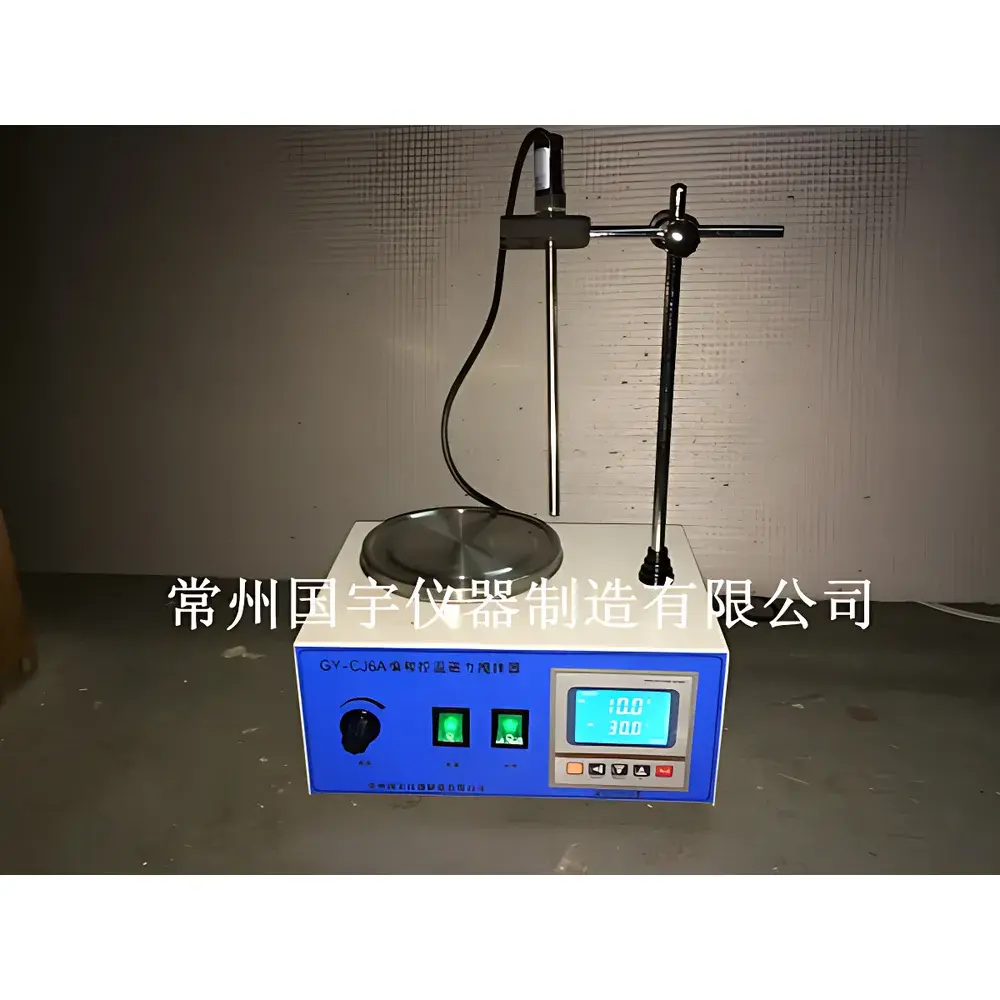
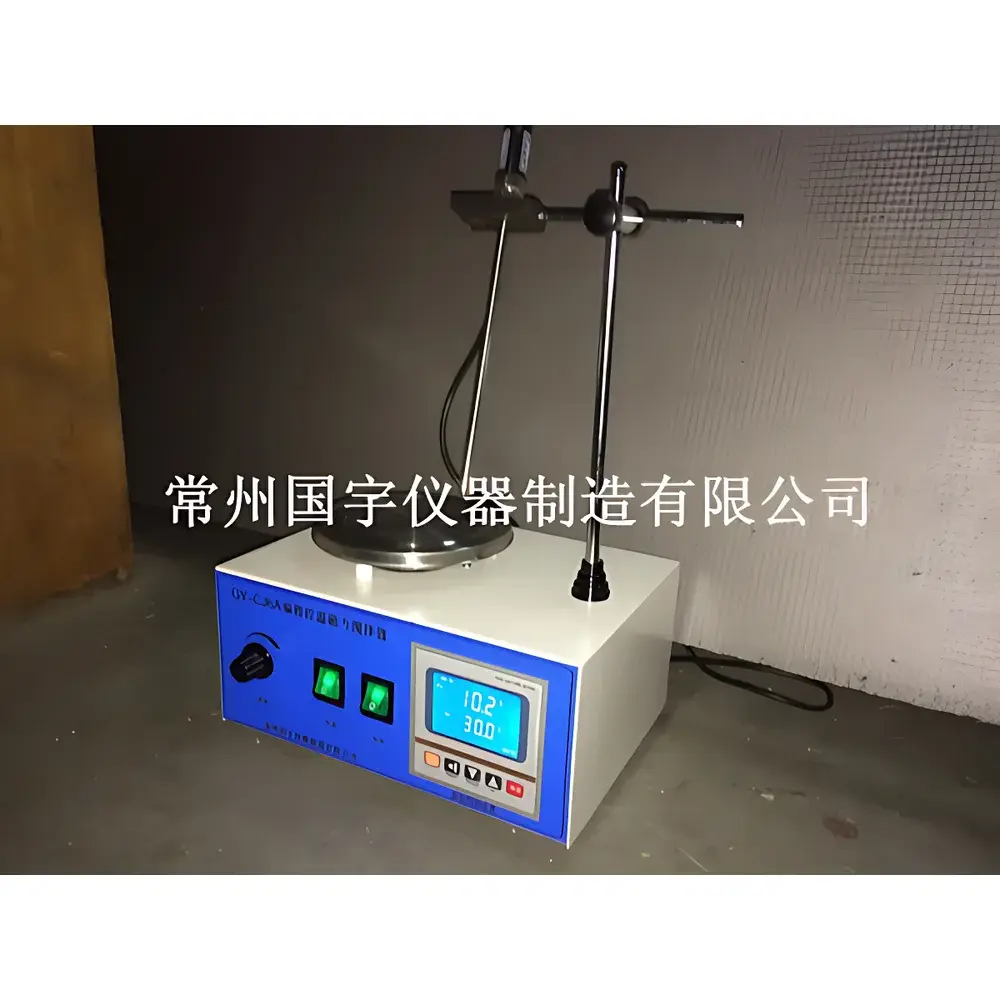
CZGY GY-CJ6A Programmable Temperature-Controlled Magnetic Stirrer
| Brand | CZGY |
|---|---|
| Origin | Jiangsu, China |
| Manufacturer Type | Direct Manufacturer |
| Instrument Type | Magnetic Stirrer |
| Max Stirring Volume | 2000 mL |
| Speed Range | 0–2400 rpm |
| Temperature Control Range | RT + 5 °C to 100 °C |
| Temperature Accuracy | ±0.5 °C |
| Power Supply | AC 220 V ±10 V, 50 Hz |
| Motor Power | 25 W |
| Heating Power | 300 W |
| Display | Large LCD with PID microprocessor control |
| Control Mode | Multi-segment programmable temperature ramping & rate control |
| Drive Type | Brushless DC motor |
| Safety Features | Grounding terminal, over-temperature protection, no-heating-without-stirring interlock |
Overview
The CZGY GY-CJ6A Programmable Temperature-Controlled Magnetic Stirrer is an engineered solution for precise, reproducible mixing and thermal regulation in analytical, synthetic, and quality control laboratories. Based on the Couette flow principle, it utilizes a rotating magnetic field generated by a stator coil beneath a chemically resistant ceramic or aluminum oxide plate to drive a PTFE- or glass-coated stir bar immersed in the sample. Unlike conventional analog stirrers, the GY-CJ6A integrates closed-loop PID temperature control with multi-step programmable ramping—enabling users to define heating profiles (e.g., hold at 25 °C for 5 min → ramp at 2 °C/min to 70 °C → hold for 15 min), critical for reaction kinetics studies, dissolution testing, and standardized sample preparation per ASTM E2509 or USP . Its brushless DC motor ensures stable torque delivery across the full 0–2400 rpm range without electromagnetic interference, mechanical wear, or audible noise—supporting uninterrupted operation over extended durations required in GLP-compliant environments.
Key Features
- Multi-segment programmable temperature control with adjustable ramp rates and hold times, implemented via embedded PID algorithm for minimal overshoot and high thermal stability (±0.5 °C accuracy)
- Brushless DC motor drive delivering consistent rotational performance from standstill to 2400 rpm, eliminating carbon brush degradation and enabling >10,000-hour service life
- Large backlit LCD interface with intuitive navigation for simultaneous real-time display of setpoint/actual temperature and speed values
- Dual-safety interlock system: heating is automatically disabled when stirring stops or when no stir bar is detected (via magnetic coupling verification)
- Robust construction featuring a corrosion-resistant aluminum oxide top plate and reinforced housing rated for continuous duty at ambient temperatures up to 40 °C
- Compliance-ready design: grounding terminal provided; firmware supports audit-trail-capable logging when integrated with external data acquisition systems
Sample Compatibility & Compliance
The GY-CJ6A accommodates standard laboratory vessels—including borosilicate glass beakers (up to 2000 mL capacity), stainless steel reactors, and polypropylene containers—provided the stir bar diameter and length are appropriately matched to vessel geometry and viscosity range (suitable for aqueous solutions, organic solvents, and low-viscosity suspensions up to ~500 mPa·s). It meets fundamental electrical safety requirements per IEC 61010-1:2010 (Equipment for measurement, control and laboratory use) and incorporates thermal cutoff protection conforming to Class II insulation standards. While not certified for hazardous area use (ATEX/IECEx), its non-sparking motor and grounded chassis make it suitable for general-purpose chemistry labs operating under ISO/IEC 17025 or FDA 21 CFR Part 11-aligned workflows when paired with validated software interfaces.
Software & Data Management
The GY-CJ6A operates as a standalone instrument with local parameter storage (up to 10 user-defined programs retained after power cycle). For traceable documentation, it supports RS-232 serial output (optional USB-to-serial adapter) to export timestamped temperature and speed logs to third-party SCADA or LIMS platforms. When interfaced with compliant laboratory software, the device enables electronic record generation meeting ALCOA+ principles—ensuring Attributable, Legible, Contemporaneous, Original, Accurate, Complete, Consistent, Enduring, and Available data integrity. No proprietary cloud platform or vendor-specific drivers are required; ASCII-based protocol documentation is supplied for integration into custom Python, LabVIEW, or MATLAB automation scripts.
Applications
- Kinetic studies requiring controlled heating ramps during catalytic reactions or polymerization initiation
- Dissolution testing of pharmaceutical tablets per USP , where precise temperature maintenance at 37.0 ± 0.5 °C and consistent agitation are mandatory
- Buffer and reagent preparation in molecular biology labs, including Tris-HCl, SDS-PAGE gels, and cell culture media conditioning
- Environmental analysis workflows involving extraction, digestion, or homogenization of soil/water samples prior to ICP-MS or HPLC analysis
- Teaching laboratories conducting calorimetry experiments, solubility mapping, or Arrhenius plot derivation
FAQ
Can the GY-CJ6A be used with metal containers or vacuum-sealed vessels?
No. The magnetic coupling mechanism requires non-ferromagnetic, non-magnetic-shielding materials. Stainless steel (especially 400-series) and aluminum vessels disrupt field transmission; only glass, ceramic, or specific polymers (e.g., PP, PTFE-lined) are compatible.
Is firmware update capability available?
Firmware is factory-programmed and not user-upgradable; however, calibration offsets for temperature and speed sensors can be adjusted via service mode using the included technician manual.
What stir bar size is recommended for optimal performance at 2000 mL volume?
A 50 mm × 8 mm PTFE-coated bar is validated for uniform mixing in cylindrical 2000 mL beakers at speeds ≥600 rpm; longer bars (>65 mm) may cause vortex instability at high rotation rates.
Does the unit comply with electromagnetic compatibility (EMC) directives for EU export?
It meets basic emission limits per CISPR 11 Group 1, Class B, but lacks CE marking for full EMC compliance; users intending EU deployment must conduct site-specific radiated/conducted emissions testing per EN 61326-1.
How is over-temperature protection implemented?
An independent bimetallic thermal cutoff switch disconnects heater power if plate surface temperature exceeds 110 °C—distinct from the PID-controlled sensor loop, providing redundant hardware-level safety.



