
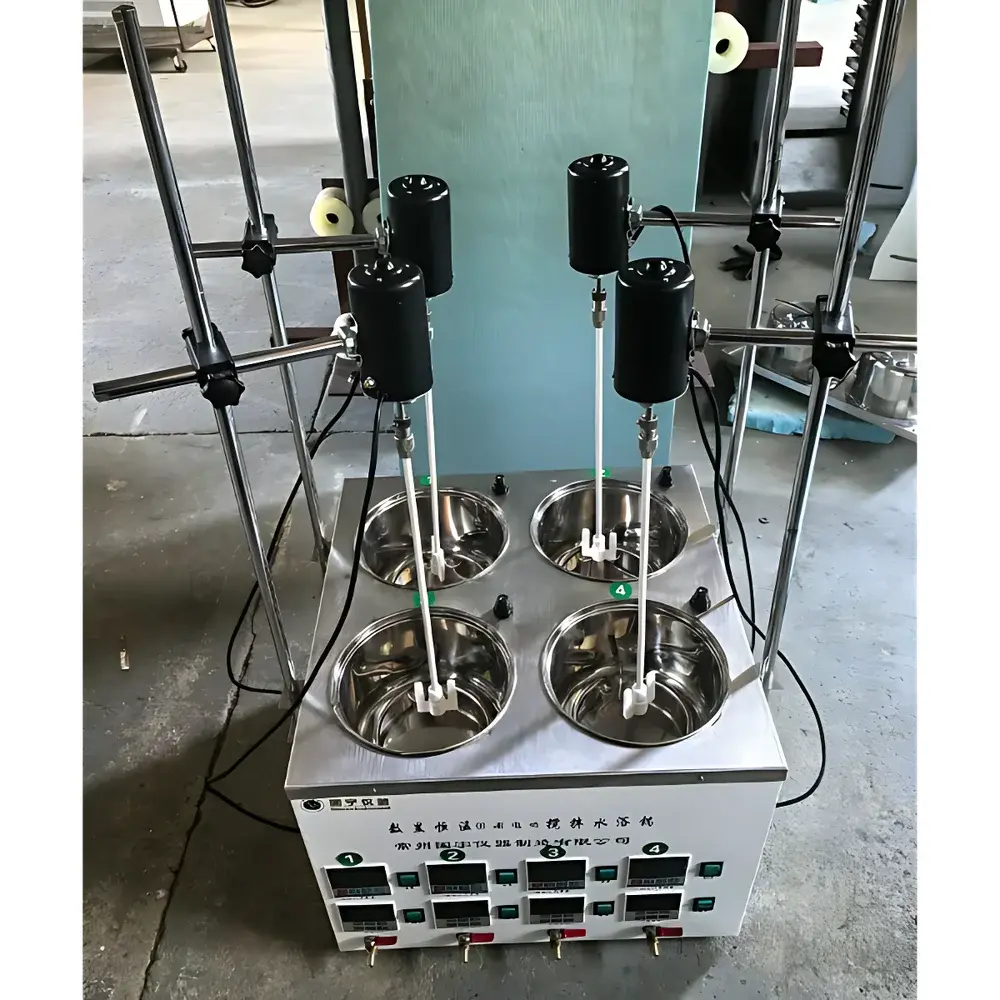
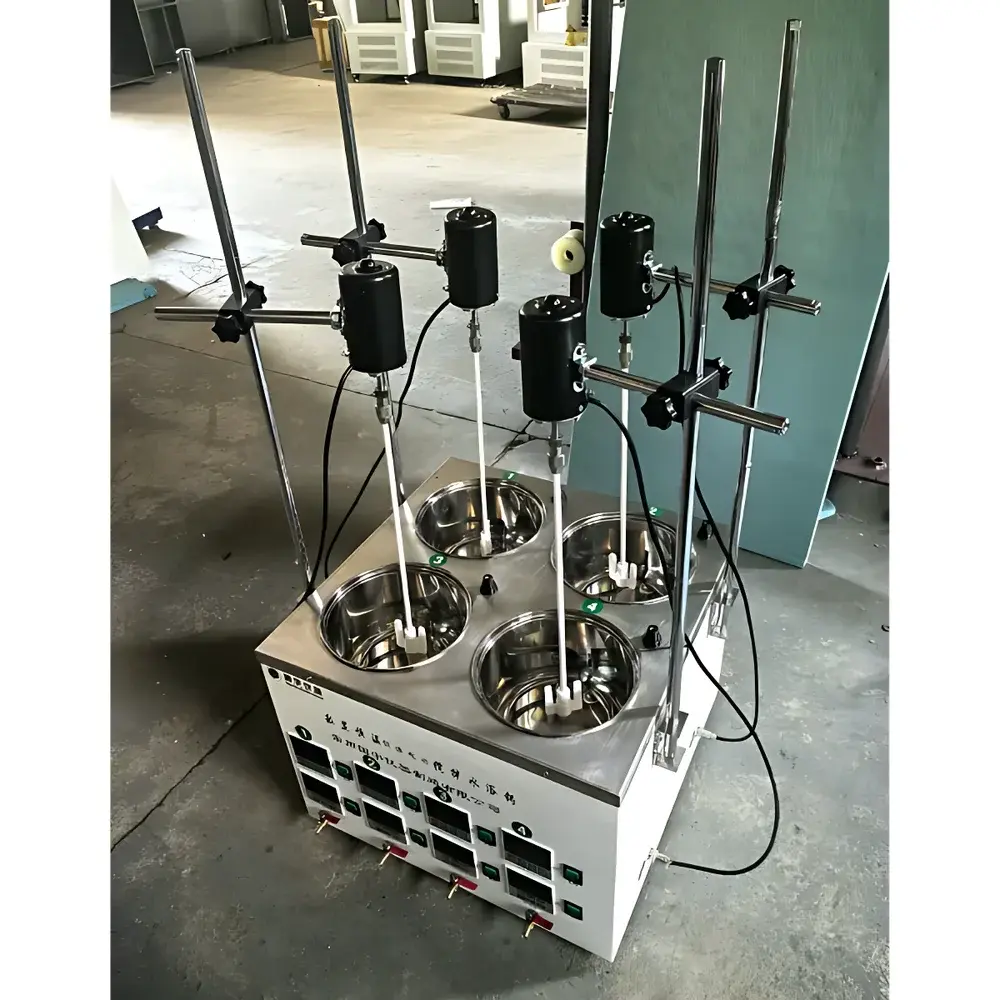
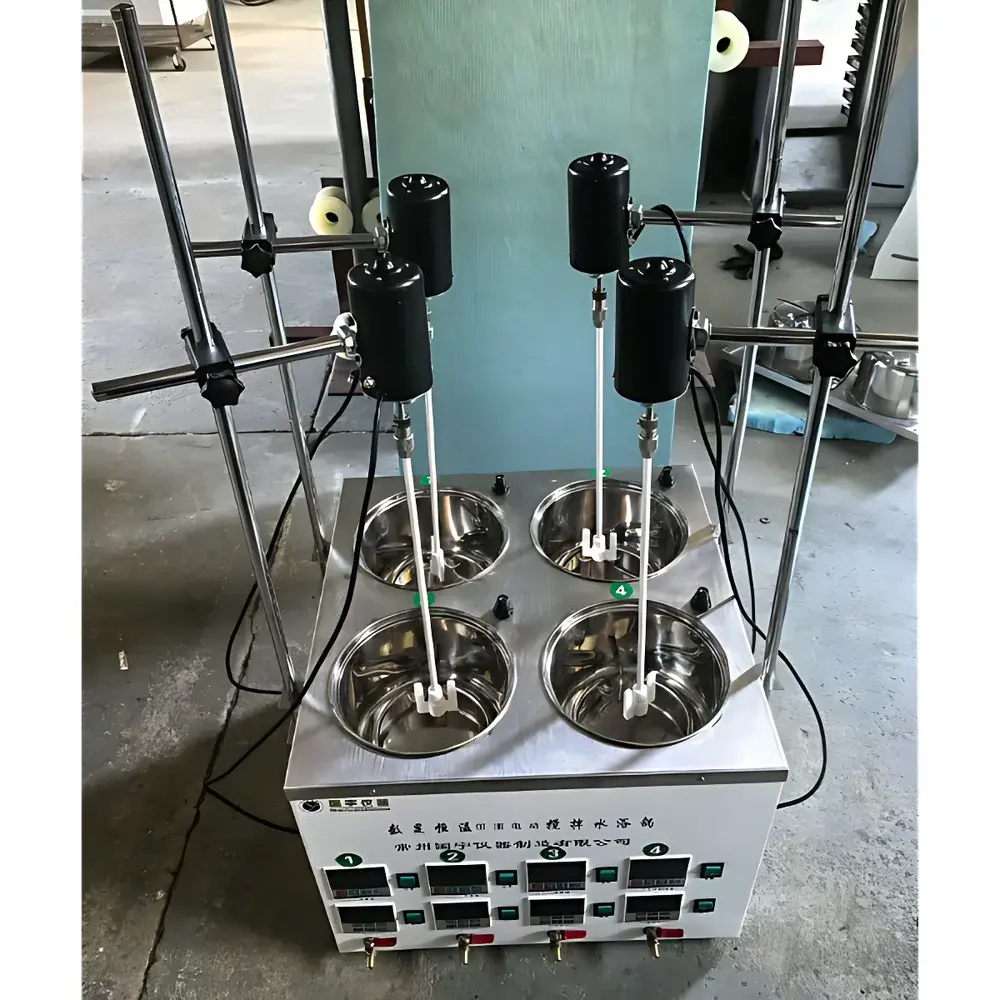
CZGY GY-SHD-4S Digital Temperature-Controlled & Speed-Stabilized Electric Stirring Water Bath
| Brand | CZGY |
|---|---|
| Origin | Jiangsu, China |
| Manufacturer Type | Direct Manufacturer |
| Product Category | Domestic |
| Model | GY-SHD-4S |
| Instrument Type | Electric Stirrer |
| Max Stirring Capacity | 4 × 1 L |
| Speed Range | 200–3000 rpm |
| Temperature Control Range | Ambient +5°C to 100°C |
| Power Supply | 220 V AC, 50 Hz |
| Motor Power | 4 × 100 W |
| Heating Power | 1600 W |
| Speed Accuracy | ±1 rpm |
| Timer Range | 0–9990 min |
| Temperature Accuracy | ±0.5°C |
| Temperature Resolution | 0.1°C |
| Bath Chamber Dimensions | φ22 cm × 13 cm (per well) × 4 wells |
| Construction | Stainless Steel Inner Bath + Stainless Steel Stirring Rods |
Overview
The CZGY GY-SHD-4S Digital Temperature-Controlled & Speed-Stabilized Electric Stirring Water Bath is an integrated laboratory platform engineered for simultaneous precision stirring and uniform thermal control across four independent reaction vessels. It operates on the principle of direct-drive magnetic or mechanical coupling (depending on stir bar or overhead impeller configuration), combined with resistive heating and PID-regulated temperature feedback in a stainless steel water bath matrix. Unlike standalone hotplates or orbital shakers, this system enables concurrent, programmable agitation and thermostatic immersion—critical for kinetic studies, dissolution testing, standard solution preparation, and wastewater treatment sample conditioning where both thermal equilibration and homogenous mixing must be maintained over extended durations. Its design targets routine QC/QA workflows in environmental monitoring labs, municipal wastewater facilities, and academic chemistry departments requiring reproducible, multi-vessel processing under GLP-aligned conditions.
Key Features
- Four independently controllable stirring stations, each equipped with digital speed display and microprocessor-based speed stabilization—ensuring consistent rotational output across load variations and ambient fluctuations.
- Integrated PID temperature control per bath well, with 0.1°C resolution and ±0.5°C accuracy over the full operating range (ambient +5°C to 100°C), minimizing thermal gradients between vessels.
- Dual-function digital timer supporting both speed-run duration (0–9990 minutes) and auto-shutdown functions, facilitating unattended operation during overnight or long-duration protocols.
- Four-channel architecture with dedicated stainless steel vertical support rods, universal clamps, locking covers, drain valves, and individual digital readouts—enabling true parallel processing without cross-contamination risk.
- Brushless permanent-magnet DC motors (100 W per channel) deliver low-noise, high-torque performance with stepless speed adjustment from 200 to 3000 rpm and real-time feedback at ±1 rpm repeatability.
- Corrosion-resistant 304 stainless steel inner bath chambers (φ22 cm × 13 cm depth per well) and matching stir rods ensure compatibility with aqueous, mildly acidic, and buffered solutions commonly used in EPA Method-compliant wastewater analysis.
Sample Compatibility & Compliance
The GY-SHD-4S accommodates standard 1 L glass beakers, Erlenmeyer flasks, and cylindrical digestion vessels up to 12 cm diameter and 15 cm height. Its open-bath geometry supports both magnetic stir bars and overhead paddle impellers. While not certified to IEC 61010-1 or UL 61010B as a single unit, its electrical architecture conforms to standard Class I laboratory equipment safety requirements for grounded 220 V AC operation. The system supports documentation practices aligned with ISO/IEC 17025 clause 7.7 (equipment management) and ASTM D1293 (pH and conductivity standardization), particularly in environmental labs performing BOD, COD, or nutrient digestions per APHA Standard Methods. No proprietary consumables are required; all components—including clamps, covers, and drain fittings—are mechanically standardized for third-party interchangeability.
Software & Data Management
The GY-SHD-4S operates via embedded microcontroller firmware with no external PC dependency. All operational parameters—including setpoints, actual speed/temperature values, elapsed time, and alarm status—are displayed locally on dual 4-digit LED modules per station. While it lacks Ethernet or USB data logging interfaces, its analog-digital hybrid architecture ensures deterministic response times and immunity to software-induced latency or OS-level failures. For regulated environments, users may integrate the unit into broader lab data ecosystems via external RS-485-to-USB adapters (third-party) and custom SCADA scripts, enabling timestamped audit trails compliant with FDA 21 CFR Part 11 when paired with validated electronic record systems. Calibration certificates for speed and temperature transducers can be generated per user-defined intervals using NIST-traceable reference standards.
Applications
- Wastewater treatment plant laboratories: Standardized digestion of sludge samples prior to heavy metal extraction (EPA Method 3050B), pH adjustment of influent/effluent replicates, and coagulant dosage optimization trials.
- Environmental testing labs: Parallel preparation of calibration standards for ICP-OES or AAS analysis, ensuring thermal and mechanical homogeneity across multi-point calibration curves.
- Pharmaceutical R&D: Dissolution profile development under USP conditions for immediate-release formulations, leveraging precise temperature hold and consistent agitation intensity.
- Academic teaching labs: Kinetic experiments involving Arrhenius-based rate constant determination, where controlled thermal ramping and stable shear input are prerequisites.
- Chemical synthesis prep: Multi-flask reagent aging, hydrolysis reactions, and buffer equilibration requiring synchronized thermal and mechanical input across replicate batches.
FAQ
Can the GY-SHD-4S operate with non-aqueous media such as silicone oil or glycerol?
Yes—provided the viscosity remains below 500 mPa·s at operating temperature and the medium does not exceed 100°C. However, stainless steel bath integrity should be verified for prolonged exposure to chlorinated or strongly oxidizing organics.
Is individual speed calibration traceable to national standards?
Each unit includes factory-set speed verification at three points (500, 1500, and 2500 rpm) using optical tachometry; full recalibration requires external metrology-grade tachometer and documented procedure per ISO/IEC 17025.
Does the system support external temperature probe input for vessel-specific monitoring?
No—the built-in Pt100 sensor measures bath fluid temperature only. For reaction mixture temperature validation, users must deploy separate calibrated immersion probes connected to external loggers.
What maintenance intervals are recommended for long-term reliability?
Motor brushes (if applicable) require inspection every 5,000 operating hours; bath water should be replaced weekly in continuous use; stainless steel surfaces cleaned with neutral detergent after each use to prevent mineral scaling.
Are replacement parts such as stir rods, clamps, or drain valves available separately?
Yes—all mechanical accessories are modular and stocked by CZGY with part numbers published in the official spare parts catalog (Revision 2024Q3).
Related Products



