
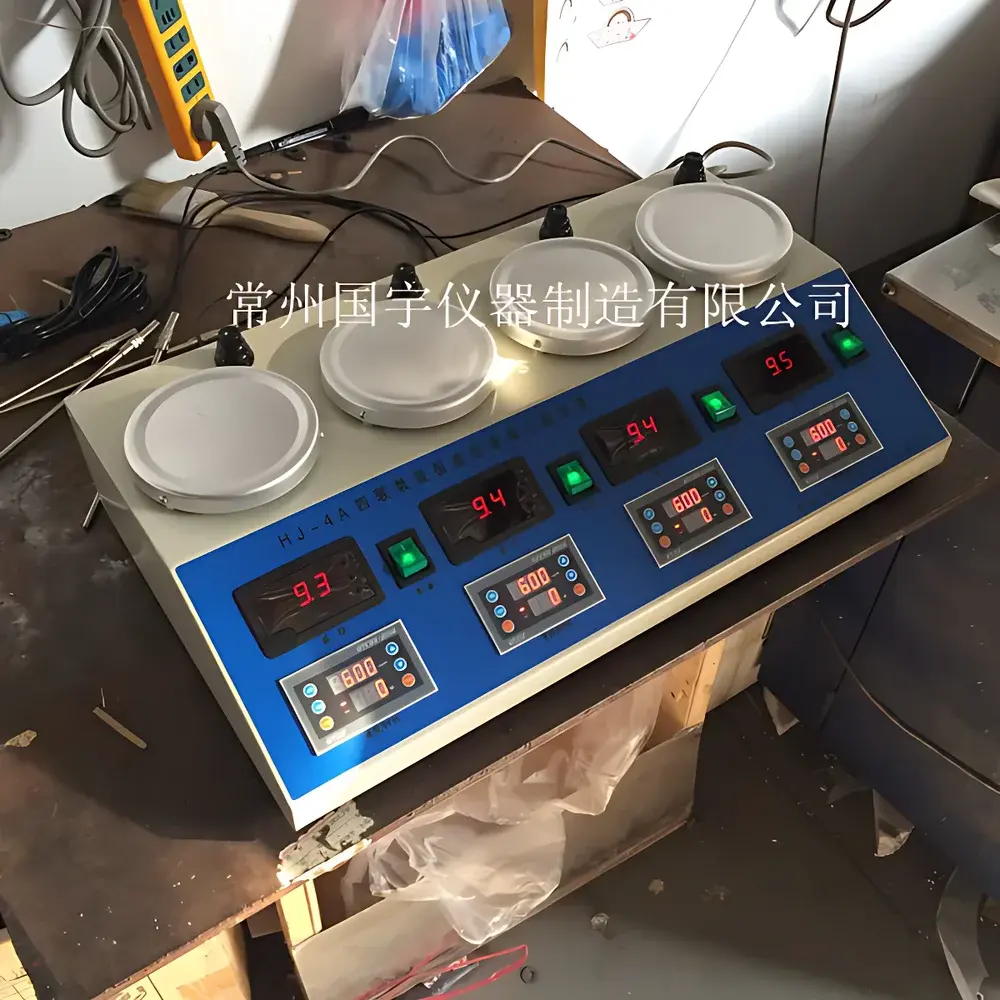
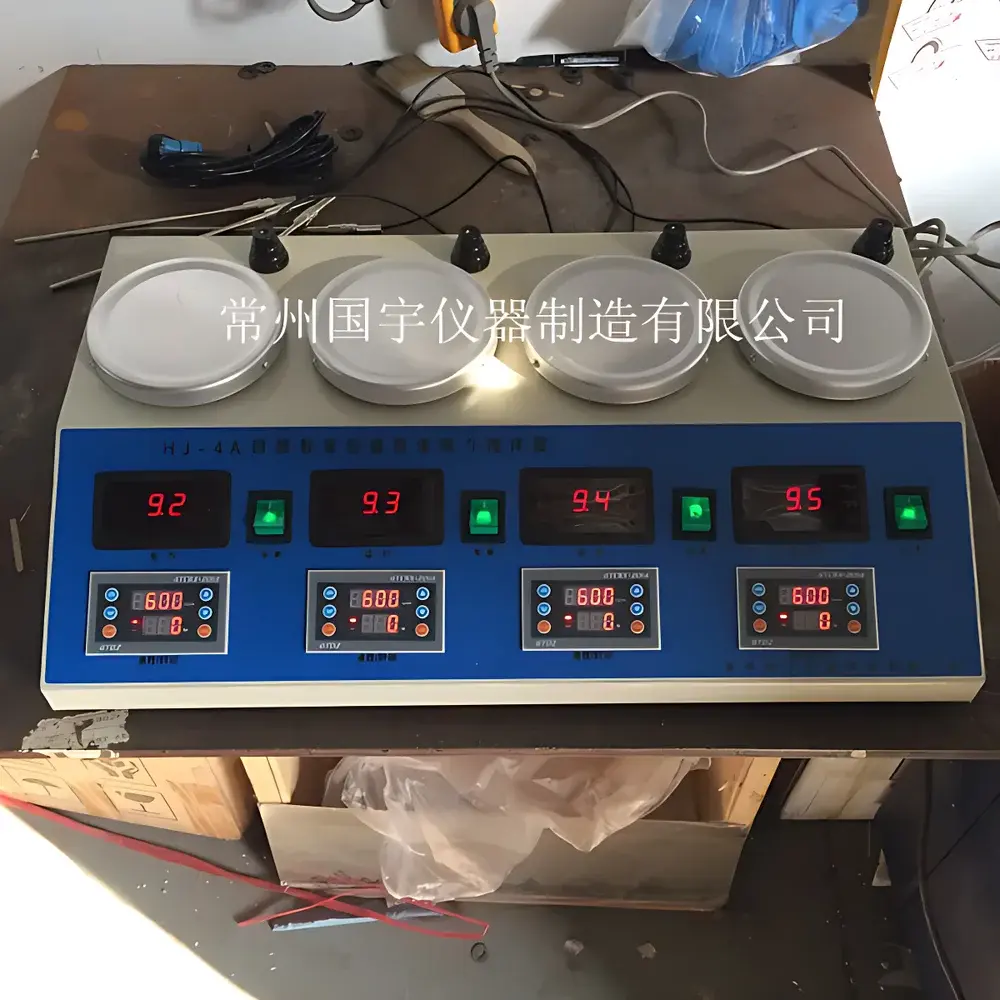
CZGY HJ-4AS Four-Station Digital Display Constant-Temperature Constant-Speed Magnetic Stirrer
| Brand | CZGY |
|---|---|
| Origin | Jiangsu, China |
| Manufacturer Type | Direct Manufacturer |
| Instrument Type | Magnetic Stirrer |
| Max Stirring Volume per Station | 1000 mL |
| Speed Range | 0–2000 rpm |
| Temperature Control Range | RT + 5°C to 100°C |
| Motor Power per Station | 25 W |
| Heating Power per Station | 200 W |
| Speed Accuracy | ±1 rpm |
| Timer Range | 0–999 min |
| Input Voltage | 220 V ±10%, 50 Hz |
Overview
The CZGY HJ-4AS Four-Station Digital Display Constant-Temperature Constant-Speed Magnetic Stirrer is an engineered solution for parallel sample processing in analytical, quality control, and preparative laboratory workflows. Designed around the principle of magnetic coupling—where a rotating permanent magnet beneath the heating plate induces synchronous rotation of a PTFE-coated stir bar immersed in the sample—the instrument delivers precise, contactless agitation while maintaining thermal homogeneity across four independent workstations. Each station operates with fully decoupled speed and temperature control, enabling simultaneous yet distinct experimental conditions (e.g., gradient temperature studies or multi-condition reaction optimization). Its robust aluminum alloy housing, sealed heating elements, and low-noise brushless DC motor architecture ensure long-term operational stability and minimal mechanical drift—critical for reproducible dissolution testing, buffer equilibration, reagent synthesis, and standard solution preparation.
Key Features
- Four independently controllable stirring stations with individual digital LED displays for real-time monitoring of speed (rpm) and temperature (°C)
- Precise speed regulation from 0 to 2000 rpm with ±1 rpm accuracy, achieved via closed-loop feedback control and high-resolution encoder integration
- Temperature control range from ambient +5°C to 100°C, using PID-based algorithm and calibrated NTC thermistors embedded in each heating plate
- Dedicated timer function per station (0–999 minutes), supporting unattended operation with automatic shutdown upon completion
- PTFE-coated ceramic top plate offering chemical resistance, uniform heat distribution, and easy cleaning—compatible with common organic solvents and aqueous media
- Integrated safety mechanisms including over-temperature cutoff, motor stall detection, and thermal fuse protection per channel
Sample Compatibility & Compliance
The HJ-4AS accommodates standard laboratory glassware up to 1000 mL per station—including beakers, Erlenmeyer flasks, and round-bottom flasks—when used with appropriately sized stir bars (recommended diameter: 6–10 mm, length: 25–40 mm). Its design complies with general electrical safety requirements per IEC 61010-1 for laboratory equipment. While not certified to GLP or GMP as a standalone system, its digital logging capability (via optional RS232/USB interface) supports traceable record-keeping aligned with internal SOPs and audit-ready documentation practices. The instrument meets electromagnetic compatibility (EMC) standards EN 61326-1 and is suitable for use in ISO/IEC 17025-accredited laboratories where equipment qualification (IQ/OQ) is performed per institutional protocols.
Software & Data Management
The HJ-4AS operates as a stand-alone unit with local digital interface; no proprietary software is required for basic operation. For advanced data capture, optional serial communication (RS232 or USB-to-serial adapter) enables connection to external PCs running custom LabVIEW, Python (PySerial), or MATLAB scripts for time-stamped parameter logging. All setpoints and real-time values are accessible via ASCII command protocol, facilitating integration into automated lab systems. Audit trail functionality—including operator ID tagging, parameter change history, and timestamped event logs—can be implemented at the host software level to satisfy FDA 21 CFR Part 11 requirements when deployed in regulated environments.
Applications
- Simultaneous pH adjustment and homogenization of multiple calibration standards in analytical chemistry labs
- Parallel dissolution testing of pharmaceutical tablets under controlled temperature and agitation profiles (aligned with USP guidance)
- Preparation of homogeneous catalyst suspensions or nanoparticle dispersions requiring consistent shear history
- Environmental water sample digestion and extraction protocols involving heated agitation (e.g., EPA Method 3050B adaptations)
- Cell culture media pre-warming and buffer equilibration prior to sterile filtration or bioreactor inoculation
- Teaching laboratories conducting comparative kinetics experiments across variable temperature–speed combinations
FAQ
Can the HJ-4AS be used with corrosive solvents such as concentrated acids or halogenated organics?
Yes—provided appropriate stir bars (e.g., PTFE-encapsulated or glass-coated) and chemically resistant glassware are used. The ceramic-coated top plate resists mild corrosion but should not be exposed to prolonged splashes of strong oxidizers.
Is speed and temperature calibration traceable to national standards?
Factory calibration is performed using NIST-traceable reference instruments. End users may perform periodic verification using calibrated digital thermometers and optical tachometers per internal QA procedures.
Does the unit support external temperature probe input for jacketed vessel control?
No—the built-in sensor measures plate surface temperature only. For bath or jacketed vessel applications, external PID controllers with immersion probes are recommended.
What maintenance is required to ensure long-term accuracy?
Annual inspection of thermal sensors, verification of motor torque consistency, and cleaning of ventilation grilles to prevent dust-induced thermal throttling are advised. No lubrication or internal user-serviceable parts are required.



