
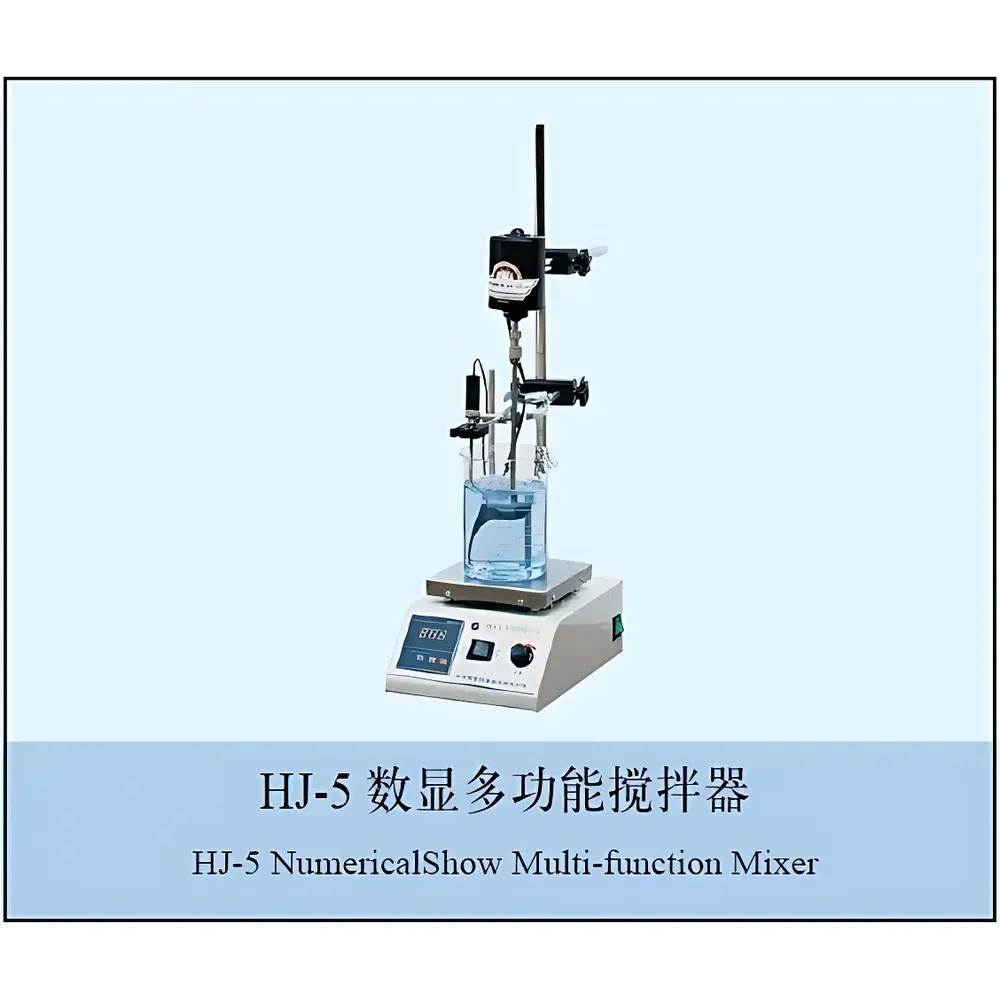
CZGY HJ-5 Dual-Mode Magnetic & Mechanical Stirrer with Integrated Heating
| Brand | CZGY |
|---|---|
| Origin | Jiangsu, China |
| Manufacturer Type | Direct Manufacturer |
| Instrument Type | Magnetic & Mechanical Stirrer |
| Max Stirring Volume | 1000 mL |
| Speed Range | Mechanical Stirring: 0–3000 rpm |
| Magnetic Stirring | 0–2400 rpm |
| Temperature Control Range | Ambient to 100 °C |
| Power Supply | 220 V ±10%, 50 Hz |
| Magnetic Stirring Power | 25 W |
| Mechanical Stirring Power | 40 W |
| Heating Power | 400 W |
| Temperature Resolution | 0.1 °C |
| Temperature Accuracy | ±0.5 °C |
| Platform Size | 16 × 16 cm |
| Safety Features | Grounded chassis, overheat protection, non-operational auto-shutoff |
Overview
The CZGY HJ-5 Dual-Mode Magnetic & Mechanical Stirrer with Integrated Heating is an engineered solution for laboratories requiring flexible, reliable, and thermally controllable mixing across diverse sample types and experimental protocols. Designed around a dual-actuation architecture—combining permanent-magnet DC motor-driven mechanical stirring with ceramic-coated magnetic coupling—the instrument delivers stable rotational output without electromagnetic interference or audible noise generation. Its integrated PTC-heated aluminum platform enables precise thermal regulation from ambient temperature up to 100 °C, supporting reactions requiring controlled endothermic or exothermic environments. The system operates under closed-loop PID temperature control with configurable proportional band (P), integral time (I), derivative time (D), and anticipation offset (E), ensuring minimal thermal overshoot and high reproducibility in heating kinetics. This architecture aligns with routine laboratory workflows in chemistry, biochemistry, materials synthesis, and quality control testing where simultaneous agitation and thermal conditioning are essential.
Key Features
- Dual-mode operation: Independent selection between magnetic stirring (0–2400 rpm) and mechanical stirring (0–3000 rpm), both offering stepless speed adjustment via rotary encoder
- Integrated heating module with 400 W power rating and ±0.5 °C temperature accuracy, calibrated against NIST-traceable references
- High-stability DC motor with brushless design ensures consistent torque delivery across the full speed range and extended service life
- Corrosion-resistant components: PTFE- and glass-coated stir bars, stainless-steel shafts, and chemically inert platform surface compatible with aqueous, organic, and mildly acidic/basic media
- User-configurable PID parameters (P, I, D, E) accessible via three-second SET key press, enabling optimization for viscous, low-volume, or thermally sensitive samples
- 16 × 16 cm anodized aluminum heating plate with uniform thermal distribution (±2 °C across surface at 80 °C)
- Comprehensive safety architecture including ground-fault detection, dry-run prevention logic, automatic thermal cutoff at 110 °C, and mandatory grounding compliance per IEC 61010-1
Sample Compatibility & Compliance
The HJ-5 accommodates standard laboratory vessels including borosilicate glass beakers (50–1000 mL), round-bottom flasks, and crystallization dishes. Its mechanical stirring mode supports use with overhead stirrers, propeller blades, and anchor impellers (diameter ≤16 mm), while magnetic mode functions optimally with cylindrical or oval stir bars (length 20–40 mm). The device meets electrical safety requirements of IEC 61010-1:2010 (Edition 3) for laboratory equipment and conforms to EMC directive 2014/30/EU. Though not certified to GLP or GMP standards out-of-the-box, its audit-ready features—including parameter logging capability, user-accessible calibration offsets, and deterministic thermal response—support integration into regulated environments when validated per internal SOPs. It is routinely deployed in academic teaching labs, R&D facilities, and QC laboratories operating under ISO/IEC 17025 frameworks.
Software & Data Management
The HJ-5 operates as a standalone instrument with no embedded firmware-based data logging or PC connectivity. All operational parameters—including setpoint temperature, real-time platform temperature, selected stirring mode, and current speed—are displayed on a dual-digit LED interface. While no proprietary software is provided, the analog control architecture ensures deterministic behavior during long-duration experiments (e.g., polymerization, enzymatic assays, or dissolution testing). Users may integrate external data acquisition systems via optional PT100 probe outputs (available upon request) or employ third-party USB thermocouple loggers synchronized with manual protocol timestamps. For regulated applications, operators are advised to document settings and observed behavior in bound lab notebooks or ELN platforms compliant with 21 CFR Part 11 requirements.
Applications
- Kinetic studies of homogeneous catalysis requiring constant temperature and agitation
- Preparation of buffer solutions, culture media, and reagent stocks in microbiology and molecular biology labs
- Synthesis of metal–organic frameworks (MOFs) and colloidal nanomaterials under controlled thermal and shear conditions
- Dissolution testing of pharmaceutical tablets per USP , particularly for sink-condition maintenance in small-volume vessels
- Standardized mixing of calibration standards in environmental and food testing laboratories
- Teaching laboratories for demonstrating Arrhenius behavior, reaction order determination, and heat transfer principles
FAQ
Can the HJ-5 be used for viscous solutions above 5000 mPa·s?
Mechanical stirring mode is recommended for viscosities exceeding 2000 mPa·s; however, maximum effective viscosity depends on impeller geometry, vessel dimensions, and target homogeneity. For >5000 mPa·s, consult the manufacturer for custom shaft and blade configurations.
Is the temperature sensor replaceable in the field?
Yes—the integrated PT100 sensor is socket-mounted and can be replaced using standard lab tools without soldering or firmware recalibration.
Does the unit support continuous operation for 72+ hours?
Yes, provided ambient temperature remains below 35 °C, ventilation is unobstructed, and the heating load does not exceed 80% of rated capacity for prolonged periods.
What is the warranty coverage and service support structure?
CZGY provides a 12-month limited warranty covering material and workmanship defects. Technical documentation, spare parts diagrams, and calibration procedures are available upon registration at czgy-instrument.com (global distributor portal).
Are CE or RoHS declarations available for export compliance?
CE marking is affixed to all units shipped to EU markets; RoHS 2011/65/EU compliance documentation is supplied with commercial invoices for customs clearance.



