
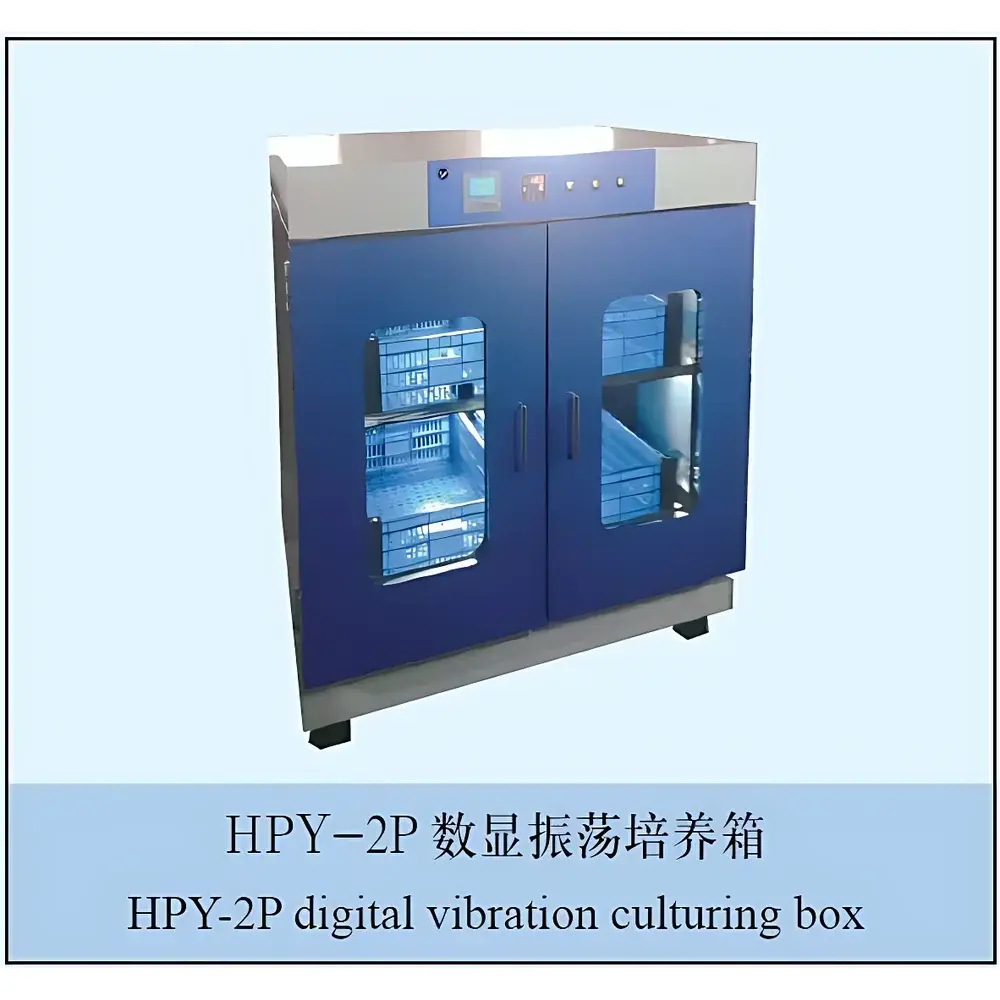
CZGY HPY-2P Digital Display Orbital Incubator Shaker
| Brand | CZGY |
|---|---|
| Origin | Jiangsu, China |
| Manufacturer Type | Direct Manufacturer |
| Model | HPY-2P |
| Control Temperature Range | Ambient +5°C to 50°C |
| Temperature Uniformity | ±1°C |
| Humidity Control | Not Available |
| Platform Dimensions | 880 mm × 770 mm |
| Power Supply | 220 V, 50 Hz |
| Heating Power | 1200 W |
| Shaking Power | 200 W |
| Speed Range | 30–300 rpm |
| Speed Accuracy | ±0.5 rpm |
| Orbit Diameter | 25 mm |
| Timer Range (Temperature & Shaking) | 0–9999 min |
| External Dimensions | 1200 mm × 970 mm × 1400 mm |
| Chamber Construction | Double-door stainless steel insulated chamber |
| Control System | Segment-type LCD display with fuzzy PID temperature control |
| Drive System | Brushless DC motor |
Overview
The CZGY HPY-2P Digital Display Orbital Incubator Shaker is an integrated benchtop bioreactor platform engineered for precise simultaneous temperature regulation and orbital agitation. It operates on convective air-heating principles, eliminating liquid baths while delivering stable thermal environments across the working chamber. Designed for applications requiring both controlled incubation and mechanical mixing—such as microbial culture expansion, enzymatic assays, cell suspension maintenance, and hybridization protocols—the instrument employs a brushless DC motor to ensure continuous operation without carbon brush wear, thereby supporting long-duration experiments under reproducible rotational conditions. Its dual-door stainless steel chamber features high-efficiency insulation, minimizing thermal gradient formation and enabling uniform temperature distribution (±1°C) throughout the 880 mm × 770 mm shaking platform. The system utilizes fuzzy PID algorithm-based digital temperature control, achieving ±0.5°C setpoint accuracy—a specification aligned with routine QC requirements in academic laboratories and GLP-compliant R&D settings.
Key Features
- Brushless DC drive mechanism ensures maintenance-free, low-noise, and high-reliability operation over extended periods (≥72 h continuous runtime)
- Fuzzy PID temperature controller with segment-type LCD interface provides intuitive parameter entry, real-time monitoring, and adaptive thermal compensation
- Orbital shaking motion with fixed 25 mm diameter ensures consistent shear profile across all vessel positions on the platform
- Independent dual timers for temperature hold and shaking duration (0–9999 minutes), supporting unattended overnight or multi-day protocols
- Double-door stainless steel chamber with reinforced thermal insulation enhances energy efficiency and reduces external heat dissipation
- Adjustable speed range of 30–300 rpm with ±0.5 rpm resolution enables fine-tuned optimization for sensitive cell lines or viscous media
- Robust mechanical architecture supports standard flask configurations (up to 5 L Erlenmeyer flasks) and multi-well plate carriers
Sample Compatibility & Compliance
The HPY-2P accommodates a wide range of sample containers—including glass and PET Erlenmeyer flasks (50 mL to 5 L), baffled flasks, tube racks, and microplate holders—without requiring auxiliary adapters. While it does not provide active humidity control, its sealed chamber design maintains ambient relative humidity levels suitable for non-desiccating applications such as bacterial fermentation, yeast propagation, and recombinant protein expression in shake-flask systems. The unit complies with IEC 61010-1:2010 safety standards for laboratory electrical equipment and incorporates grounded chassis construction per EN 61326-1 for electromagnetic compatibility. Although not certified for ISO 13485 or FDA 21 CFR Part 11 out-of-the-box, its deterministic timer logic and non-volatile parameter storage support audit-ready documentation when integrated into internal SOP workflows.
Software & Data Management
The HPY-2P operates via embedded firmware with no external PC dependency. All operational parameters—including setpoints, timers, and runtime logs—are retained in non-volatile memory during power interruption. While the device lacks USB/Ethernet connectivity or cloud synchronization, its segment LCD interface displays real-time temperature and speed values with timestamped start/stop indicators, facilitating manual logbook entries compliant with GLP recordkeeping practices. For institutions requiring electronic data capture, third-party RS-232 or analog 0–5 V output modules (available separately) can be interfaced for integration into LIMS or SCADA environments.
Applications
- Microbial growth kinetics studies in Escherichia coli, Bacillus subtilis, and other aerobic prokaryotes
- Suspension culture of insect and mammalian cells (e.g., Sf9, CHO-K1) in serum-free or chemically defined media
- Enzyme activity profiling under controlled thermal and agitation conditions
- DNA hybridization and antigen-antibody binding assays requiring gentle mixing
- Preparation of starter cultures for bioreactor inoculation in bioprocess development
- Environmental microbiology sampling analysis, including waterborne pathogen enrichment
- Teaching laboratory use for undergraduate biochemistry and molecular biology courses
FAQ
Does the HPY-2P support humidity control?
No. This model is designed as a dry-air incubator shaker and does not include humidification or dehumidification subsystems.
What is the maximum load capacity of the shaking platform?
The platform supports up to 25 kg distributed evenly across the 880 mm × 770 mm surface, compatible with standard 2 L flasks placed in balanced configurations.
Can the instrument operate continuously for more than 24 hours?
Yes. With its brushless motor and thermally optimized heating system, the HPY-2P is rated for uninterrupted operation up to 168 hours (7 days) under nominal load conditions.
Is calibration documentation provided with the unit?
Factory calibration certificates for temperature and speed sensors are available upon request and may be supplied with NIST-traceable reference data.
How is thermal uniformity verified across the chamber?
Uniformity is validated using nine-point mapping per ASTM E145-20 Annex A3 methodology, with probes positioned at center, corners, and midpoints of the platform plane.




