
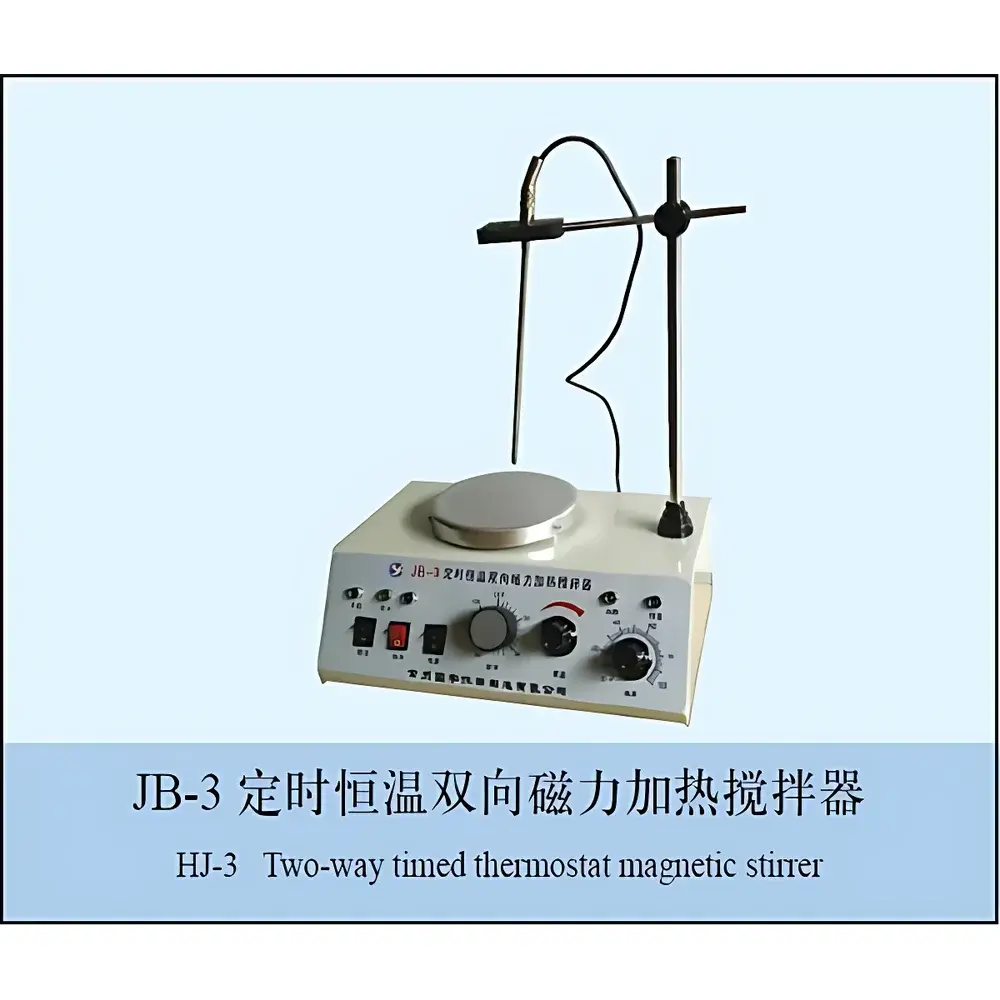
CZGY JB-3 Programmable Dual-Direction Magnetic Hotplate Stirrer
| Brand | CZGY |
|---|---|
| Origin | Jiangsu, China |
| Manufacturer Type | Direct Manufacturer |
| Instrument Type | Magnetic Stirrer |
| Maximum Stirring Volume | 3000 mL |
| Speed Range | 0–1600 rpm |
| Temperature Control Range | Ambient to 100 °C |
| Heating Power | 150 W |
| Motor Power | 25 W |
| Plate Diameter | 15 cm |
| Voltage/Frequency | 220 V / 50 Hz |
| Timing Function | Mechanical Timer |
| Temperature Accuracy | ±1 °C |
| Safety | Grounded Operation Required |
| Duty Cycle | 8 h continuous at medium speed |
Overview
The CZGY JB-3 Programmable Dual-Direction Magnetic Hotplate Stirrer is an engineered solution for precise, reproducible mixing and temperature-controlled sample preparation in routine laboratory environments. Based on the principle of magnetic coupling—where a rotating permanent magnet beneath the ceramic-coated heating plate induces synchronous rotation of a PTFE- or glass-coated stir bar immersed in the sample—the JB-3 delivers consistent agitation without mechanical shaft penetration. Its dual-direction stirring mode alternates clockwise and counterclockwise rotation at user-defined intervals, enhancing homogenization efficiency for viscous or heterogeneous solutions where unidirectional motion may induce vortex asymmetry or sediment re-agglomeration. Integrated resistive heating enables stable thermal regulation from ambient up to 100 °C, with electronic PID-based control ensuring ±1 °C accuracy across the operating range. Designed for reliability in educational, environmental, pharmaceutical QC, and industrial R&D labs, the JB-3 complies with general electrical safety requirements for Class I laboratory equipment (IEC 61010-1) and supports grounded operation to mitigate leakage current risks.
Key Features
- Dual-direction programmable stirring: Alternating rotation improves dispersion uniformity in suspensions, emulsions, and polymer solutions
- 0–1600 rpm continuously adjustable speed control via analog dial, optimized for low-noise, vibration-free operation
- Integrated hotplate with ceramic-coated aluminum surface (Ø15 cm), rated at 150 W heating power and calibrated to ±1 °C accuracy
- Mechanical timer (0–120 min) for unattended endpoint control—ideal for standardized dissolution, extraction, or reaction protocols
- Compact benchtop architecture (220 × 160 × 120 mm) with IP20-rated enclosure; non-corrosive surface compatible with mild aqueous and organic solvents
- 25 W brushless motor ensures extended service life and minimal electromagnetic interference with adjacent instrumentation
Sample Compatibility & Compliance
The JB-3 accommodates standard laboratory vessels including borosilicate glass beakers (up to 3 L capacity), polypropylene cylinders, and stainless-steel containers, provided flat-bottom geometry is maintained for optimal magnetic coupling. Stir bar selection (e.g., 30 mm × 8 mm elliptical or cross-shaped magnets) is critical for torque transmission at higher viscosities (>500 mPa·s). While not certified to ISO/IEC 17025 or GLP-specific validation protocols, the instrument meets baseline functional criteria for method reproducibility under ASTM E2912 (Standard Guide for Selection and Use of Laboratory Stirring Equipment) and supports traceable calibration via external thermocouple verification. Grounding compliance (per IEC 61010-1 Clause 6.3.2) is mandatory during operation to ensure operator safety and signal integrity in regulated settings.
Software & Data Management
The JB-3 operates as a standalone analog instrument with no embedded microprocessor or digital interface. All controls—including speed setting, temperature setpoint, and timer activation—are managed manually via front-panel dials and switches. Consequently, it generates no electronic audit trail, does not support FDA 21 CFR Part 11-compliant data logging, and requires manual recording of operational parameters in lab notebooks or LIMS-integrated workflows. This design prioritizes robustness, electromagnetic compatibility, and ease of maintenance over connectivity—a deliberate choice for environments where simplicity, long-term stability, and resistance to firmware obsolescence are primary operational requirements.
Applications
- Buffer and reagent preparation in molecular biology and clinical diagnostics laboratories
- Heavy metal digestion and sample homogenization prior to ICP-OES or AAS analysis
- Controlled heating/stirring during titration, standardization, and calibration solution preparation
- Accelerated solvent extraction (ASE) pre-treatment in environmental testing (e.g., EPA Method 3540C)
- Viscosity-independent mixing of culture media in microbiology and cell culture support workflows
- Preparation of homogeneous catalyst slurries in synthetic chemistry R&D
FAQ
What is the maximum recommended viscosity for reliable stirring with the JB-3?
For consistent performance, the JB-3 is validated for Newtonian fluids up to ~1,200 mPa·s at 1600 rpm using a 40 mm stir bar. Above this range, torque limitations may reduce rotational fidelity; users should verify stir bar engagement visually and adjust speed downward accordingly.
Can the JB-3 be used with corrosive solvents such as concentrated HCl or NaOH solutions?
The ceramic-coated plate surface resists mild corrosion, but prolonged exposure to strong acids/bases may degrade the coating over time. Always use chemically inert stir bars (e.g., PTFE-coated) and avoid spillage onto the housing or control panel.
Is calibration documentation provided with the unit?
No factory calibration certificate is included. Users performing GLP/GMP work must conduct in-house verification using NIST-traceable thermometers and tachometers per internal SOPs.
Does the mechanical timer retain settings after power interruption?
No—the timer resets to zero upon power loss and requires manual reconfiguration before each use.
What maintenance is required for long-term reliability?
Periodic cleaning of the plate surface with isopropyl alcohol, inspection of stir bar magnetism, and verification of grounding continuity every 6 months are recommended practices.



