
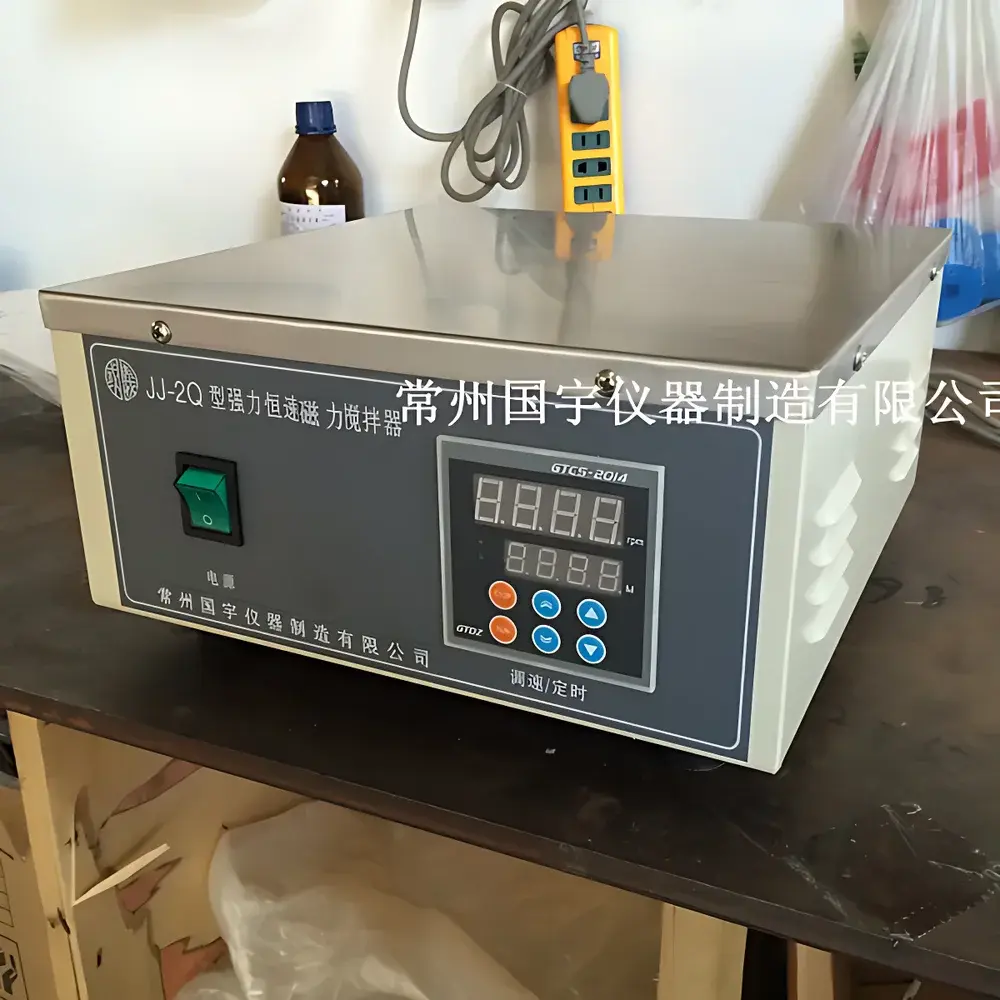
CZGY JJ-2Q Heavy-Duty Constant-Speed Magnetic Stirrer
| Brand | CZGY |
|---|---|
| Origin | Jiangsu, China |
| Manufacturer Type | Direct Manufacturer |
| Product Category | Domestic |
| Model | JJ-2Q |
| Instrument Type | Magnetic Stirrer |
| Max. Stirring Volume | 100–3000 mL |
| Speed Range | 1–500 rpm |
| Power Supply | 220 V, 50 Hz |
| Motor Power | 100 W |
| Timer Range | 0–9999 min |
| Control Interface | Keypad with Memory Function |
| Work Surface Material | Stainless Steel (304) |
| Temperature Control | None (Non-heated) |
| Memory Function | Power-loss retention of set parameters |
Overview
The CZGY JJ-2Q Heavy-Duty Constant-Speed Magnetic Stirrer is engineered for sustained, high-torque mixing across a broad volume range—from small-scale reagent preparation (100 mL) to large-volume buffer or media formulation (up to 3000 mL). Unlike standard magnetic stirrers optimized for low-viscosity aqueous solutions, the JJ-2Q employs a brushless DC motor coupled with an advanced high-speed microcontroller-based drive system. This architecture ensures stable rotational output even at ultra-low speeds (1 rpm), where torque retention is critical for initiating motion in viscous or particle-laden suspensions—such as polymer solutions, cell culture media with serum, or heterogeneous catalyst slurries. Its non-heated design distinguishes it from hotplate stirrers, making it suitable for temperature-sensitive applications where external heating would compromise sample integrity or induce unwanted reactions.
Key Features
- High-Torque Low-Speed Performance: Delivers consistent torque output across the full 1–500 rpm range, enabling reliable agitation of high-viscosity fluids without stalling or speed drift.
- Stainless Steel Work Surface (Grade 304): Chemically resistant and non-porous; withstands repeated exposure to acids, bases, and organic solvents without corrosion or surface degradation.
- Intelligent Parameter Memory: Microcontroller retains speed and timer settings after power interruption—eliminating manual reconfiguration during routine lab workflows or extended unattended operation.
- Precision Keypad Interface: Dedicated “∧”/“∨” keys for incremental speed adjustment; “M” key initiates timer setup mode; “RUN”/“STOP” provide unambiguous start/stop control—designed for glove-compatible, error-resistant operation.
- Extended Timer Capability: Programmable timing up to 9999 minutes (~7 days), supporting long-duration homogenization, dissolution testing, or slow-reaction monitoring protocols.
- Robust Mechanical Architecture: Reinforced housing and precision-balanced rotor assembly minimize vibration and acoustic noise at all operating speeds, enhancing stability on shared benchtops.
Sample Compatibility & Compliance
The JJ-2Q accommodates standard laboratory glassware—including beakers (50–4000 mL), Erlenmeyer flasks, and graduated cylinders—when used with appropriately sized magnetic stir bars (e.g., 20–60 mm PTFE-coated rods). It is compatible with aqueous, organic, and mildly corrosive media but not rated for explosive atmospheres or Class I Div 1 environments. While the device itself carries no CE, UL, or RoHS certification markings per its domestic manufacturing origin, its electrical design conforms to IEC 61010-1 safety principles for laboratory equipment (reinforced insulation, overcurrent protection, grounding continuity). Users implementing the JJ-2Q in regulated environments (e.g., GLP-compliant analytical labs or pharmaceutical QC) should validate operational consistency per internal SOPs and document calibration intervals for speed accuracy using traceable tachometric verification.
Software & Data Management
The JJ-2Q operates as a standalone instrument with no embedded software stack, network interface, or data export capability. All parameter inputs and status feedback occur via the front-panel LED display and tactile keypad. As such, it does not support FDA 21 CFR Part 11 electronic record requirements, nor does it generate audit trails or user-access logs. However, its deterministic behavior—combined with parameter memory and repeatable mechanical response—enables robust manual documentation practices. Lab managers may integrate usage logs into LIMS or ELN systems by recording setpoints, run durations, and operator IDs alongside experimental metadata.
Applications
- Preparation of homogeneous buffers, growth media, and reagent solutions in molecular biology and microbiology labs.
- Dispersion of nanoparticles or nanocomposites in solvent matrices prior to characterization (e.g., DLS, TEM sample prep).
- Controlled agitation during titration endpoint stabilization or redox equilibration studies.
- Long-term suspension maintenance in sedimentation or flocculation experiments requiring uninterrupted low-shear mixing.
- Supporting ASTM D4097 (Standard Test Method for Determining the Stability of Emulsions) through standardized agitation cycles.
- QC/QA workflows in food, cosmetics, and chemical manufacturing where ISO/IEC 17025 traceability demands stable, documented mixing conditions.
FAQ
Is the JJ-2Q suitable for use with corrosive solvents like concentrated HCl or NaOH?
Yes—the 304 stainless steel platform provides resistance to common laboratory acids and bases under normal handling conditions. However, prolonged direct contact with >30% HCl or hot caustic solutions may cause pitting; rinse immediately after use.
Can the timer be modified while the motor is running?
No—the timer must be programmed prior to initiating rotation. Once “RUN” is engaged, timer adjustments are disabled to prevent accidental interruption or misalignment of timed protocols.
Does this unit include thermal regulation or heating capability?
No—the JJ-2Q is a non-heated magnetic stirrer. It lacks a built-in heating element or temperature sensor. For combined stirring and heating, consider a hotplate stirrer model.
What stir bar size is recommended for optimal performance at 3000 mL capacity?
A 40–60 mm dual-lobe PTFE-coated stir bar is recommended for vessels ≥2000 mL to ensure vortex formation and bottom-layer suspension without excessive splashing.
Is third-party calibration available for speed accuracy verification?
While CZGY does not offer certified calibration services, users may perform in-house verification using a NIST-traceable optical tachometer; typical deviation is ≤±2 rpm across the 10–500 rpm range when measured at steady state.



