
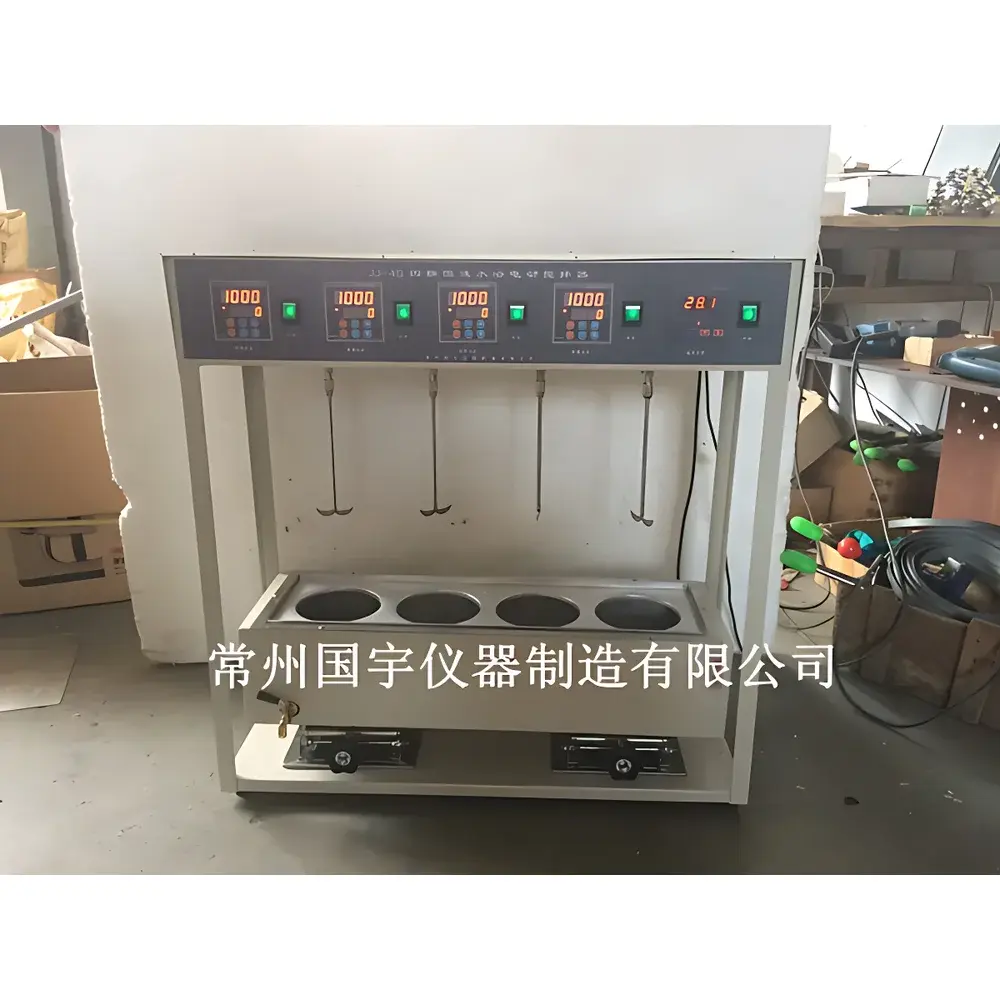
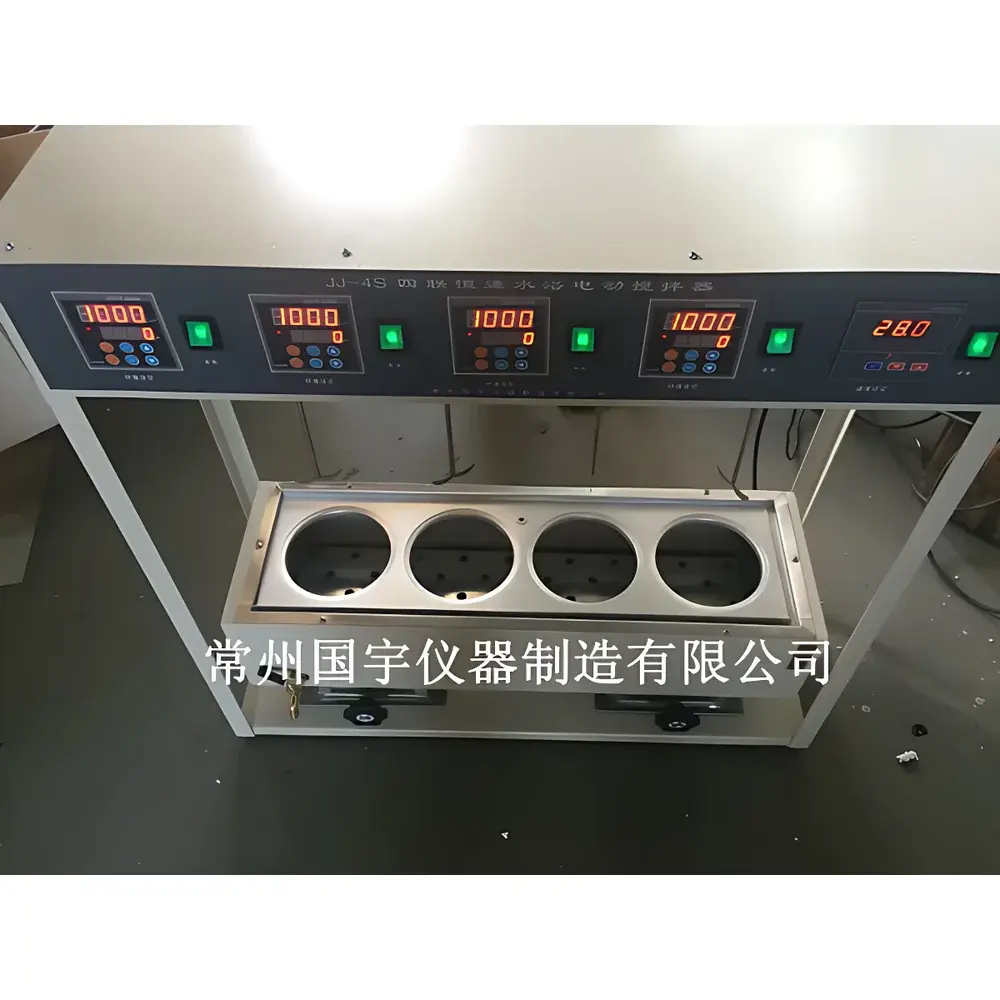
CZGY JJ-4S Constant-Speed Quadruple Water-Bath Magnetic Stirrer
| Brand | CZGY |
|---|---|
| Origin | Jiangsu, China |
| Manufacturer Type | Direct Manufacturer |
| Product Category | Domestic Laboratory Equipment |
| Model | JJ-4S |
| Instrument Type | Electric Stirrer |
| Max Stirring Volume | 1000 mL × 4 |
| Speed Range | 200–3000 rpm |
| Temperature Control Range | Room Temp +5°C to 99.9°C |
| Power Supply | AC 220 V, 50 Hz |
| Motor Power | 4 × 60 W |
| Heating Power | 1000 W |
| Speed Accuracy | ±1 rpm |
| Temperature Accuracy | ±0.5°C |
| Temperature Resolution | 0.1°C |
| Timer Range | 0–9999 min |
| Control Method | Microprocessor-based PID Temperature Control & Digital Speed Regulation |
| Construction | Stainless Steel Bath Chamber & Corrosion-Resistant Stir Bars |
| Compliance | Designed for GLP-compliant lab environments |
Overview
The CZGY JJ-4S Constant-Speed Quadruple Water-Bath Magnetic Stirrer is an engineered solution for simultaneous, reproducible thermal and mechanical conditioning of up to four independent liquid samples. Unlike conventional single-station stirrers, this unit integrates precision water-bath heating with digitally regulated DC motor-driven stirring—enabling concurrent experiments under identical or individually optimized thermal and hydrodynamic conditions. Its operational principle relies on magnetically coupled rotation (via stainless-steel stir bars) combined with uniform conductive heat transfer through a thermostatically controlled stainless-steel water bath. This dual-function architecture meets rigorous requirements in environmental testing (e.g., wastewater treatment simulation per ASTM D5210), pharmaceutical dissolution studies (aligned with USP apparatus compatibility), and polymer solution rheology pre-conditioning prior to viscometry.
Key Features
- Quadruple independent stirring stations with synchronized or asynchronous speed control—each channel supports discrete setpoints from 200 to 3000 rpm at ±1 rpm accuracy
- Microprocessor-based PID temperature controller with 0.1°C resolution and ±0.5°C stability across the full range (RT+5°C to 99.9°C)
- Dual-mode operation: constant-speed mode ensures long-term rotational stability; programmable timer (0–9999 minutes) enables unattended batch processing
- Four 60 W brushless permanent-magnet DC motors—low-noise, high-torque output with no gear wear or speed drift over extended runs
- Corrosion-resistant construction: 304 stainless-steel bath chamber, PTFE-coated stir bars, and sealed motor housings prevent electrolyte ingress and thermal degradation
- Digital interface with LED dual-display: upper row shows real-time speed (rpm), lower row displays remaining time or setpoint temperature
Sample Compatibility & Compliance
The JJ-4S accommodates standard laboratory vessels—including 500 mL and 1000 mL glass beakers, Erlenmeyer flasks, and cylindrical digestion tubes—up to 1000 mL per station. Its water-bath geometry ensures uniform thermal distribution (±0.8°C spatial gradient at 60°C), critical for kinetic assays requiring precise Arrhenius-controlled reaction rates. The unit complies with IEC 61010-1 safety standards for laboratory electrical equipment and incorporates grounding terminals, thermal cutoff fuses, and automatic dry-run protection. While not FDA 21 CFR Part 11 certified out-of-the-box, its deterministic control logic, non-volatile parameter storage, and immutable event logging (power-on, start/stop, setpoint changes) support validation under GLP and GMP frameworks when integrated into documented SOPs.
Software & Data Management
This is a standalone hardware instrument with no embedded software stack or network connectivity. All operational parameters—including speed, temperature, timer values, and PID tuning constants (P, T, E)—are retained in non-volatile memory after power cycling. The front-panel interface provides full manual configuration without dependency on external drivers or proprietary applications. For traceability, users may manually record setpoints and timestamps in lab notebooks or LIMS-compatible spreadsheets. Optional RS-232 or analog 0–5 V output modules (sold separately) enable integration with data acquisition systems for automated logging compliant with ISO/IEC 17025 clause 7.7 (result reporting).
Applications
- Environmental labs: Standardized BOD5 incubation, coagulation-flocculation trials, and heavy metal leaching tests per EPA Method 1311
- Pharmaceutical QC: Uniform dissolution media conditioning prior to USP Apparatus 1/2 testing
- Materials science: Pre-heating and homogenization of polymer melts, colloidal suspensions, and nanocomposite precursors
- Academic research: Multi-variable kinetic studies (e.g., pH-dependent hydrolysis) where four parallel conditions must be maintained identically
- Clinical microbiology: Preparation of standardized bacterial culture media with controlled viscosity and thermal history
FAQ
Can the JJ-4S operate without water in the bath chamber?
No. The heating element is fully submersible and requires water coverage above the minimum fill line to prevent overheating and permanent damage.
Is individual speed calibration available per station?
Speed is digitally regulated via closed-loop feedback; factory calibration ensures ±1 rpm consistency across all four channels without user adjustment.
What maintenance is required to sustain long-term accuracy?
Routine cleaning of the bath chamber with deionized water and periodic inspection of stir bar magnetism and clamp torque are sufficient. No lubrication or recalibration is needed within the 12-month warranty period.
Does the unit support external temperature probe input for sample-specific monitoring?
No. Temperature control is based solely on the built-in bath sensor. For sample-core temperature validation, users must employ separate calibrated PT100 probes placed directly in vessels.
How is thermal uniformity verified during installation qualification?
Users should perform a 3-point bath mapping test (center + two diagonally opposite corners) using NIST-traceable thermometers at three temperatures (25°C, 50°C, 80°C) per ISO/IEC 17025 Annex A.3 guidelines.



