
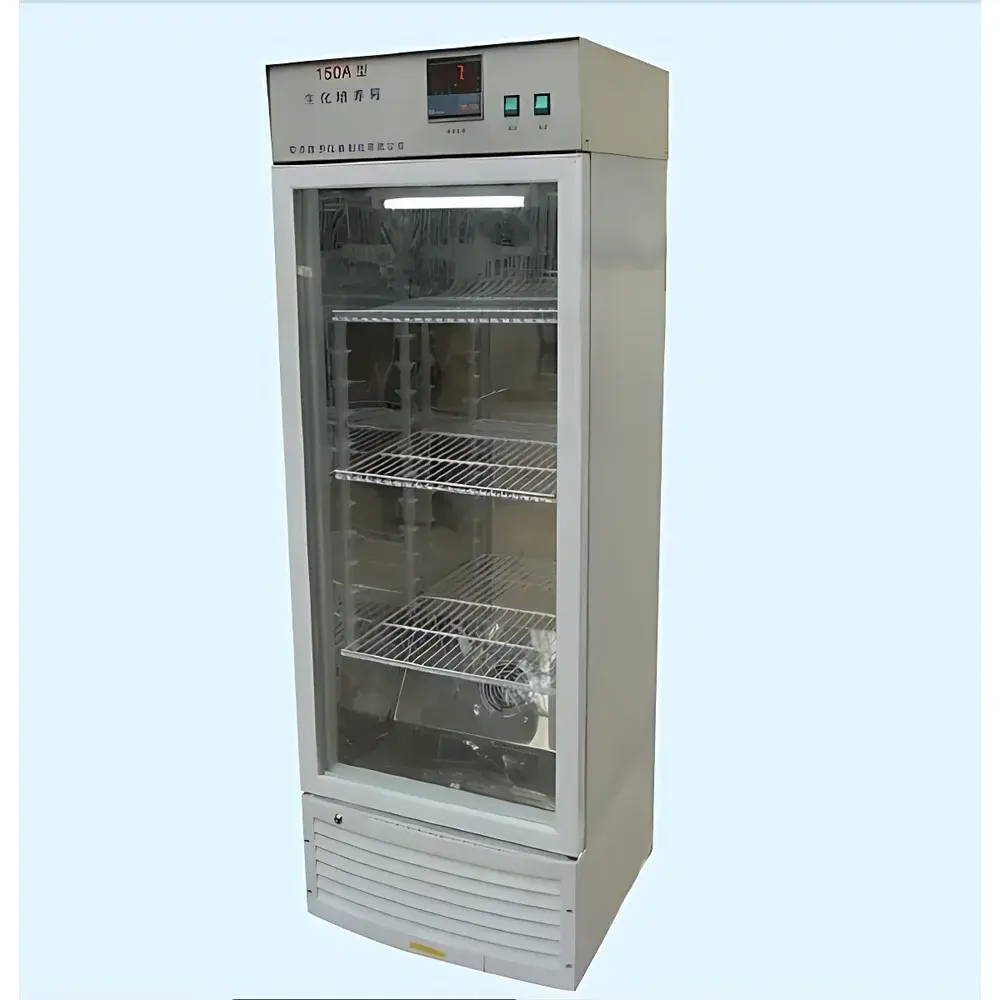
CZGY MHP-160 Mold Incubator
| Brand | CZGY |
|---|---|
| Origin | Jiangsu, China |
| Manufacturer | CZGY Instrument Co., Ltd. |
| Model | MHP-160 |
| Price | USD 1,120 (FOB) |
| Temperature Range | 5–50 °C |
| Temperature Uniformity | ±1 °C |
| Temperature Control Accuracy | ±0.5 °C |
| Humidity Range | 50–95 % RH |
| Capacity | 160 L |
| Power Supply | 220 V AC, 50 Hz |
| Refrigeration Power | 140 W |
| Heating Power | 300 W |
| UV Germicidal Lamp | 15 W |
| Compressor Restart Delay | 140 s |
| Continuous Operation | Yes |
Overview
The CZGY MHP-160 Mold Incubator is a purpose-engineered environmental chamber designed for the controlled cultivation of filamentous fungi, yeasts, and other eukaryotic microorganisms requiring stable temperature and humidity conditions. Unlike general-purpose incubators, this unit integrates dual-mode thermal regulation—active refrigeration and resistive heating—with programmable relative humidity control to replicate the mesophilic growth niche typical of Aspergillus, Penicillium, and Trichoderma species. Its operation relies on a PID-controlled feedback loop using high-stability Pt100 temperature sensors and capacitive humidity transducers, ensuring reproducible environmental setpoints across extended durations. The chamber’s insulated double-wall construction minimizes thermal bridging, while the internal air circulation system—driven by a low-turbulence axial fan—maintains uniformity within ±1 °C throughout the 160 L working volume. This architecture meets fundamental requirements for microbiological standard methods including ISO 7218:2017 (microbiology of food and animal feeding stuffs) and USP <61> (microbiological examination of nonsterile products), where consistent incubation conditions directly impact colony morphology, sporulation kinetics, and assay validity.
Key Features
- Independent dual-stage climate control: Compressor-based cooling (140 W) + PTC heating (300 W) enables precise setpoint maintenance from 5 °C to 50 °C with ±0.5 °C accuracy
- Humidity regulation module delivering 50–95 % RH via integrated evaporation/humidification system with real-time closed-loop feedback
- UV-C germicidal lamp (15 W, 254 nm) for chamber decontamination between cycles—compliant with ISO 14644-1 Class 8 cleanroom surface disinfection protocols
- Compressor protection logic: 140-second restart delay and pressure-equalization cycle prevent mechanical stress during repeated on/off cycling
- Configurable PID parameters (P = 10 °C, I = 120 s, D = 30 s) and auto-tuning capability (Atu mode) for adaptive thermal response across load variations
- Robust stainless-steel interior (304 grade) with seamless corners and removable perforated shelves facilitating cleaning and residue-free sterilization
- Dual-point alarm system (AL1/AL2) with relay outputs for external monitoring or integration into lab-wide BMS networks
Sample Compatibility & Compliance
The MHP-160 accommodates standard microbiological vessels—including Petri dishes (90 mm and 150 mm), slant tubes, broth culture flasks (up to 500 mL), and multi-well plates—without airflow obstruction. Its chamber geometry supports simultaneous incubation of heterogeneous sample types under identical environmental conditions, critical for comparative studies in antifungal susceptibility testing (CLSI M38-A3), mycotoxin production assays, and fungal biodegradation screening. The unit complies with electrical safety standards IEC 61010-1 and EMC directive 2014/30/EU. While not certified for GMP manufacturing environments, its design supports GLP-compliant workflows through traceable parameter logging, user-accessible calibration offset (SC ±19.9 °C), and configurable alarm thresholds aligned with ISO/IEC 17025:2017 clause 7.7 (uncertainty of measurement).
Software & Data Management
The MHP-160 operates via an embedded microcontroller interface with tactile membrane keypad and dual-line LED display. All operational parameters—including setpoints, actual readings, alarm status, and compressor duty cycle—are retained in non-volatile memory during power loss. Though lacking Ethernet or USB connectivity, the device supports manual audit trails through timestamped operator logs and built-in event history (e.g., door-open duration, UV activation count, error codes). For laboratories implementing 21 CFR Part 11 compliance, external data loggers (e.g., HOBO UX100-003) may be deployed via the analog output port (0–5 V DC proportional to temperature) to capture time-series environmental records with electronic signatures and version-controlled archives.
Applications
- BOD5 incubation per APHA Standard Methods 5210B, maintaining 20 ± 0.5 °C for 5-day biochemical oxygen demand assessment
- Fungal isolation and identification in clinical mycology labs following CLSI M51-A guidelines
- Mycotoxin biosynthesis studies requiring humidity-dependent secondary metabolite expression (e.g., aflatoxin B1 induction at 85 % RH)
- Environmental monitoring of indoor air quality per ISO 16000-17 for viable mold spore enumeration
- Plant pathology research involving host–pathogen interaction assays under defined hygrothermal stress
- Validation of disinfectant efficacy against biofilm-forming molds per ASTM E2197-20
FAQ
Does the MHP-160 support programmable ramp-and-soak temperature profiles?
No—the unit provides static setpoint control only. Multi-step profiles require external programmable controllers interfaced via analog input/output terminals.
Can the UV lamp operate simultaneously with active temperature/humidity control?
No—UV irradiation is interlocked with the main chamber door switch and must be initiated manually after door closure; thermal and humidification systems deactivate during UV exposure.
What is the recommended maintenance interval for the humidity generation system?
Clean the water reservoir and evaporator tray weekly with deionized water; replace the wick element every 6 months under continuous operation to prevent mineral scaling and microbial carryover.
Is the incubator suitable for CO2-dependent cell cultures?
No—it lacks gas inlet/outlet ports, CO2 sensors, or pH-controlled humidification; it is strictly configured for ambient-air microbiological incubation.
How is temperature sensor calibration verified?
Use a NIST-traceable reference thermometer inserted at three spatial locations (top/middle/bottom) while stabilized at 25 °C; apply SC offset correction if deviations exceed ±0.5 °C per ISO/IEC 17025 calibration verification criteria.




