
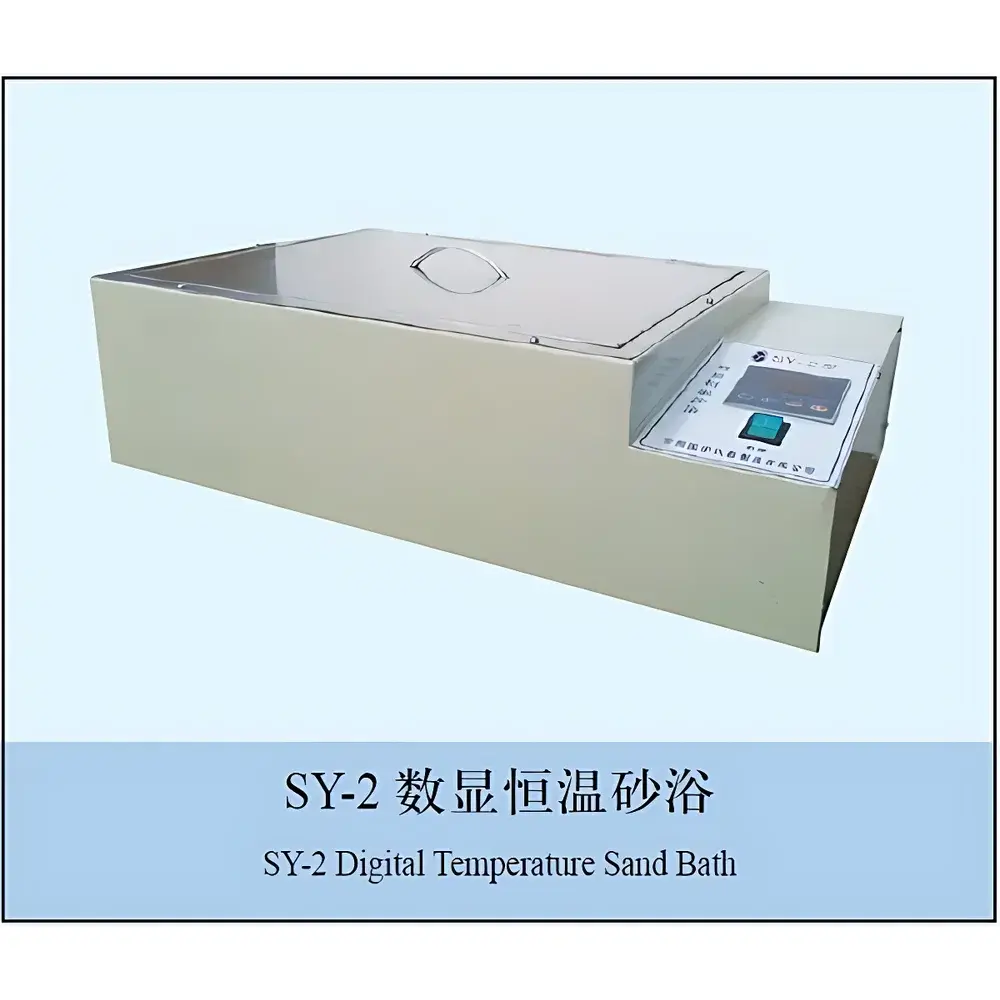
CZGY SY-2 Digital Display Constant-Temperature Sand Bath
| Brand | CZGY |
|---|---|
| Origin | Jiangsu, China |
| Manufacturer Type | Direct Manufacturer |
| Product Category | Domestic |
| Model | SY-2 |
| Instrument Type | Constant-Temperature Bath |
| Circulation Function | None |
| Temperature Control | Heating-Only |
| Bath Chamber Dimensions | 400 × 300 × 120 mm |
| Temperature Range | Ambient to 300 °C |
| Temperature Stability | ±1 °C |
| Temperature Resolution | 1 °C |
| Input Power | 2000 W |
| Supply Voltage | 220 V, 50 Hz |
Overview
The CZGY SY-2 Digital Display Constant-Temperature Sand Bath is a robust, benchtop thermal platform engineered for precise, uniform heating of samples in solid-phase media—primarily dry sand or ceramic beads—within laboratory and analytical settings. Unlike water or oil baths, the SY-2 leverages the high thermal inertia and wide operational range of granular solid media to deliver stable, contamination-free heating up to 300 °C. Its operation is based on resistive heating of an embedded heating element beneath a stainless-steel working chamber, coupled with PID-controlled digital temperature regulation. This architecture eliminates fluid volatility, oxidation risk, and evaporation loss—making it especially suitable for applications requiring prolonged exposure to elevated temperatures without liquid-phase interference. Designed as a direct evolution of the DB-series electric hotplate, the SY-2 integrates enhanced thermal uniformity, real-time dual-display monitoring (actual vs. setpoint), and fail-safe grounding compliance for routine QC, sample preparation, gravimetric analysis, and pre-concentration workflows.
Key Features
- Dual-line LED display: Upper row shows real-time chamber temperature; lower row displays user-defined setpoint—enabling immediate visual verification of thermal status.
- PID-based digital temperature controller with 1 °C resolution and ±1 °C stability across the full 20–300 °C operating range (ambient referenced).
- Stainless-steel working chamber (400 × 300 × 120 mm) offering corrosion resistance, mechanical durability, and compatibility with aggressive solvents or acidic residues during post-run cleaning.
- 2000 W high-power heating system optimized for rapid thermal ramp-up and sustained plateau performance—even under heavy thermal load conditions.
- No-circulation design ensures passive, conduction-dominated heat transfer—ideal for batch processing of multiple vessels (e.g., crucibles, evaporating dishes, digestion tubes) placed directly into heated sand.
- Integrated “OUT” status indicator confirms active heating phase, supporting procedural traceability in GLP-aligned environments.
Sample Compatibility & Compliance
The SY-2 accommodates standard laboratory vessels—including porcelain crucibles, quartz boats, stainless-steel digestion cups, and borosilicate glassware—when embedded in thermally stable sand or inert ceramic media. It supports ASTM E145 (Standard Specification for Gravity-Convection and Forced-Ventilation Ovens) and ISO 17025-relevant thermal validation protocols when used within documented SOPs. While not intrinsically certified for hazardous location use, its grounded 220 V/50 Hz configuration complies with IEC 61010-1 safety requirements for laboratory electrical equipment. The absence of circulating fluid eliminates cross-contamination risks—critical for trace-metal analysis (e.g., EPA Method 3050B), ash content determination (AOAC 923.03), and solvent-free evaporation steps in pharmaceutical residual solvent testing (ICH Q3C).
Software & Data Management
The SY-2 operates via embedded firmware with no external software dependency. All control logic resides in the onboard microcontroller, ensuring deterministic response and immunity to PC interface failures. Temperature setpoints, real-time readings, and heater activation status are retained locally without volatile memory—supporting audit-ready manual log entries. For laboratories implementing 21 CFR Part 11 compliance, optional external data loggers (e.g., calibrated thermocouple-based USB recorders) may be deployed to capture time-stamped temperature profiles, satisfying ALCOA+ data integrity principles. No cloud connectivity or proprietary drivers are required—aligning with air-gapped lab network policies.
Applications
- Gravimetric moisture and ash content analysis per AOAC, USP & ISO standards.
- Pre-concentration of environmental water samples prior to ICP-MS or AAS analysis.
- Thermal decomposition of organic matrices in soil and sediment testing.
- Drying and conditioning of filter papers, desiccants, and reference standards.
- Controlled evaporation of high-boiling-point solvents (e.g., DMF, NMP, ethylene glycol) where oil bath degradation is a concern.
- Pre-heating of reaction vessels prior to insertion into furnaces or microwave digesters.
FAQ
Is the SY-2 suitable for heating liquids directly in the chamber?
Yes—though designed primarily for sand-mediated heating, the stainless-steel chamber permits direct placement of beakers or flasks containing aqueous or organic liquids. However, users must ensure vessel stability and avoid overflow during thermal expansion.
What safety certifications does the unit carry?
The SY-2 conforms to IEC 61010-1:2010 for laboratory electrical equipment. It requires connection to a dedicated 20 A grounded circuit with RCD/GFCI protection, as specified in the installation manual.
Can temperature calibration be performed onsite?
Yes—using a NIST-traceable reference thermometer inserted into the sand bed at working depth, users may verify and adjust offset values via the SET key sequence per manufacturer’s calibration procedure.
Does the unit support programmable ramp-soak profiles?
No—the SY-2 implements single-setpoint thermostatic control only. For multi-stage thermal protocols, external timer relays or programmable logic controllers (PLCs) must be integrated into the power supply line.
What maintenance is recommended for long-term reliability?
Annual inspection of heating element continuity, terminal screw torque, and chamber surface integrity is advised. Sand media should be periodically sieved and dried to prevent moisture-induced thermal lag or localized hotspots.



