
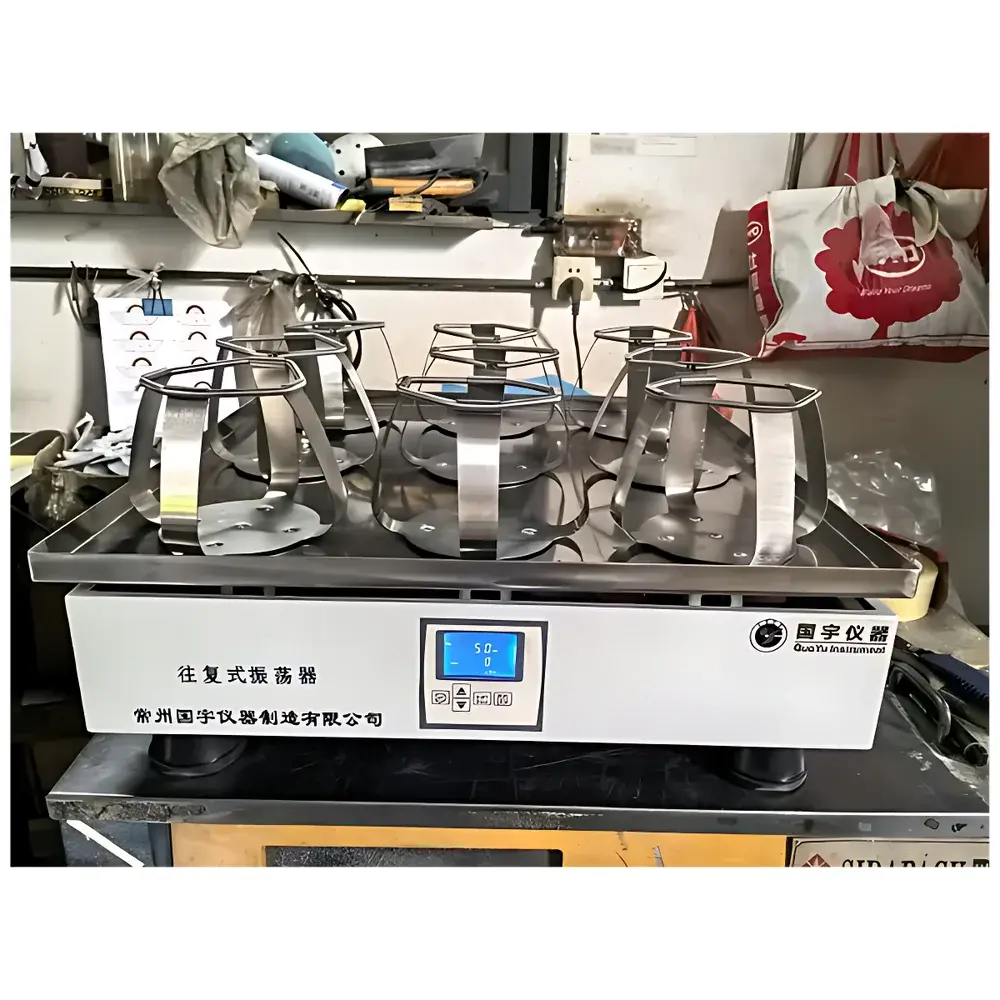
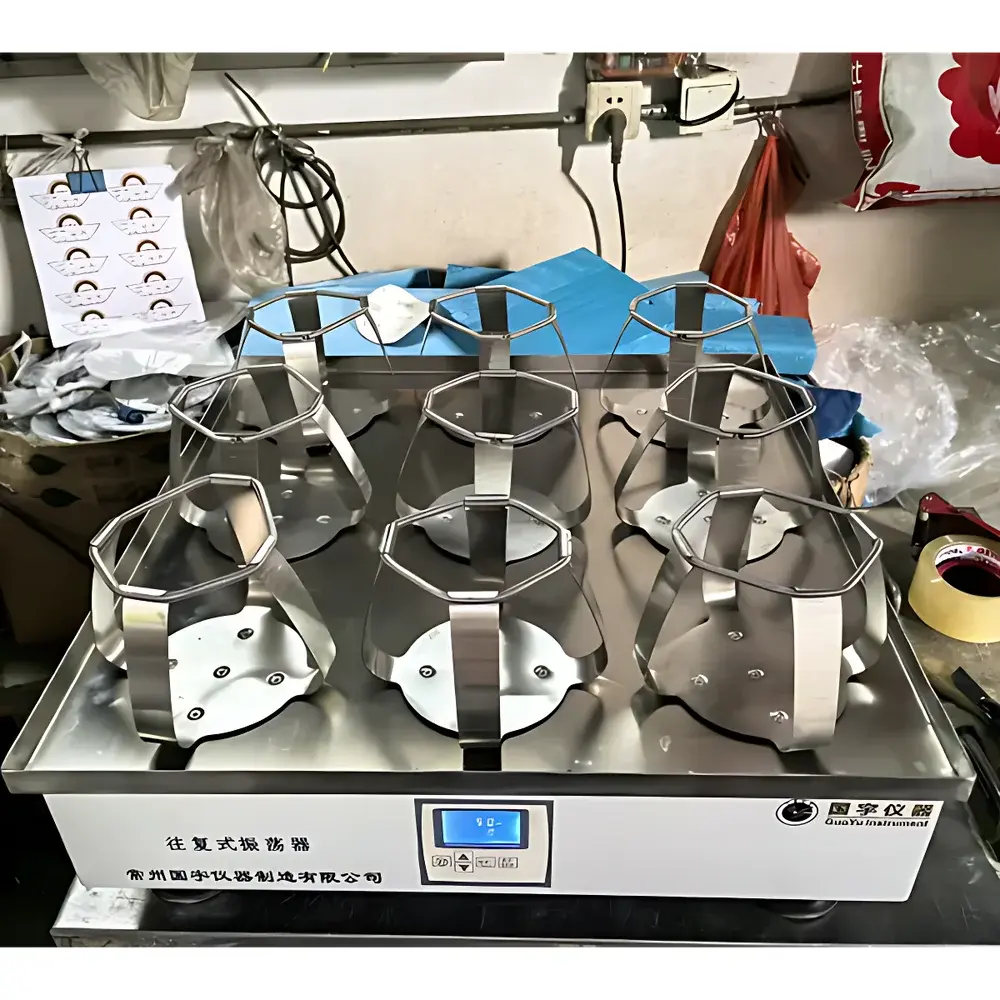
CZGY ZW-08A9 Horizontal Shaker for Toxicity Characterization of Solid Waste
| Brand | CZGY |
|---|---|
| Origin | Jiangsu, China |
| Manufacturer Type | Direct Manufacturer |
| Model | ZW-08A9 |
| Timer Range | 0–9999 seconds/minutes/hours (user-selectable) |
| Oscillation Frequency | 30–200 rpm |
| Stroke Amplitude | 40 mm (reciprocating) |
| Platform Quantity | 1 |
| Drive Motor | Brushless DC motor |
| Speed Accuracy | ±1 rpm |
| Platform Material | Stainless steel |
| Housing Material | Powder-coated cold-rolled steel |
| Compatible Vessels | Nine 2 L PE bottles (standard configuration) |
| Compliance | HJ 557–2010, HJ/T 299–2007 (as referenced in solid waste leaching protocols) |
Overview
The CZGY ZW-08A9 Horizontal Shaker is an engineered laboratory instrument designed specifically to perform standardized leaching procedures for toxicity characterization of solid waste matrices under controlled mechanical agitation. It operates on the principle of horizontal reciprocating motion—generating consistent, reproducible shear and mass-transfer conditions across sample containers—to simulate field-relevant leaching dynamics as defined by the People’s Republic of China Environmental Protection Standard HJ 557–2010: Leaching Procedure for Toxicity Identification of Solid Waste – Horizontal Oscillation Method. This method is foundational for regulatory classification of hazardous waste, supporting compliance with national environmental management frameworks including the Technical Specification for Identification of Hazardous Waste (HJ 298) and supplementary guidance issued by the Ministry of Ecology and Environment (MEE). The shaker’s mechanical architecture ensures uniform energy input across all vessel positions, minimizing inter-sample variability—a critical requirement for GLP-aligned environmental testing laboratories conducting waste characterization, landfill leachate risk assessment, or remediation feasibility studies.
Key Features
- Brushless DC motor drive system delivering stable rotational output across the full 30–200 rpm range, with speed accuracy maintained within ±1 rpm under load; eliminates carbon brush wear, enabling uninterrupted operation over extended test durations (e.g., 18-hour or 24-hour leaching cycles).
- Single stainless-steel oscillation platform (40 mm stroke amplitude, reciprocating motion), precisely calibrated to meet HJ 557–2010 mechanical specification requirements for displacement consistency and waveform fidelity.
- LCD-based control interface with intuitive menu navigation, supporting timer programming in seconds, minutes, or hours (0–9999 units per selection); real-time display of elapsed time and set parameters enhances protocol traceability.
- Powder-coated cold-rolled steel enclosure with corrosion-resistant internal components; stainless-steel platform and custom-fitted clamps ensure long-term durability in humid or chemically aggressive environments typical of environmental testing labs.
- Standard configuration accommodates nine 2 L polyethylene (PE) leaching vessels—compatible with alternative container types including borosilicate glass and PTFE bottles—as specified in HJ 557–2010 Annex A.
Sample Compatibility & Compliance
The ZW-08A9 is validated for use with heterogeneous solid-phase samples—including municipal solid waste, industrial slags, contaminated soils, fly ash, and construction/demolition debris—when processed according to EPA SW-846 Method 1311 (TCLP) analogs and Chinese national standards. Its platform geometry and clamp design maintain secure vessel positioning during prolonged agitation, preventing leakage or cross-contamination. All operational parameters—including oscillation frequency, stroke length, and runtime—are directly traceable to HJ 557–2010 Section 6 (Apparatus Requirements) and HJ/T 299–2007 (for pH-dependent leaching variants). While not certified to ISO/IEC 17025 calibration standards out-of-box, the unit supports third-party verification per CNAS-CL01:2018 requirements when integrated into accredited laboratory quality systems.
Software & Data Management
The ZW-08A9 operates as a standalone hardware platform without embedded data logging or network connectivity. However, its deterministic timer and fixed-speed control architecture facilitate integration into externally managed QA/QC workflows. Laboratories implementing electronic recordkeeping may document run parameters (start time, duration, rpm setting, vessel ID) manually or via LIMS-compatible entry forms. For audit readiness, users are advised to retain hard-copy logs alongside raw analytical data from subsequent ICP-MS, AAS, or IC analyses—ensuring full chain-of-custody alignment with GB/T 27025–2019 (equivalent to ISO/IEC 17025) documentation expectations.
Applications
- Determination of leachable concentrations of heavy metals (e.g., Pb, Cd, Cr, As, Hg), cyanide, fluoride, and semi-volatile organics from solid waste streams.
- Supporting hazardous waste identification per China’s Directory of Hazardous Wastes (2021 Edition), particularly for wastes listed under HW17, HW21, HW22, and HW48 categories.
- Pre-treatment agitation step prior to filtration and instrumental analysis in accordance with HJ 442.4–2020 (marine environmental monitoring) and HJ 613–2011 (soil pollution surveys).
- Method development and validation studies for alternative leaching protocols, including pH-stat or sequential extraction schemes requiring precise mechanical input control.
- Academic research in environmental geochemistry, landfill bioreactor modeling, and contaminant transport kinetics where reproducible boundary-condition simulation is essential.
FAQ
Does the ZW-08A9 comply with international standards such as EPA Method 1311 or ISO 11268?
The instrument meets mechanical specifications outlined in HJ 557–2010, which is functionally aligned with EPA TCLP (Method 1311) and ISO 11268-1 for horizontal agitation—but formal equivalency requires method-specific validation by the end user per their accreditation scope.
Can the shaker accommodate non-standard bottle sizes or custom fixtures?
Yes; while shipped with nine 2 L PE bottle clamps, the stainless-steel platform accepts user-supplied fixtures compatible with M6 threaded mounting points (center-to-center spacing: 120 mm). Engineering drawings available upon request for OEM integration.
Is routine calibration required, and what maintenance intervals are recommended?
No periodic recalibration is mandated; however, annual verification of speed accuracy (using a certified tachometer) and mechanical integrity (guide rail lubrication, clamp torque check) is advised per GB/T 33589–2017 guidelines for laboratory equipment maintenance.
What power supply and environmental conditions are required for safe operation?
Operates on 220 V AC ±10%, 50 Hz; ambient temperature range: 5–40 °C; relative humidity ≤80% RH (non-condensing). Installation requires level, vibration-dampened benchtop surface with ≥10 cm rear clearance for heat dissipation.
Is remote monitoring or Ethernet connectivity supported?
No native digital interface is provided; the device is designed for manual operation in regulated environments where simplicity and reliability supersede automation—consistent with common practice in Chinese provincial environmental monitoring centers.




