

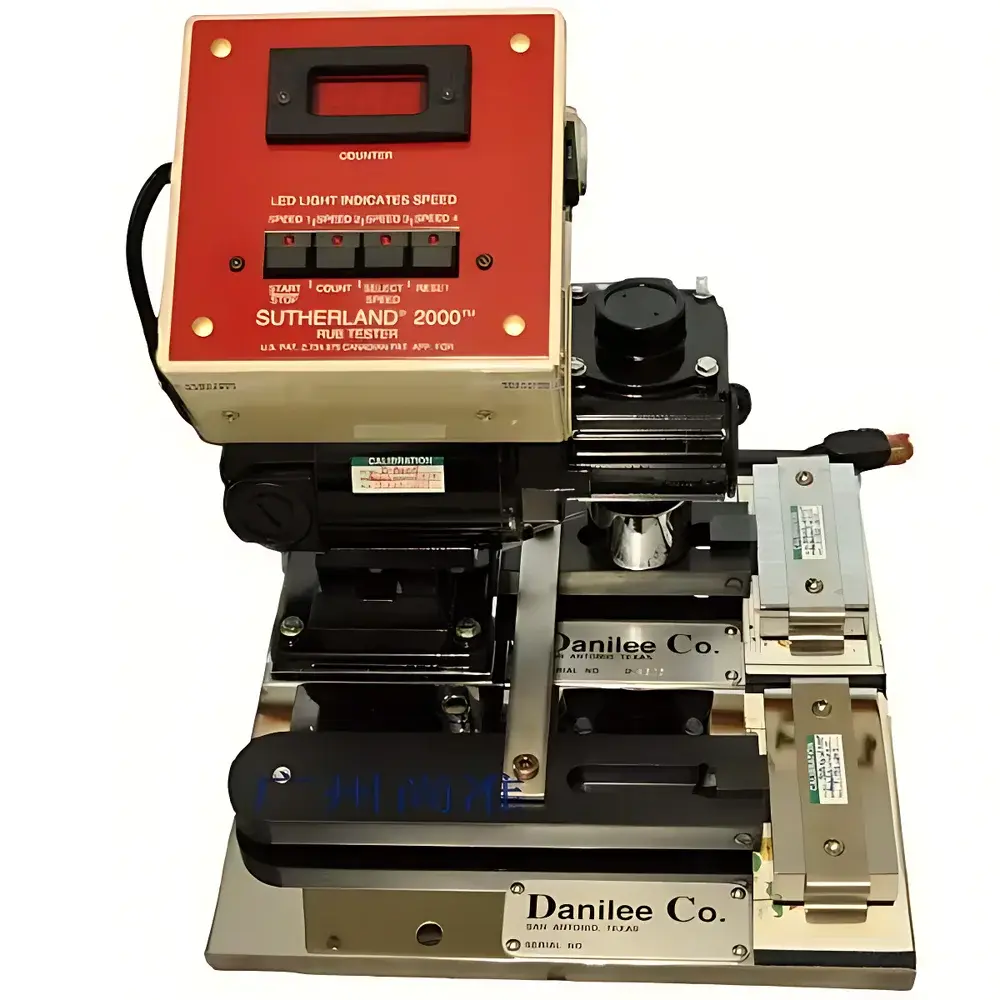
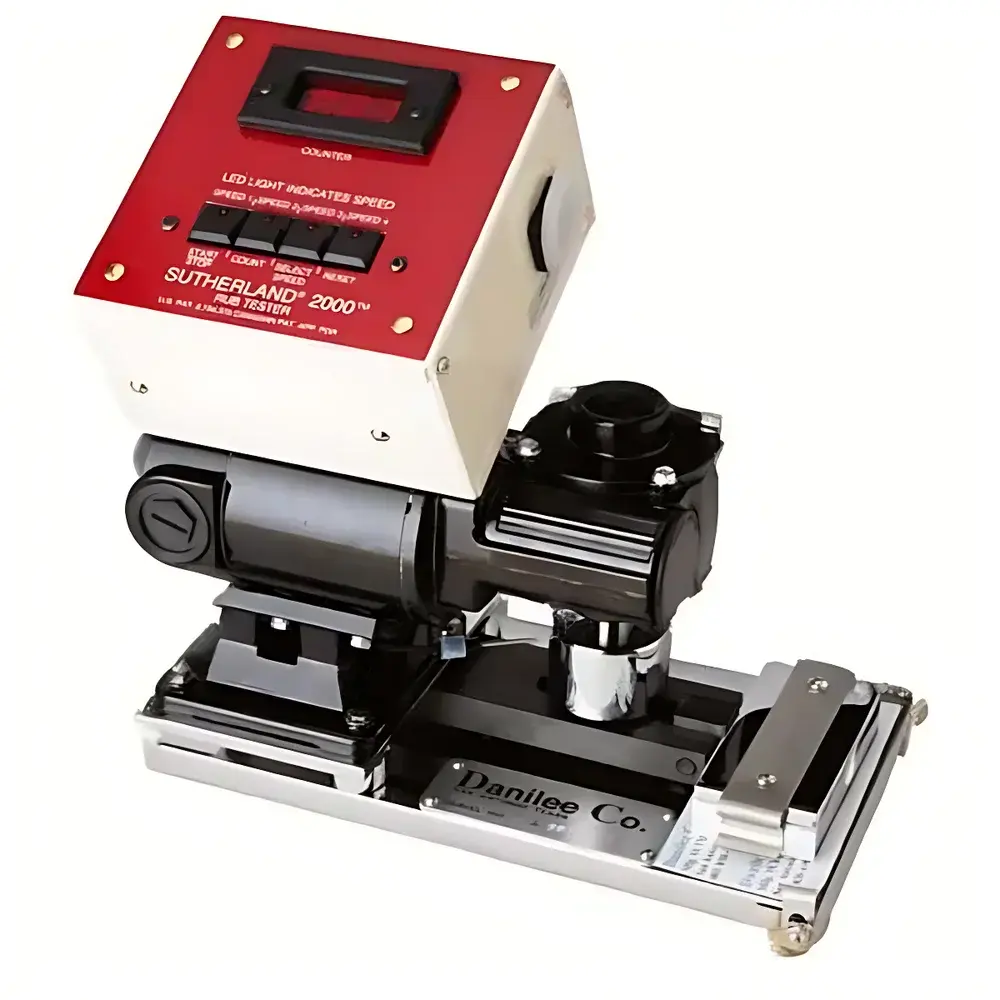
Danilee Sutherland 2000 Dual-Head Abrasion Tester
| Brand | Danilee |
|---|---|
| Origin | USA |
| Model | Sutherland 2000 |
| Speeds | 21, 42, 85, 106 cycles/min |
| Load Options | 0.9 kg (2 lb), 1.8 kg (4 lb), optional 20 N weight |
| Compliance | ASTM D5264–92, GB/T 7705–2008 |
| Display | LCD with preset cycle counter |
| Power | 220 V, 50/60 Hz, single-phase, 2 A |
| Dimensions | 15 × 15 × 12 in |
| Net Weight | 42 lb |
| Test Modes | Dry rub, wet rub, wet smudge/transfer, wet smear, functional abrasion |
Overview
The Danilee Sutherland 2000 Dual-Head Abrasion Tester is a precision-engineered instrument designed for quantitative evaluation of ink adhesion and surface durability on printed packaging substrates—including paper, paperboard, corrugated board, and flexible films. Based on the established Sutherland rub test principle—where controlled reciprocating motion simulates real-world mechanical wear—the instrument applies standardized linear abrasion via weighted test fingers moving in an arc across the printed surface. This method quantifies resistance to scuffing, smudging, color transfer, and delamination under reproducible mechanical stress. Developed over seven decades by Danilee (USA), the Sutherland 2000 represents the current evolution of the industry-recognized Sutherland 2000 platform, retaining full backward compatibility with legacy test protocols while introducing enhanced operational flexibility through four discrete motor-driven stroke frequencies.
Key Features
- Dual-head configuration enables simultaneous testing of two identical or dissimilar samples under identical load and motion parameters—improving throughput and inter-sample comparability.
- Four selectable stroke speeds: 21, 42, 85, and 106 cycles per minute—supporting both low-force “wet” evaluations (e.g., freshly printed or solvent-wetted surfaces) and high-intensity dry abrasion protocols.
- LCD interface with programmable cycle counter and automatic shutdown upon completion—ensuring repeatability and eliminating operator-dependent timing errors.
- Standard dual-weight set: 0.9 kg (2 lb) and 1.8 kg (4 lb) stainless-steel test fingers; optional 20 N calibrated weight available for compliance with GB/T 7705–2008 (Chinese national standard for offset decorative printing).
- Modular design accommodates accessory integration—including heated test fingers for temperature-controlled abrasion studies and custom-mass weights for application-specific force calibration.
- Robust cast-aluminum frame and sealed stepper motor drive ensure long-term mechanical stability and minimal maintenance across high-volume QC environments.
Sample Compatibility & Compliance
The Sutherland 2000 is optimized for flat, rigid, or semi-rigid sheet specimens up to 15 × 15 inches. It accommodates standard press sheets, cut packaging blanks, laminated labels, and coated folding cartons without sample clamping fixtures—relying instead on gravity-based contact pressure. The instrument meets the geometric and kinematic requirements of ASTM D5264–92 (“Standard Practice for Determining Ink Rub Resistance of Printed Materials Using the Sutherland Rub Tester”), ensuring data interoperability across global packaging laboratories. For regulatory alignment in China, the optional 20 N weight satisfies the nominal normal force requirement specified in GB/T 7705–2008. While not intrinsically compliant with FDA 21 CFR Part 11, audit-ready operation is achievable when integrated into validated laboratory workflows that include electronic logbooks, user access controls, and manual record retention per GLP/GMP documentation practices.
Software & Data Management
The Sutherland 2000 operates as a standalone electromechanical system with no embedded firmware or network connectivity. All test parameters—including speed selection, cycle count, and weight configuration—are set manually via front-panel controls. Results are recorded externally using standardized lab notebooks or LIMS-integrated templates. Users may document outcomes as qualitative assessments (e.g., visual grading per ASTM D2244 or ISO 105-X12) or quantitative metrics (e.g., ΔE*ab color shift measured post-abrasion using a spectrophotometer). For laboratories requiring digital traceability, third-party data acquisition modules can be interfaced via analog output signals (0–5 V) corresponding to motor status and cycle completion pulses—enabling synchronization with time-stamped instrument logs.
Applications
- Evaluation of ink set-off resistance during stack storage and transport.
- Validation of UV-curable, water-based, and solvent-based ink formulations for flexographic, gravure, and offset printing processes.
- Quality control of varnish, aqueous coating, and lamination adhesion integrity on folding cartons and labels.
- Comparative assessment of substrate surface energy treatments (e.g., corona, flame, plasma) on printability and post-print durability.
- Development testing of anti-scratch topcoats for premium retail packaging and pharmaceutical blister cards.
- Root-cause analysis of print marring in high-speed packaging line trials.
FAQ
What standards does the Sutherland 2000 directly support?
ASTM D5264–92 is the primary referenced standard; GB/T 7705–2008 compliance is enabled via the optional 20 N weight.
Can the instrument perform tests at elevated temperatures?
Yes—when equipped with the optional heated test finger accessory, which maintains stable surface temperatures between 25 °C and 60 °C during abrasion cycles.
Is calibration certification provided with the unit?
The base instrument ships with factory verification of stroke frequency accuracy and weight tolerance; NIST-traceable calibration certificates are available as a separate service.
How is sample wear assessed after testing?
Visual evaluation using standardized grayscale rating scales (e.g., ISO 105-X12) or instrumental measurement via spectrophotometry, glossmetry, or microscopic imaging.
Does the dual-head design allow for different test conditions on each head?
No—both heads operate synchronously at the same speed and load; independent parameter control requires two separate units.






