Dantec Dynamics EduPIV Educational Particle Image Velocimetry System
| Brand | Dantec Dynamics |
|---|---|
| Origin | Denmark |
| Manufacturer Status | Authorized Distributor |
| Origin Category | Imported |
| Model | 81X30 |
| Measurement Capability | Planar (2D/3D) |
| Frame Rate | >100 Hz |
| Velocity Range | 0–0.5 m/s |
| Accuracy | ±1% of full scale |
| Measurement Area | 190 mm × 120 mm |
| Illumination Source | High-power pulsed LED array with fiber-coupled lens system |
| Camera | FlowSense USB 2M-165 (2 MP, global shutter, 165 fps @ full resolution) |
| Synchronization | Software-controlled via DynamicStudio v7.x |
| Data Acquisition & Analysis | DynamicStudio PIV software suite |
Overview
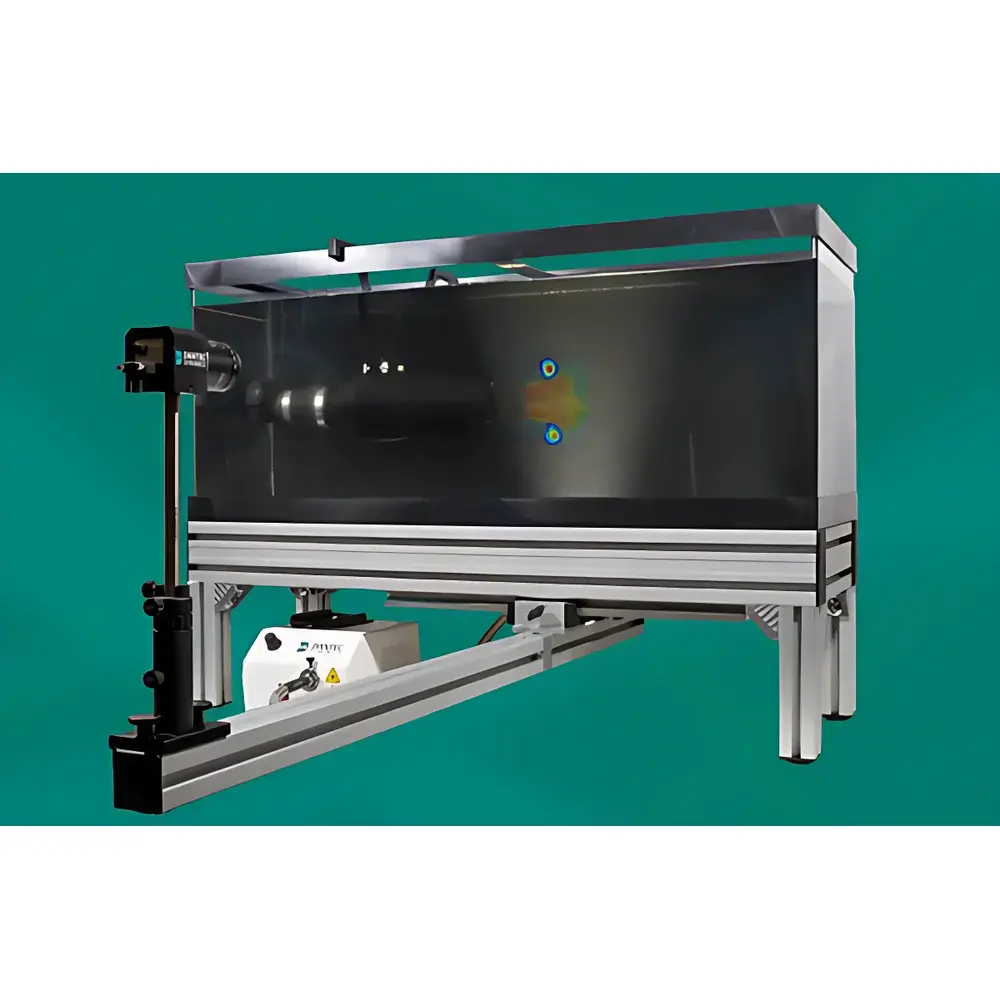
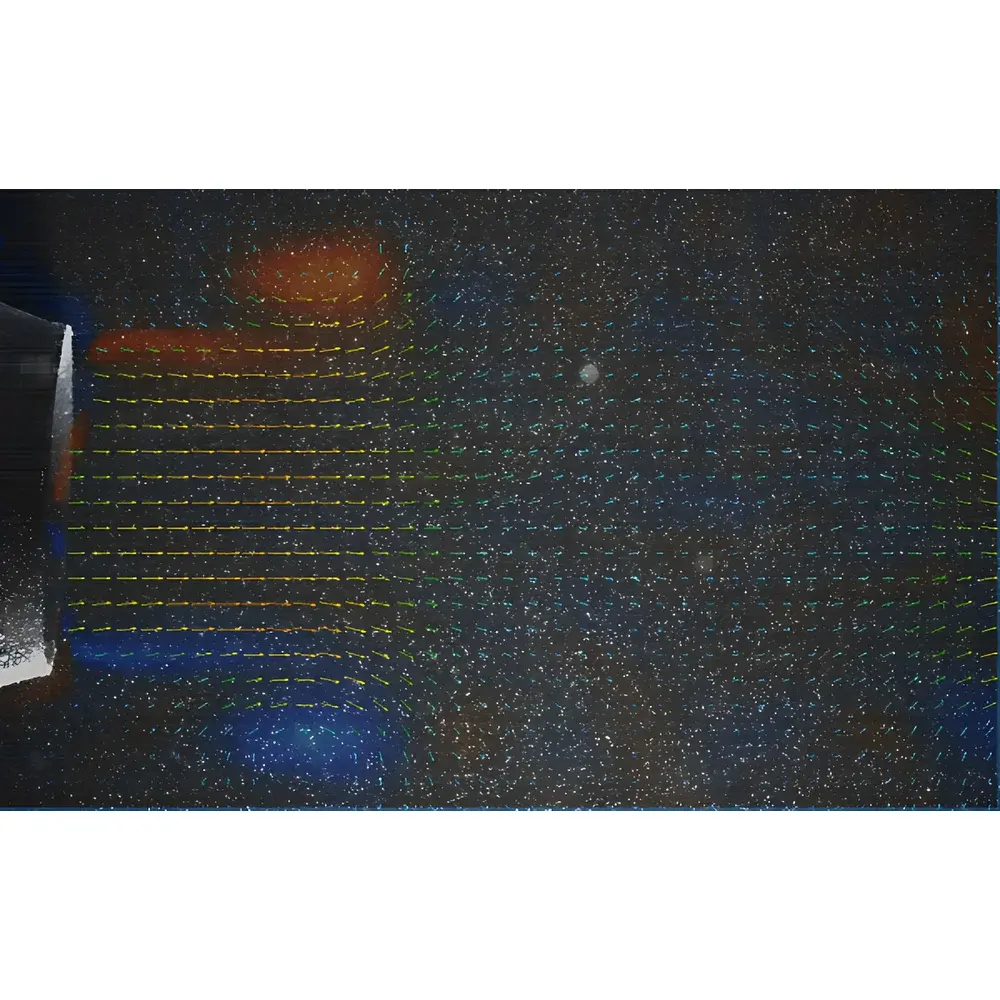
The Dantec Dynamics EduPIV Educational Particle Image Velocimetry System is a purpose-engineered teaching platform designed to introduce undergraduate and graduate students to the foundational principles and practical implementation of planar particle image velocimetry (PIV). Unlike research-grade laser-based PIV systems, the EduPIV employs a high-intensity, synchronized pulsed LED illumination source coupled with a fiber-optic lens assembly—eliminating laser safety hazards while preserving optical coherence sufficient for reliable sub-pixel displacement estimation. The system operates on the core principle of cross-correlation analysis: two consecutive short-exposure images of tracer-seeded flow are acquired; local intensity patterns (associated with micron-scale seeding particles) are tracked between frames to compute instantaneous velocity vectors across the illuminated measurement plane. This enables quantitative, non-intrusive, time-resolved mapping of two-dimensional, two-component (2D2C) velocity fields—ideal for visualizing laminar-to-turbulent transition, jet development, vortex shedding, and boundary layer behavior in controlled hydrodynamic experiments.
Key Features
- Integrated educational workflow: Pre-aligned optical path, plug-and-play camera interface, and pre-configured DynamicStudio acquisition templates reduce setup time from hours to minutes.
- Safety-optimized illumination: Pulsed high-brightness LED array (peak wavelength 530 nm) replaces Class IV lasers—compliant with IEC 60825-1 for classroom deployment without dedicated laser safety officers or interlocked enclosures.
- Dedicated experimental loop: Modular water tank circuit featuring programmable peristaltic pump (flow rate range: 0.1–5 L/min), interchangeable nozzles (0.5–3 mm diameter), and quick-connect fittings for rapid reconfiguration between jet, wake, and mixing-layer configurations.
- Validated tracer compatibility: Optimized for use with polyamide PSP particles (10–20 µm diameter, ρ ≈ 1.03 g/cm³), ensuring near-neutral buoyancy and faithful flow-following response up to 100 Hz temporal resolution.
- Real-time feedback capability: DynamicStudio supports live correlation map preview, interrogation window sizing, and adaptive peak-locking algorithms—enabling immediate assessment of signal-to-noise ratio and seeding density adequacy during lab sessions.
Sample Compatibility & Compliance
The EduPIV system is validated for transparent Newtonian fluids (e.g., water, glycerol-water mixtures) at room temperature (20–25 °C) and atmospheric pressure. It supports both passive seeding (PSP particles) and optional fluorescent tracer integration for selective-plane excitation in multi-phase or layered flows. All hardware components comply with CE marking requirements under the EU Machinery Directive 2006/42/EC and EMC Directive 2014/30/EU. DynamicStudio software adheres to ISO/IEC 17025:2017 guidelines for data integrity in educational metrology applications, and includes audit-trail logging for all processing parameters (interrogation window size, overlap ratio, validation thresholds) to support GLP-aligned laboratory reporting standards.
Software & Data Management
DynamicStudio v7.4 serves as the unified acquisition, processing, and visualization environment. It provides native support for batch processing of time-series PIV data, export of velocity fields in HDF5 and ASCII formats, and direct integration with MATLAB and Python (via PyPIV-compatible APIs). Built-in modules enable calculation of derived quantities—including vorticity, Reynolds stress tensors, turbulent kinetic energy spectra, and Lagrangian coherent structures—without requiring external post-processing scripts. All raw image sequences and processed vector fields are stored with embedded metadata (timestamp, pump RPM, nozzle ID, ambient temperature), ensuring traceability across student groups and academic terms. Software licensing includes perpetual academic use rights and annual minor-version updates.
Applications
- Undergraduate fluid mechanics labs: Quantitative verification of Bernoulli’s equation, continuity principle, and momentum conservation in confined jets and orifice flows.
- Graduate turbulence courses: Experimental characterization of integral length scales, energy cascade rates, and intermittency factors in grid-generated turbulence.
- Multiphysics education: Coupling with thermal imaging or pressure-sensitive paint (PSP) systems to explore velocity–pressure–temperature correlations in convective heat transfer.
- Capstone design projects: Development of custom nozzle geometries, active flow control actuators, or AI-assisted PIV preprocessing pipelines using open DynamicStudio SDK.
- Research readiness training: Standardized protocols aligned with ASTM D7504-22 (“Standard Practice for PIV-Based Velocity Field Measurement in Fluid Flows”) prepare students for industrial or national lab internships.
FAQ
Is laser safety certification required to operate the EduPIV system?
No. The LED-based illumination system meets Class 1 LED safety requirements per IEC 62471, eliminating the need for laser safety training, controlled access zones, or protective eyewear.
Can the system be upgraded to true 3D3C measurements?
Yes—through optional stereo PIV add-ons (dual-camera head kit, calibration target, and stereo reconstruction module), enabling out-of-plane velocity component resolution with <5% uncertainty under optimal seeding conditions.
What is the minimum recommended working distance between the lens and measurement plane?
The standard fiber-coupled lens assembly is optimized for a 300 mm working distance, yielding uniform illumination intensity (±8%) across the full 190 mm × 120 mm field of view.
Does DynamicStudio support automated calibration against NIST-traceable targets?
Yes—the software includes a certified calibration routine compliant with ISO 16063-31, supporting both single-point and multi-grid target registration with uncertainty propagation reporting.
Are teaching materials and lab manuals included?
Yes—each system ships with a comprehensive instructor guide (12 structured experiments), student worksheets, pre-recorded benchmark datasets, and editable PowerPoint lecture slides aligned with ABET-accredited curriculum outcomes.