
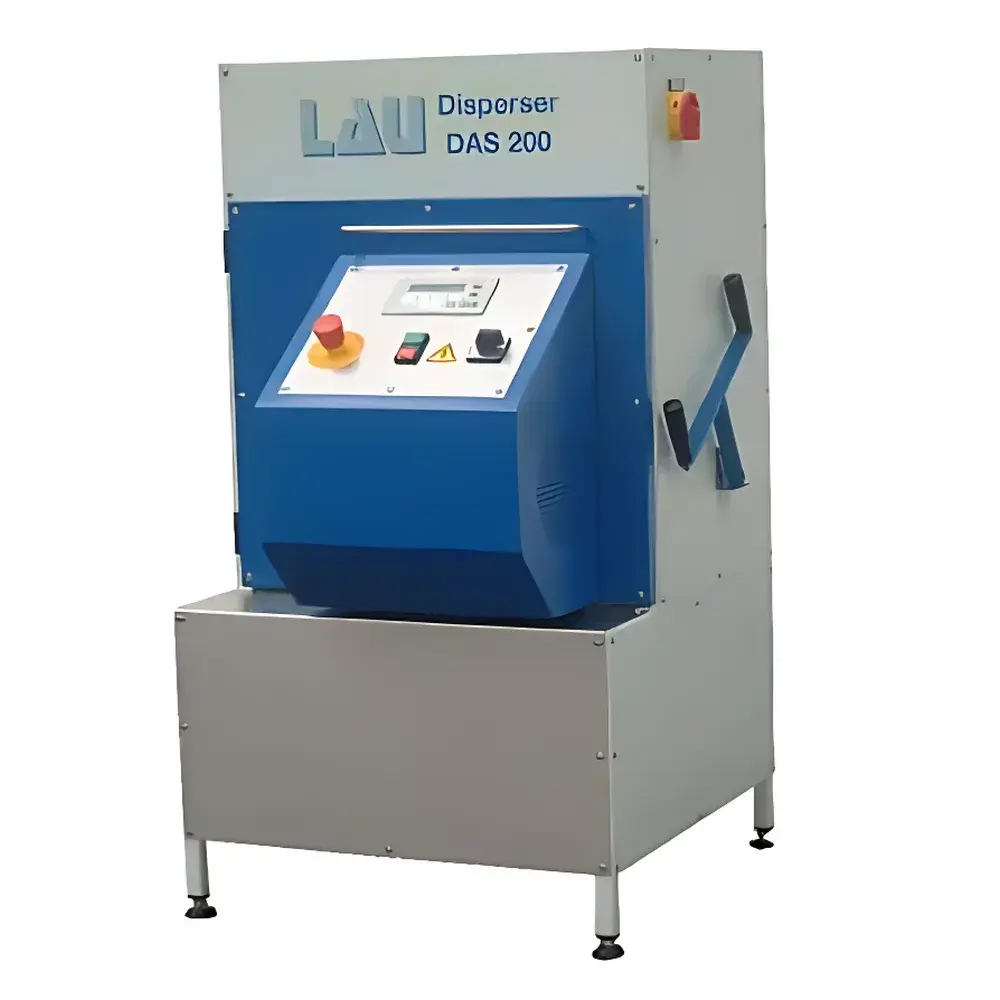
DAS 200 High-Shear Laboratory Dispersion Mixer
| Origin | Germany |
|---|---|
| Manufacturer Type | Authorized Distributor |
| Origin Category | Imported |
| Model | DAS 200 |
| Pricing | Available Upon Request |
Overview
The DAS 200 High-Shear Laboratory Dispersion Mixer is an engineered solution for reproducible, scalable dispersion of pigments, fillers, and functional additives in liquid media—primarily formulated for coatings, inks, paints, and polymer-based suspensions. It operates on the principle of high-speed rotor-stator shear, generating intense hydrodynamic forces that overcome interparticle van der Waals attraction and agglomerate binding energy. Unlike simple stirrers or magnetic mixers, the DAS 200 delivers controlled energy input through a precision-machined dispersing disc rotating at up to 6,000 rpm, enabling deagglomeration down to sub-micron particle distributions while maintaining thermal stability during extended processing cycles.
Key Features
- Compliance with DIN 53238-13: Fully conforms to the German industrial standard for pigment dispersion testing in printing inks, ensuring methodological consistency for quality control and R&D validation.
- Integrated active cooling system: A built-in axial fan continuously circulates ambient air across the motor housing and drive shaft assembly, preventing thermal drift during prolonged operation—critical for heat-sensitive resins, UV-curable systems, and low-Tg acrylic dispersions.
- Modular dispersing head design: Interchangeable dispersing discs (standard 20 mm diameter, optional 12 mm and 30 mm variants) allow optimization of shear rate and energy density based on batch volume (50–500 mL), viscosity range (up to 10,000 mPa·s), and target particle size distribution.
- Robust mechanical architecture: Stainless steel housing, IP54-rated enclosure, and brushless DC motor ensure long-term operational reliability under laboratory and pilot-scale conditions.
- Digital speed control with real-time RPM feedback: Precise adjustment from 1,000 to 6,000 rpm in 100-rpm increments; speed stability ±1% over full load range.
Sample Compatibility & Compliance
The DAS 200 accommodates a broad spectrum of non-hazardous, non-explosive liquid-phase formulations including water-based acrylic dispersions, solvent-borne nitrocellulose inks, epoxy resin pastes, and nano-pigmented UV-curable monomers. It supports sample containers ranging from standard DIN 53238-13 test cups (50 mL) to cylindrical glass beakers (100–500 mL) with depth-to-diameter ratios optimized for vortex suppression. All wetted parts are chemically resistant to common solvents (e.g., ethyl acetate, isopropanol, xylene) and alkaline aqueous media (pH 3–12). The instrument meets CE marking requirements and complies with EN 61000-6-2 (EMC immunity) and EN 61000-6-3 (EMC emission) standards. While not intrinsically safe, it is suitable for use in general laboratory environments operating under ISO/IEC 17025-accredited quality management systems.
Software & Data Management
The DAS 200 operates as a standalone benchtop unit with no embedded software or data logging capability. However, its analog tachometer output (0–10 V DC proportional to RPM) enables integration with external DAQ systems (e.g., National Instruments USB-6009, LabVIEW-based acquisition platforms) for time-synchronized recording of rotational speed, process duration, and auxiliary temperature sensor inputs. For GLP/GMP-aligned workflows, users may implement manual logbook entries or integrate the device into validated electronic lab notebook (ELN) systems using standardized SOP templates referencing DIN 53238-13 test protocols. Audit trails, user access control, and electronic signatures are managed externally—consistent with FDA 21 CFR Part 11 compliance frameworks when deployed within regulated QC laboratories.
Applications
- Routine dispersion optimization for OEM ink formulation, including cyan/magenta/yellow/black (CMYK) pigment systems and specialty effect pigments (e.g., aluminum flakes, pearlescent micas).
- Preparation of reference dispersions for particle size analysis (e.g., laser diffraction via Malvern Mastersizer, dynamic light scattering via Zetasizer).
- Stability assessment of nanocomposite coatings by correlating dispersion time with post-processing viscosity recovery and sedimentation behavior.
- QC release testing of incoming pigment batches against internal specifications derived from DIN 53238-13 gloss and rub-off performance metrics.
- Method development for scale-up to production-scale high-shear mixers (e.g., Silverson L4R, IKA Ultra-Turrax T25), leveraging the DAS 200’s defined power input per unit mass (kW/kg) and tip speed (m/s) parameters.
FAQ
Is the DAS 200 suitable for abrasive pigment systems such as titanium dioxide or carbon black?
Yes—when used with hardened stainless steel dispersing discs and appropriate container geometry, it achieves consistent deagglomeration of high-density, high-hardness pigments without measurable disc wear over typical R&D batch lifetimes.
Can the DAS 200 be operated under inert atmosphere?
Not natively; the unit lacks gas purge ports or sealed vessel interfaces. However, compatible vacuum-sealed jacketed beakers with gas inlet/outlet fittings can be mounted externally, provided mechanical stability and clearance around the dispersing shaft are maintained.
Does the DAS 200 support variable torque measurement?
No—it is a speed-controlled, constant-power device without integrated torque sensing. For rheological characterization, pairing with a separate rotational viscometer (e.g., Brookfield DVNext) before and after dispersion is recommended.
What maintenance intervals are specified for the motor and bearing assembly?
The brushless DC motor requires no scheduled lubrication. Annual inspection of shaft runout (<0.05 mm) and fan airflow integrity is advised; full service is recommended every 3,000 operating hours or biannually, whichever occurs first.



