
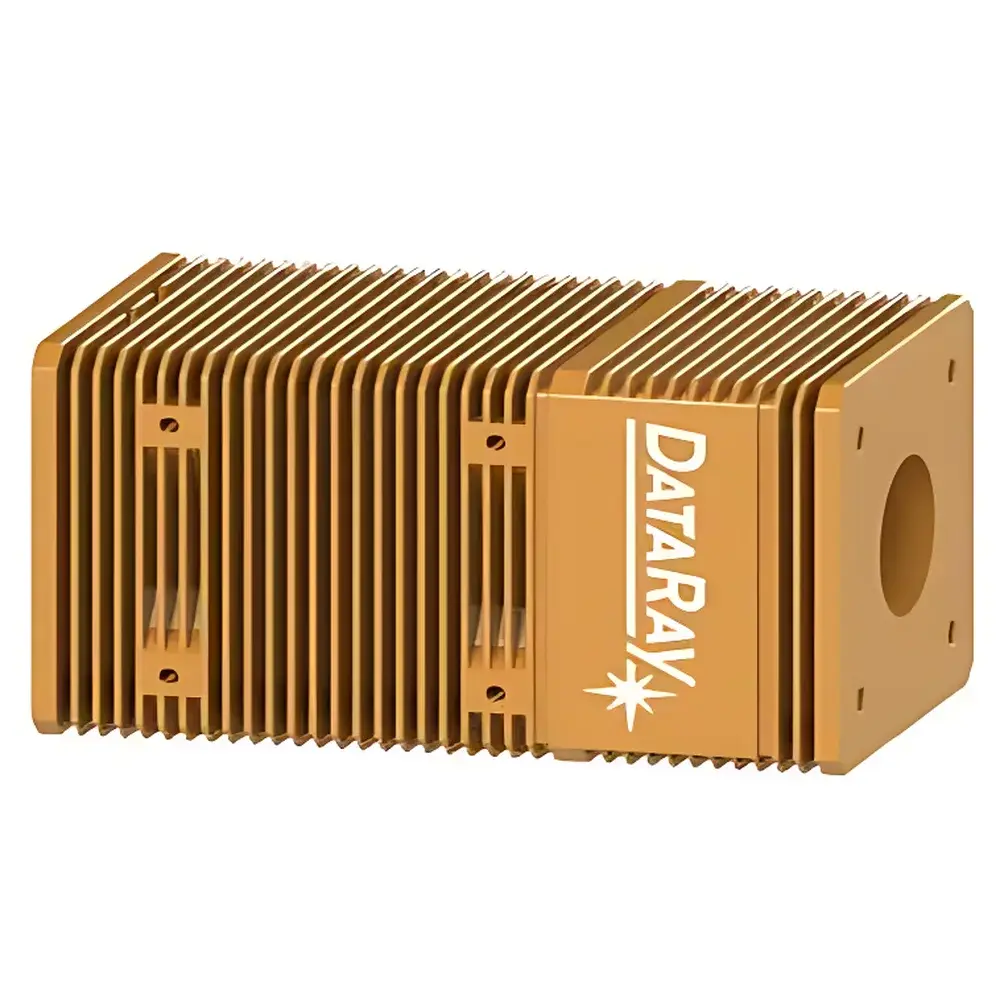
DataRay WinCamD-QD Quantum Dot Beam Profiler for Telecom Wavelengths (S-WCD-QD-1550 / S-WCD-QD-2000)
| Brand | DataRay |
|---|---|
| Origin | USA |
| Model | S-WCD-QD-1550 / S-WCD-QD-2000 |
| Wavelength Range | 400–1700 nm / 350–2000 nm |
| Pixel Size | 15 µm |
| Resolution | Up to 1920 × 1080 |
| Effective Sensor Area | Up to 28.8 × 16.2 mm |
| Bit Depth | 14-bit ADC |
| Shutter Type | Global Shutter |
| SNR | ≥2100:1 (33 dB optical / 66 dB electrical) |
| Frame Rate | Up to 25 fps |
| Interface | GigE or USB 3.0 |
| Compliance | ISO 11146-1:2005, ISO 11146-2:2005 |
Overview
The DataRay WinCamD-QD is a high-performance, quantum dot (QD)-based beam profiling camera engineered specifically for precise characterization of laser beams in the telecom and near-infrared spectral bands. Unlike conventional silicon-based or InGaAs sensors, the WinCamD-QD leverages proprietary colloidal quantum dot photodetector technology—optimized for peak responsivity at 1550 nm—to deliver exceptional sensitivity, uniform quantum efficiency, and broad spectral coverage from 350 nm to 2000 nm. Its measurement principle relies on direct photon-to-charge conversion across the full active area, enabling accurate spatial intensity mapping of both CW and pulsed laser sources under ISO 11146-compliant conditions. The system supports full 2D/3D beam parameter extraction—including beam width (D4σ, knife-edge, 1/e²), centroid position, ellipticity, astigmatism, M² estimation (when integrated with DataRay’s M2DU motorized stage), and beam propagation analysis—making it an essential metrology tool for R&D labs, fiber optic manufacturing facilities, and laser system integrators requiring traceable, repeatable beam quality validation.
Key Features
- Quantum dot detector architecture with peak quantum efficiency at 1550 nm and extended response to 2000 nm
- Global shutter operation ensures temporal fidelity for nanosecond- to continuous-wave laser pulses without motion artifacts
- High dynamic range: 14-bit analog-to-digital conversion with ≥2100:1 signal-to-noise ratio (optical SNR = 33 dB; electrical SNR = 66 dB)
- Multiple sensor formats available: standard 640 × 512 (9.5 × 7.68 mm), large 1280 × 1024 (19.2 × 15.36 mm), and extended 1920 × 1080 (28.8 × 16.2 mm)
- 15 µm pixel pitch enables resolution of beam diameters down to ~150 µm with sub-pixel centroiding accuracy
- Choice of GigE Vision or USB 3.0 interface for deterministic latency, real-time streaming, and compatibility with industrial machine vision frameworks
- No software licensing fees: unlimited installations, perpetual free updates, and native support for third-party API integration (e.g., LabVIEW, MATLAB, Python via DLL/SDK)
Sample Compatibility & Compliance
The WinCamD-QD accommodates a wide range of beam types—including single-mode and multimode fiber-coupled outputs, free-space collimated or focused beams, and high-peak-power pulsed sources—provided appropriate attenuation (e.g., calibrated reflective or absorptive neutral density filters, beam splitters, or integrating spheres) is employed per ANSI Z136.1 and IEC 60825-1 safety guidelines. Its calibration traceability aligns with NIST-traceable reference standards, and all beam parameter calculations adhere strictly to ISO 11146-1:2005 (determination of beam widths and divergence) and ISO 11146-2:2005 (determination of M²). For regulated environments, the DataRay BeamGage software supports audit trails, user access control, electronic signatures, and 21 CFR Part 11–compliant data integrity features when configured with optional validation packages.
Software & Data Management
BeamGage Professional—the fully featured, vendor-agnostic software platform included with every WinCamD-QD—provides real-time beam visualization, automated pass/fail testing, statistical process control (SPC) charting, and batch report generation in PDF, CSV, or XML formats. It natively supports synchronized acquisition with DataRay’s M2DU translation stage for fully automated M² measurements per ISO 11146-3. Data export includes raw frame buffers, calibrated intensity matrices, and metadata-rich .BGA files compatible with third-party analysis tools. All firmware and software updates are distributed free of charge via DataRay’s secure customer portal, with version-controlled release notes and backward-compatible file format preservation.
Applications
- Characterization and alignment of 1550 nm telecom lasers, EDFAs, and tunable external cavity diodes
- In-line monitoring during fiber splicing, connector polishing, and passive component assembly
- Beam stability tracking over time (drift, jitter, pointing error) in environmental stress testing
- M² and BPP (beam parameter product) validation for QC in laser diode module production
- Optical system commissioning—including collimator, isolator, and wavelength division multiplexer alignment
- Support for LIDAR transmitter qualification (1550 nm eye-safe systems), free-space optical interconnects, and ultrafast amplifier diagnostics
FAQ
What is the minimum measurable beam diameter with the WinCamD-QD?
The theoretical diffraction-limited resolution is ~150 µm for the standard 640 × 512 sensor configuration, assuming optimal sampling (≥3 pixels per FWHM) and proper lens magnification.
Can the WinCamD-QD measure ultrashort pulses (e.g., femtosecond lasers)?
Yes—its global shutter eliminates rolling-shutter distortion, and its high SNR enables reliable profiling of pulses as short as tens of picoseconds when used with appropriate pulse energy attenuation and synchronization triggers.
Is ISO 11146 certification included with the instrument?
The hardware and software are designed and validated to meet ISO 11146 requirements; formal ISO certification documentation (e.g., calibration certificate with uncertainty budget) is available upon request as an optional service.
How does quantum dot technology improve performance over InGaAs cameras?
QD detectors offer higher uniformity across the array, broader NIR response without cooling, superior linearity, and lower dark current compared to thermoelectrically cooled InGaAs alternatives—enabling ambient-temperature operation with stable baseline performance.
Does BeamGage support automated M² measurement?
Yes—when paired with the M2DU motorized stage and configured in “M² Scan” mode, BeamGage executes fully compliant ISO 11146-3 scans, computes beam propagation parameters, and generates comprehensive M² reports with confidence intervals.




