
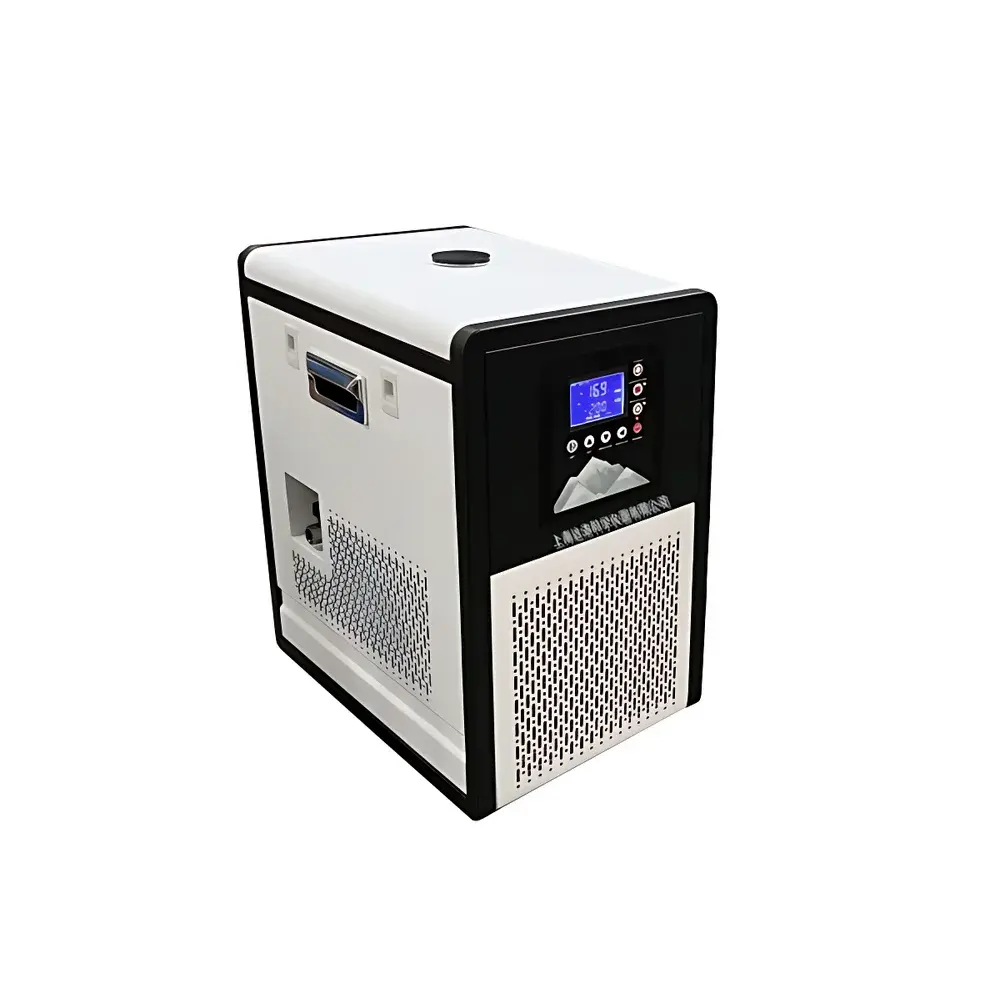
Daxluot DLM-1003 Compact Circulating Chiller with Integrated Refrigeration and Heating
| Brand | Daxluot |
|---|---|
| Origin | Shanghai, China |
| Model | DLM-1003 |
| Type | Integrated Circulating Chiller |
| Cooling Method | Air-Cooled |
| Temperature Range | −10 °C to 100 °C |
| Temperature Stability | ±0.5 °C |
| Refrigeration Capacity | 800 W |
| Circulation Pressure | 0.7 bar |
| Flow Rate | 8 L/min |
| Reservoir Volume | 3.5 L |
| Operating Mode | Continuous |
| Display Resolution | 0.1 °C |
| Power Supply | 220 V / 50 Hz |
| Housing Material | ABS Molded Enclosure |
| Pump Type | Hermetic, Low-Heat Circulation Pump |
| Safety Features | Overtemperature Alarm, Low-Liquid-Level Protection, Compressor Overheat & Overcurrent Protection, Dual-Audio/Visual Alert |
| Interface | 304 Stainless Steel Bayonet Fittings |
| Dimensions (W×D×H) | 440 × 300 × 510 mm |
Overview
The Daxluot DLM-1003 is an integrated, air-cooled circulating chiller engineered for precision temperature control in laboratory-scale applications requiring both active cooling and heating within a single compact unit. It operates on a closed-loop refrigeration cycle using a hermetically sealed compressor, coupled with resistive heating elements and a microprocessor-based PID temperature controller. The system delivers stable, programmable fluid circulation across a wide operational range of −10 °C to 100 °C—enabling dual-mode thermal management for instruments such as rotary evaporators, spectrophotometers, calorimeters, condensers, and small-volume jacketed reactors. Its compact footprint (440 × 300 × 510 mm) and low-noise operation make it suitable for benchtop deployment inside fume hoods or adjacent to sensitive analytical instrumentation without compromising workspace efficiency or ambient thermal stability.
Key Features
- Microprocessor-controlled XMT digital PID algorithm with backlit LCD interface—displays setpoint, real-time bath temperature, and system status with 0.1 °C resolution
- Air-cooled, fully enclosed refrigeration system rated at 800 W cooling capacity, incorporating dual-stage thermal protection (compressor overheat and overcurrent cutoff)
- Hermetic, low-heat circulation pump delivering consistent 8 L/min flow at 0.7 bar pressure—designed for minimal thermal load and extended service life
- 3.5 L stainless steel-lined reservoir with calibrated level window, sealed fill port, overflow outlet, and integrated drain valve (304 stainless steel bayonet fittings)
- Independent functional control of refrigeration, heating, and internal/external circulation modes—enabling rapid thermal equilibration under variable experimental loads
- ABS molded housing with tool-free removable side panels for routine maintenance and component access
- Comprehensive safety architecture: low-fluid-level cutoff for heater elements, audible/visual overtemperature alarm, automatic power interruption upon fault detection
- Standard accessories include silicone circulation tubing, thermal insulation sleeve, and quick-connect drainage assembly
Sample Compatibility & Compliance
The DLM-1003 is compatible with aqueous solutions, water–glycol mixtures (up to 30% v/v), and other non-corrosive heat-transfer fluids commonly used in laboratory thermal management. Its 304 stainless steel fluid-contact components ensure chemical resistance to standard coolants and prevent leaching into recirculated streams. While not certified to IEC 61010-1 or UL 61010B as a standalone medical device, the unit complies with general electrical safety requirements for Class I laboratory equipment operating under 220 V / 50 Hz supply. Its temperature stability (±0.5 °C) meets typical calibration traceability needs for QC/QA workflows aligned with ISO/IEC 17025-accredited laboratories. For regulated environments, users may configure logging intervals and alarm thresholds to support GLP documentation practices.
Software & Data Management
The DLM-1003 operates via embedded firmware without external PC dependency; however, its analog/digital I/O architecture supports optional RS485 Modbus RTU integration for centralized monitoring in multi-chiller lab networks. Temperature setpoints, actual bath readings, and alarm events are retained in non-volatile memory for post-run review. Though no proprietary software suite is bundled, the device’s protocol-compliant interface enables interoperability with third-party SCADA platforms or LIMS systems where environmental parameter logging is required for audit trails per FDA 21 CFR Part 11 Annex 11 guidelines—provided user-defined validation protocols govern data integrity controls.
Applications
- Condenser cooling in rotary evaporation and distillation setups
- Thermal stabilization of UV-Vis spectrophotometer cuvette compartments and detector housings
- Temperature regulation of small-scale jacketed glass reactors (≤5 L volume)
- Heat sink management for laser sources, CCD detectors, and high-power electronics in metrology labs
- Calibration baths for thermocouple and RTD probe verification per ASTM E74 and ISO 17025 Clause 6.4
- Controlled-rate cooling in polymer crystallization studies and phase-transition characterization
FAQ
What is the minimum operating temperature achievable with ethylene glycol–water mixture?
When using a 30% v/v ethylene glycol solution, the DLM-1003 maintains stable operation down to −10 °C; lower concentrations may limit sub-zero performance due to freezing point elevation.
Can the unit operate continuously for 24/7 unattended use?
Yes—the system is rated for continuous duty cycling and includes redundant thermal safeguards to prevent dry-run or overheating failures during extended operation.
Is remote monitoring supported out of the box?
No native Ethernet or Wi-Fi interface is included; however, optional RS485 Modbus RTU communication enables integration into existing building automation or lab infrastructure.
What maintenance intervals are recommended?
Inspect coolant level and cleanliness every 90 days; replace fluid annually or after 2,000 operational hours—clean condenser coils quarterly in dusty environments.
Does the chiller meet CE or RoHS requirements?
While manufactured to conform with baseline EMC and LVD directives applicable to Class I lab equipment, formal CE marking requires end-user responsibility for conformity assessment under EU Regulation 2019/1020.
Related Products



