
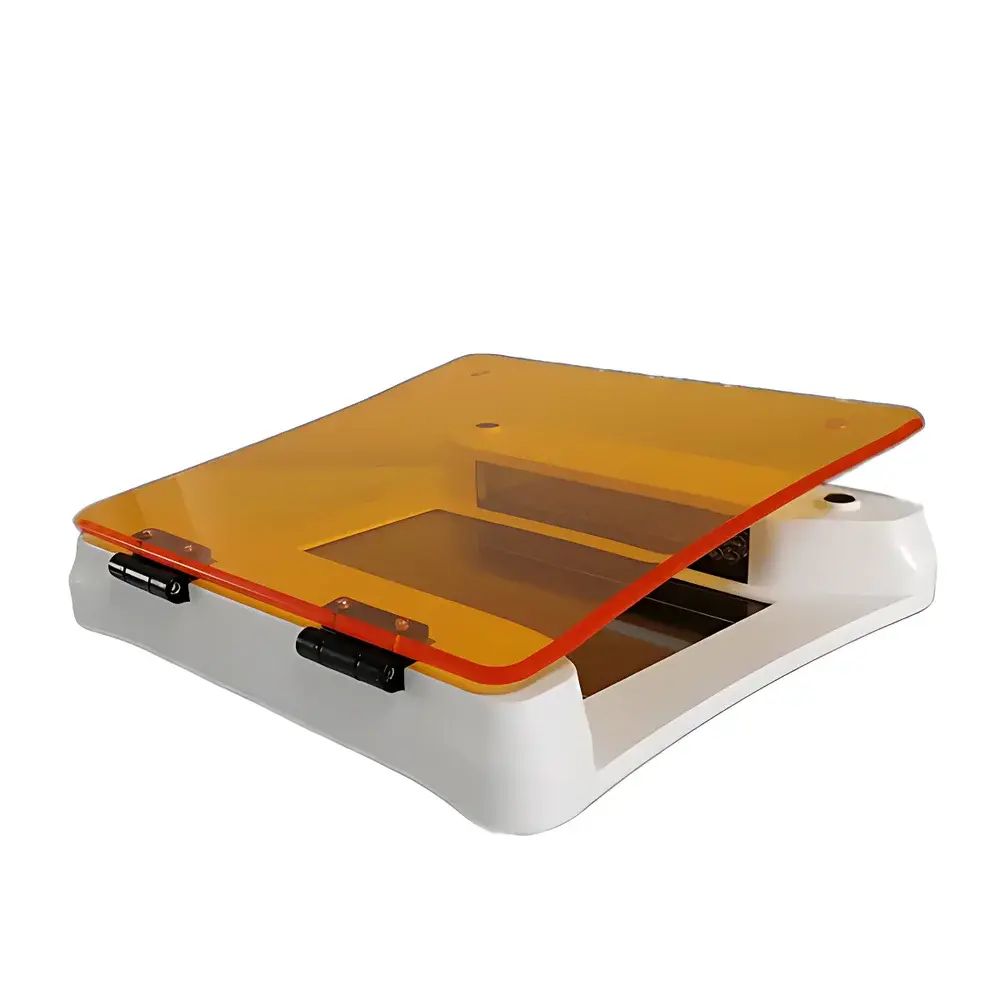
Daxluot UVI UV-Blue Transilluminator with Integrated Gel Cutting Platform
| Brand | Daxluot |
|---|---|
| Model | UVI |
| Type | Benchtop UV-Blue Transilluminator & Gel Cutter |
| Wavelength | 470 nm (Blue LED) |
| Filter Dimensions | 160 × 100 mm |
| Illumination | Dual-Sided LED Matrix |
| Input Power | DC 24 V, 1 A |
| Cutting Area | 160 × 100 mm |
| Overall Dimensions | 220 × 210 × 50 mm |
| Weight | 1.5 kg |
| Safety | Integrated Transparent UV-Blocking Acrylic Shield |
Overview
The Daxluot UVI UV-Blue Transilluminator is a compact, benchtop instrument engineered for safe and precise visualization and excision of nucleic acid bands following agarose or polyacrylamide gel electrophoresis. Unlike traditional 302 nm UV transilluminators—which pose significant photodamage risks to DNA and increased occupational hazard due to germicidal UV-C exposure—the UVI employs a 470 nm high-intensity blue LED matrix. This wavelength enables ethidium bromide (EtBr), SYBR Safe, SYBR Gold, GelRed, and other common nucleic acid stains to fluoresce efficiently while minimizing both sample photobleaching and operator exposure to harmful short-wavelength radiation. The system integrates a rigid, optically clear acrylic safety shield that attenuates residual UV emissions and provides physical barrier protection during real-time band inspection and manual gel excision. Its low-voltage DC 24 V operation ensures electrical safety in wet-lab environments and eliminates line-voltage hazards near electrophoresis setups.
Key Features
- Dual-sided 470 nm LED matrix illumination delivers uniform, shadow-free excitation across the full 160 × 100 mm viewing area—eliminating hotspots and enabling consistent band intensity assessment.
- Rotatable gel platform with adjustable-angle locking mechanism allows ergonomic positioning for both vertical observation and lateral cutting without repositioning the entire unit.
- Full-surface transparent acrylic filter (160 × 100 mm) serves simultaneously as optical transmission window and certified UV-blocking shield (OD ≥ 3 at <400 nm), compliant with IEC 62471 Photobiological Safety standards for lamp systems.
- Zero-maintenance solid-state LED light source rated for >20,000 hours L70 lifetime—no lamp replacement, no warm-up time, and stable spectral output over extended use.
- Compact footprint (220 × 210 × 50 mm) and lightweight design (1.5 kg) facilitate integration into laminar flow hoods, cold rooms, or shared core facility workstations without spatial compromise.
Sample Compatibility & Compliance
The UVI supports standard slab gels up to 15 cm × 10 cm, including TAE- and TBE-buffered agarose (0.8–2.0%) and SDS-PAGE or native PAGE acrylamide gels stained with blue-light-compatible dyes. It is validated for use with commercially available nucleic acid stains requiring excitation in the 450–490 nm range per manufacturer specifications (e.g., Thermo Fisher SYBR Safe, Biotium GelGreen, Lonza FlashGel dyes). The device conforms to general laboratory safety requirements outlined in ANSI Z87.1-2020 for protective eyewear compatibility and meets CE marking criteria for low-voltage equipment (2014/35/EU). While not classified as a medical device, its design aligns with GLP-relevant principles for documentation traceability and operator protection during routine molecular biology workflows.
Software & Data Management
The Daxluot UVI operates as a standalone hardware platform with no embedded microcontroller or digital interface—ensuring electromagnetic compatibility (EMC) in proximity to sensitive detection instruments such as CCD-based gel documentation systems or mass spectrometers. All operational parameters are fixed at factory calibration; no firmware updates or software drivers are required. This architecture eliminates cybersecurity vulnerabilities, avoids regulatory complications associated with Class II medical device software, and guarantees long-term functional consistency across laboratory deployments. Users may pair the UVI with external imaging systems (e.g., DSLR cameras or dedicated gel doc units) using standard white-light or blue-light excitation protocols defined in ISO/IEC 17025-accredited methods.
Applications
- Real-time visualization and comparative quantification of DNA/RNA fragments post-electrophoresis under blue-light excitation.
- Targeted excision of discrete bands for downstream cloning, sequencing library preparation, or PCR template recovery.
- Verification of restriction digest completeness, ligation efficiency, or CRISPR editing outcomes via fragment size resolution.
- Educational laboratory instruction in molecular biology techniques where student safety and instrument durability are primary concerns.
- Quality control checks in diagnostic assay development, particularly for assays employing intercalating dyes approved under CLIA-waived or ISO 15189 frameworks.
FAQ
Does the UVI emit ultraviolet radiation? Why is it labeled “UV-Blue”?
The UVI emits only visible blue light at 470 nm and contains no UV-emitting components. The designation “UV-Blue” reflects its functional equivalence to traditional UV transilluminators in nucleic acid visualization—i.e., it replaces UV excitation with safer blue-light excitation of compatible dyes.
Can I use ethidium bromide (EtBr) with this system?
Yes—EtBr exhibits strong fluorescence quantum yield under 470 nm excitation. However, SYBR Safe or GelRed are recommended for reduced mutagenicity and improved signal-to-noise ratio.
Is the acrylic shield removable for cleaning or maintenance?
Yes—the shield is mechanically secured with captive screws and can be detached without tools. Cleaning is performed with 70% ethanol or isopropanol; avoid abrasive solvents or ammonia-based cleaners.
What power supply is included?
A CE-certified, UL-listed 24 V DC, 1 A switching adapter with international plug options (EU, UK, US, AU) is supplied. Output ripple is <50 mVpp to prevent LED current fluctuation.
Is the UVI suitable for RNA visualization?
Yes—when stained with RNA-specific dyes such as SYBR Gold or GelRed, RNA bands are clearly resolved with minimal degradation due to absence of UV-induced strand breakage.





