
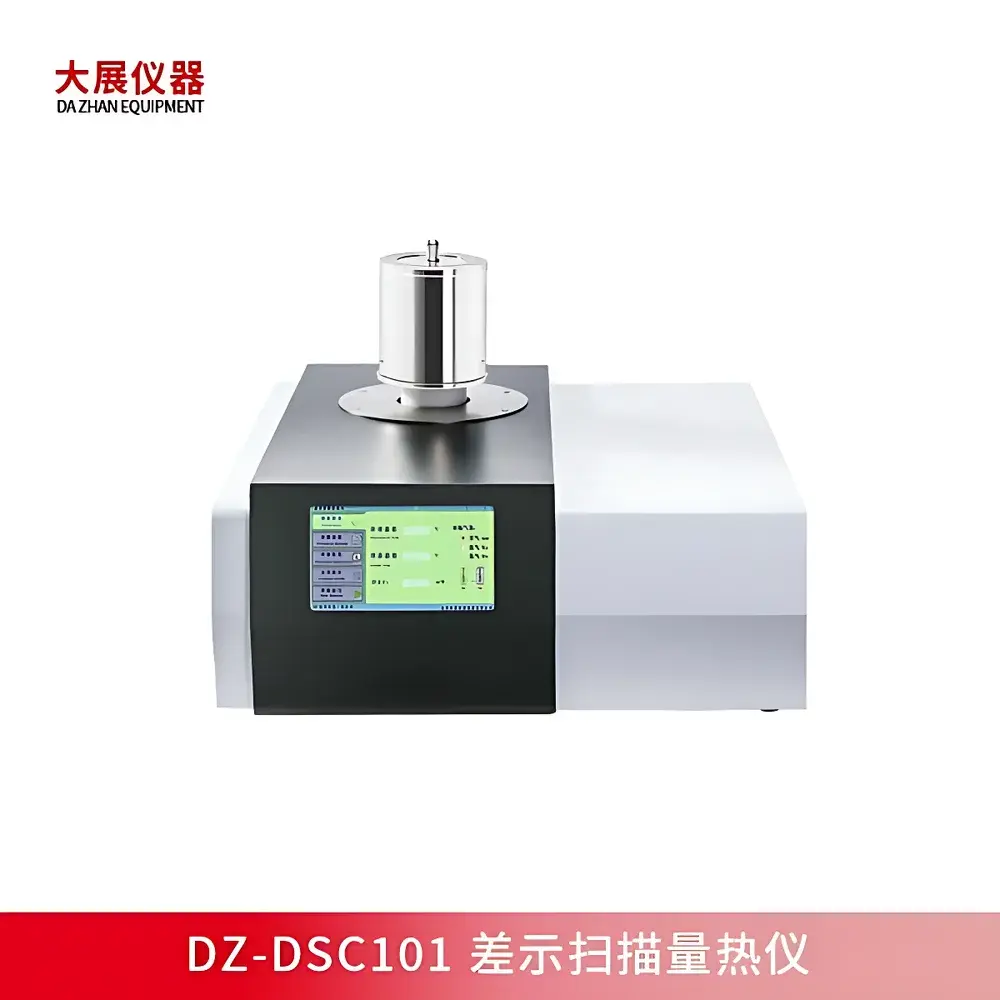
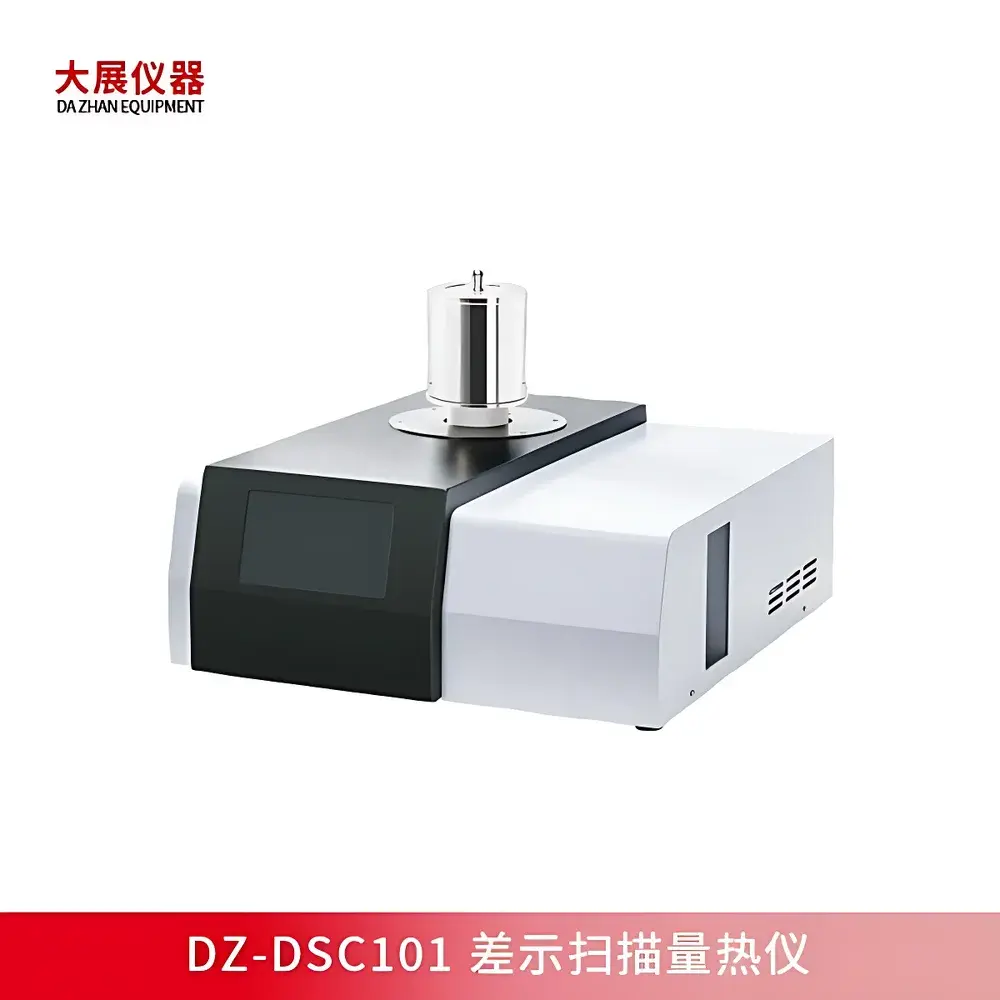
DAZHAN DZ-DSC101 High-Temperature Differential Scanning Calorimeter with Intelligent PID Temperature Control
| Brand | DAZHAN |
|---|---|
| Origin | Jiangsu, China |
| Manufacturer Type | Domestic Instrument Manufacturer |
| Model | DZ-DSC101 |
| Sample Capacity | Single-sample configuration |
| Instrument Type | Differential Scanning Calorimeter (DSC) |
| Temperature Range | Ambient to 800 °C |
| Temperature Accuracy | ±0.001 °C |
| Temperature Precision | ±0.001 °C |
| Heating/Cooling Rate | 0.1–100 °C/min |
| DSC Signal Range | ±800 mW |
| Temperature Control Method | Digital PID algorithm with programmable ramp-hold-cool profiles |
| Sensor Material | Constantan-based thermocouple array |
| Atmosphere Control | Dual-gas switching system with integrated flow regulation and auxiliary purge gas inlet |
| Cooling Method | Forced-air cooling |
| Compliance | Designed for GLP-compliant thermal analysis workflows |
Overview
The DAZHAN DZ-DSC101 is a high-temperature differential scanning calorimeter engineered for precise, reproducible measurement of heat flow differences between a sample and inert reference as a function of temperature or time. Operating on the principle of heat-flux DSC, it employs a symmetrical furnace design with indirect conductive heating—minimizing thermal gradients and radiative perturbations—to ensure exceptional baseline stability and signal fidelity across its full operating range (ambient to 800 °C). The instrument integrates a custom-engineered constantan-based thermocouple sensor array optimized for thermal shock resistance, long-term oxidation stability, and sub-millikelvin thermal resolution. Its architecture supports both exothermic and endothermic event detection—including melting transitions, glass transitions (Tg), crystallization kinetics, enthalpy quantification, oxidative induction time (OIT), and specific heat capacity (Cp) determination—under controlled atmospheric conditions.
Key Features
- Robust high-temperature furnace design with indirect conductive heating, delivering superior temperature uniformity and reduced thermal pulsation compared to resistive direct-heating configurations.
- Digital PID temperature control system enabling precise, repeatable ramp-hold-cool programs with programmable multi-segment profiles and arbitrary isothermal dwell durations.
- Thermal sensitivity of ±0.001 °C and DSC signal resolution of ±0.001 mW, supporting detection of subtle phase transitions and low-energy thermal events in advanced polymers, composites, and pharmaceutical formulations.
- Dual independent gas channel management with fast-switching solenoid valves, integrated float-type mass flow control, and dedicated inert purge line—ensuring rapid atmosphere stabilization and compatibility with oxidative, reductive, or inert testing environments (e.g., N2, O2, Ar).
- Modular software interface supporting real-time thermogram acquisition, baseline correction, peak integration, onset/midpoint/endpoint temperature annotation, and automated report generation compliant with internal QA documentation standards.
- Forced-air cooling system enabling rapid thermal cycling without liquid nitrogen dependency—ideal for routine QC screening and iterative method development.
Sample Compatibility & Compliance
The DZ-DSC101 accommodates standard aluminum, gold, platinum, and hermetically sealed crucibles (up to 70 µL volume), supporting solid, semi-crystalline, powdered, and thin-film specimens up to 50 mg. It meets foundational requirements for thermal analysis in accordance with ASTM E794 (melting point), ASTM E1356 (glass transition), ISO 11357 series (polymer characterization), and USP (thermal analysis of pharmaceuticals). While not pre-certified for FDA 21 CFR Part 11, the data acquisition and reporting module supports audit-trail-enabled operation when deployed within validated laboratory information management systems (LIMS) under GLP or GMP frameworks.
Software & Data Management
The proprietary DSCControl Suite provides intuitive instrument control via USB 2.0 interface, with synchronized real-time plotting of heat flow, temperature, and furnace power. Raw data are saved in ASCII-compatible .DTA format for third-party analysis (e.g., TA Instruments Universal Analysis, Netzsch Proteus). The software includes built-in calibration routines for temperature (indium, zinc, tin standards) and enthalpy (indium), supports baseline subtraction using multiple reference methods (linear, polynomial, spline), and exports annotated results to PDF, CSV, or Excel. All user actions—including method edits, calibration events, and manual annotations—are timestamped and logged for traceability.
Applications
This instrument serves cross-disciplinary thermal characterization needs: polymer processing (cure kinetics, degree of cure, Tg shift analysis), metal alloy development (solidus/liquidus mapping, precipitation behavior), battery material evaluation (SEI formation, cathode decomposition onset), food science (starch gelatinization, fat crystallization), and pharmaceutical solid-state analysis (polymorph screening, excipient compatibility, stability-indicating assays). Its 800 °C upper limit enables reliable assessment of high-performance ceramics, refractory composites, and next-generation thermal barrier coatings.
FAQ
What calibration standards are recommended for routine verification?
Indium (Tm = 156.6 °C, ΔHfus = 28.45 J/g) is used for temperature and enthalpy calibration; zinc (Tm = 419.5 °C) and tin (Tm = 231.9 °C) serve as secondary references.
Can the DZ-DSC101 operate under vacuum conditions?
No—this model is configured for ambient-pressure gas-controlled environments only. Vacuum compatibility requires optional furnace modification and is not supported out-of-the-box.
Is the software compatible with Windows 10/11 64-bit systems?
Yes—DSCControl Suite v3.2+ supports Windows 10 and 11 (64-bit), requiring .NET Framework 4.8 and minimum 4 GB RAM.
What crucible types are supplied as standard equipment?
Aluminum pans with matching lids (non-hermetic) and empty platinum crucibles (100 µL) are included; hermetic aluminum and gold crucibles are available as accessories.
Does the instrument support Cp measurement by the sapphire method?
Yes—Cp determination is enabled via comparative analysis against certified sapphire reference material, with software-assisted baseline normalization and integration limits.



