
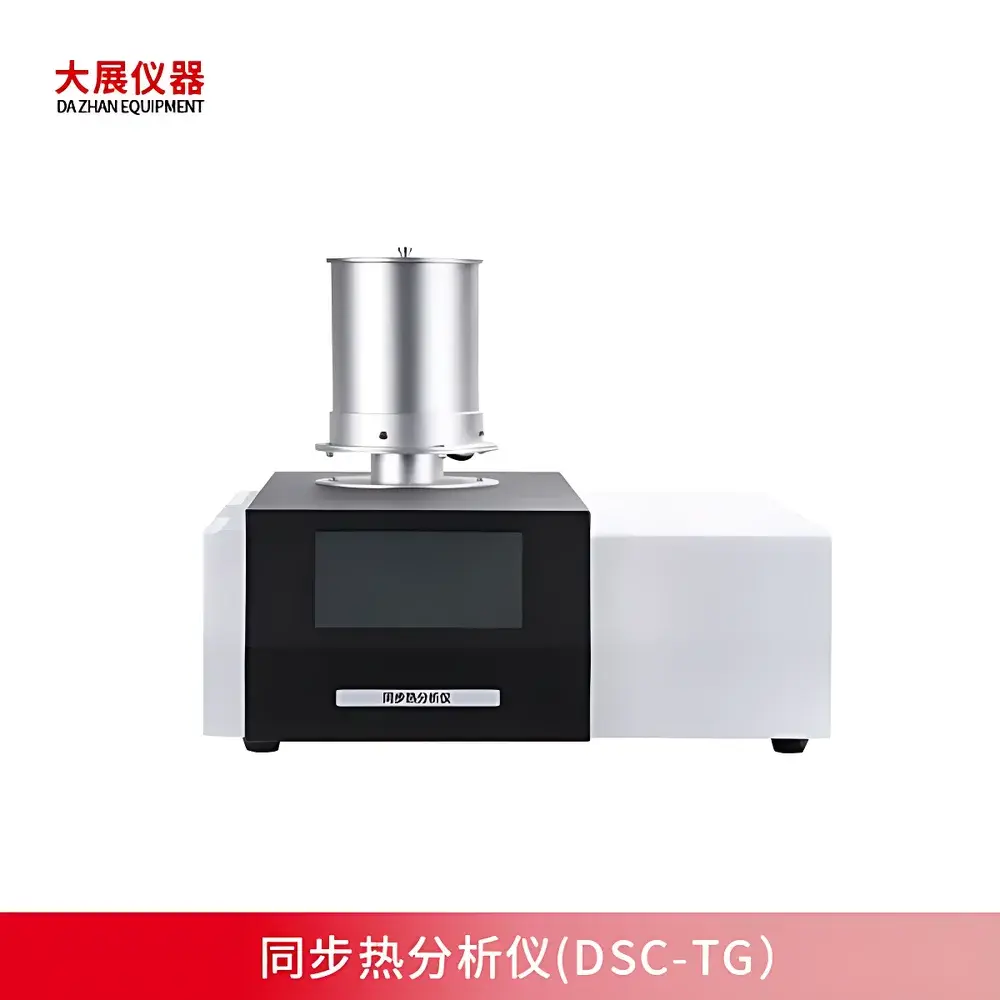
DAZHAN DZ-STA200 Simultaneous Thermal Analyzer (DSC-TGA)
| Brand | DAZHAN |
|---|---|
| Origin | Jiangsu, China |
| Manufacturer Type | Authorized Distributor |
| Country of Origin | China |
| Model | DZ-STA200 |
| Temperature Range | Ambient to 1250 °C |
| Heating Rate | 0.1–100 °C/min |
| Maximum Sample Mass | 30 g |
| Atmosphere Control | Inert, Oxidizing, Reducing |
| Temperature Resolution | 0.01 °C |
| Temperature Stability | ±0.1 °C |
| Balance Range | 0.01 mg–3 g (extendable to 30 g) |
| Balance Sensitivity | 0.01 mg |
| DSC Range | 0 to ±800 mW |
| DSC Resolution | 0.001 mW |
| Atmosphere System | Dual-gas mass flow control with integrated flow meters |
| Display | 7-inch 24-bit color LCD touchscreen |
| Data Interface | Standard USB |
| Power Supply | AC 220 V, 50 Hz |
| Crucible Material | High-purity alumina ceramic |
Overview
The DAZHAN DZ-STA200 Simultaneous Thermal Analyzer is an engineered solution for high-fidelity, concurrent measurement of differential scanning calorimetry (DSC) and thermogravimetric analysis (TGA) signals under precisely controlled thermal and atmospheric conditions. Based on the principle of simultaneous detection—where a single sample experiences identical thermal history while its heat flow (DSC) and mass change (TGA) are recorded in real time—the instrument enables rigorous correlation between enthalpic transitions and mass-loss events. This architecture is essential for elucidating complex solid-state behavior, including polymorphic transformations, decomposition kinetics, oxidative degradation pathways, and multi-step reaction mechanisms. With an operational temperature range extending from ambient to 1250 °C and programmable heating rates spanning 0.1–100 °C/min, the DZ-STA200 supports both low-temperature polymer characterization and high-temperature ceramic sintering studies. Its dual-mode thermal control (ramp, hold, and cool) implements PID-based regulation with ±0.1 °C stability and 0.01 °C resolution—meeting baseline requirements for ASTM E1131, ISO 11357, and USP thermal analysis protocols.
Key Features
- High-stability furnace assembly featuring dual-wound precious-metal alloy heating elements, minimizing electromagnetic interference and ensuring uniform thermal distribution up to 1250 °C.
- Ceramic-rod suspended microbalance sensor system: chemically inert, oxidation-resistant, and thermally stable across full operating range—critical for long-term repeatability in aggressive atmospheres.
- Thermally decoupled mechanical architecture: power supply, cooling fan module, and main electronics are physically isolated from the balance and furnace chamber to suppress vibration and conductive heat transfer.
- Top-loading furnace design with rapid-access lid mechanism—enabling safe, tool-free sample insertion and crucible exchange without thermal shutdown.
- Integrated thermal shielding: multilayer reflective insulation separates the high-temperature furnace core from the balance housing and control electronics, preserving microgram-level mass resolution during extended high-temperature holds.
- Standardized alumina ceramic crucibles (included), compatible with inert (N₂, Ar), oxidizing (air, O₂), and reducing (H₂/N₂, CO/N₂) gas environments—configurable as static or dynamic flow (0–200 mL/min per channel).
Sample Compatibility & Compliance
The DZ-STA200 accommodates solid, powder, and thin-film specimens weighing from 0.1 mg to 30 g, supporting standard and custom crucible geometries. It complies with key regulatory frameworks for materials qualification: data integrity features—including user-access logs, electronic signature support, and audit-trail-enabled software—align with FDA 21 CFR Part 11 readiness when deployed in GLP/GMP environments. All thermal calibrations (temperature, enthalpy, and mass) follow traceable multi-point procedures per ISO 11357-1 and ASTM E967, enabling validated reporting for quality control labs and R&D centers. Optional calibration kits (indium, zinc, nickel, calcium oxalate) are available for routine verification.
Software & Data Management
The embedded intelligent analysis platform provides synchronized visualization and processing of TG, DTG, DSC, and derivative curves. Users can perform baseline correction, peak integration, onset/endpoint determination, kinetic modeling (e.g., Ozawa-Flynn-Wall), and comparative overlay across multiple runs. Export functions support CSV, Excel (.xlsx), and PDF report generation with customizable templates—including header metadata (operator, date, method ID, instrument SN). Raw data files retain full timestamped acquisition parameters and are stored in vendor-neutral binary format for third-party reprocessing. USB interface ensures seamless transfer to LIMS or ELN systems without proprietary drivers.
Applications
- Quantification of crystallinity and melting enthalpy in semicrystalline polymers (e.g., PP, PET, PEEK) per ISO 11357-3.
- Decomposition onset temperature and activation energy determination for pharmaceutical actives and excipients under nitrogen and air.
- Char yield and oxidative induction time (OIT) assessment of flame-retardant composites and carbon-filled elastomers.
- Phase transition mapping in battery cathode materials (e.g., NMC, LFP) during thermal runaway simulation.
- Hydration/dehydration steps in metal-organic frameworks (MOFs) and layered double hydroxides (LDHs).
- Residual solvent quantification and curing exotherm analysis in epoxy resins and UV-curable coatings.
FAQ
What types of gases can be used with the DZ-STA200?
The system supports inert (N₂, Ar), oxidizing (air, O₂), and reducing (5% H₂/95% N₂, 5% CO/95% N₂) atmospheres, delivered via dual independent mass flow controllers with adjustable rates from 0–200 mL/min.
Is the instrument compliant with 21 CFR Part 11 for regulated laboratories?
Yes—the software includes configurable user roles, electronic signatures, and tamper-evident audit trails. Full compliance requires site-specific validation documentation and network configuration per organizational SOPs.
Can the DZ-STA200 perform isothermal TGA or DSC holds?
Yes. Multi-segment temperature programs allow arbitrary combinations of ramp, isothermal hold (duration user-defined), and controlled cooling—enabling oxidation induction time (OIT) or glass transition relaxation studies.
What is the maximum recommended sample mass for optimal DSC sensitivity?
For highest DSC signal-to-noise ratio, samples between 2–10 mg are recommended. The 30 g upper limit applies to TGA-only stability screening where absolute mass resolution is secondary to thermal robustness.
Are calibration standards included with the system?
A basic calibration kit (indium, aluminum oxide) is supplied. Traceable NIST-certified reference materials for temperature, enthalpy, and mass are available as optional accessories.



