
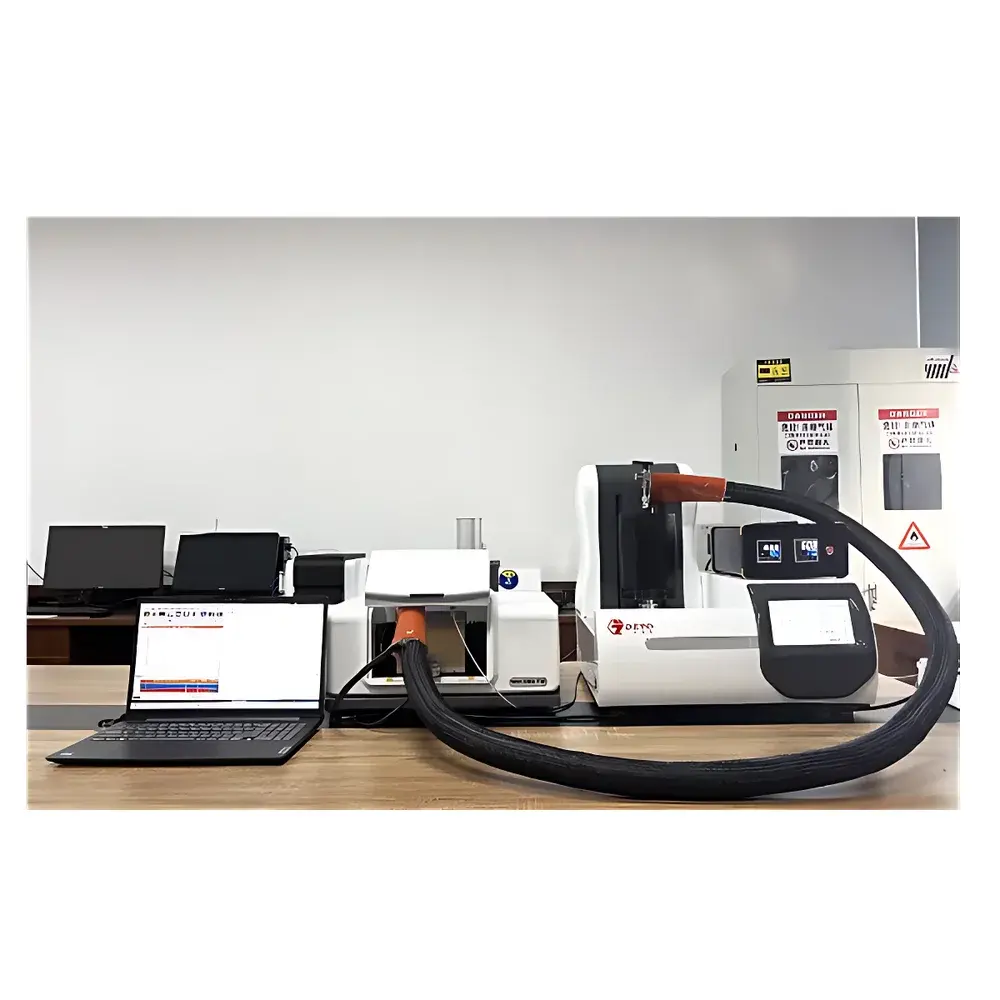
DAZHAN DZ-TGA201 Automated Thermogravimetric Analyzer with Integrated FTIR Coupling Interface
| Brand | DAZHAN |
|---|---|
| Origin | Jiangsu, China |
| Manufacturer Type | Authorized Distributor |
| Region Classification | Domestic (PRC) |
| Model | DZ-TGA201 |
| Pricing | Upon Request |
| Temperature Range | Ambient to 1250 °C |
| Mass Resolution | 1 µg |
| Mass Accuracy | ±1 µg |
| Dynamic Weighing Capacity | 0.01 mg–3 g (expandable to 50 g) |
| Balance Sensitivity | 1 µg |
| Heating/Cooling Rate | 0.1–100 °C/min |
| Maximum Sample Load | 50 g |
Overview
The DAZHAN DZ-TGA201 is a high-precision, automated thermogravimetric analyzer engineered for rigorous thermal stability and compositional analysis under ambient pressure conditions. It operates on the fundamental principle of thermogravimetry—measuring real-time mass change of a solid or liquid sample as a function of controlled temperature or time. The instrument integrates a vertically actuated furnace assembly, enabling rapid sample insertion and accelerated cooling via mechanical lift-off from the heated zone—a design feature that improves workflow efficiency and thermal reproducibility across repeated runs. Its core measurement architecture employs a high-stability microbalance with 1 µg resolution and accuracy, coupled with PID-driven dual-directional temperature control (heating and cooling), ensuring precise thermal programming from ambient up to 1250 °C. The system is explicitly designed for hyphenated operation, featuring a dedicated effluent gas port with standardized flange interface (KF-25 or equivalent) for seamless coupling to Fourier Transform Infrared (FTIR) spectrometers—enabling simultaneous detection of evolved gas species during thermal decomposition.
Key Features
- Automated vertical furnace lift mechanism for ergonomic sample loading/unloading and enhanced thermal quench capability
- High-temperature furnace wound with dual-row platinum-rhodium alloy heating wire, minimizing electromagnetic interference and ensuring uniform thermal distribution up to 1250 °C
- Corrosion-resistant, oxidation-stable precious-metal alloy sensor platform for crucible support and force transmission
- Dual-layer thermal insulation architecture, improving baseline linearity and reducing radial temperature gradients
- Programmable heating/cooling rates spanning 0.1 to 100 °C/min, supporting both slow-scan kinetic studies and rapid thermal profiling
- Expandable mass capacity (standard: 0.01 mg–3 g; optional upgrade path to 50 g maximum load) without compromising sensitivity
- Integrated gas outlet with adjustable flow regulation and condensate trap compatibility for evolved gas analysis (EGA)
Sample Compatibility & Compliance
The DZ-TGA201 accommodates standard ceramic, platinum, aluminum oxide, and nickel crucibles (typical diameters: 5–8 mm), supporting powders, granules, thin films, and small monolithic specimens. It complies with foundational thermal analysis standards including ASTM E1131 (Standard Test Method for Compositional Analysis by Thermogravimetry) and ISO 11358-1 (Plastics — Thermogravimetry of polymers — Part 1: General principles). While not pre-certified for regulated environments, its hardware architecture supports GLP/GMP-aligned operation when deployed with validated software protocols—including audit-trail-enabled data logging, user access controls, and electronic signature readiness per FDA 21 CFR Part 11 requirements (when used with compliant third-party acquisition software).
Software & Data Management
The DZ-TGA201 operates via PC-based acquisition software supporting Windows OS (7/10/11, 64-bit). Core functionalities include multi-step temperature program definition (ramp/hold/cool cycles), real-time mass and derivative (DTG) curve visualization, automatic peak detection, and baseline correction algorithms. Export formats include CSV, TXT, and universal .TGA binary for cross-platform compatibility with third-party analysis tools (e.g., Kinetics Neo, Thermo-Calc, OriginLab). Raw data files embed metadata such as instrument ID, operator name, date/time stamps, calibration history flags, and environmental ambient logs—facilitating traceability in academic, industrial R&D, and quality control settings.
Applications
- Quantitative determination of moisture, volatiles, fillers, and polymer degradation residues in composites and pharmaceutical excipients
- Thermal decomposition kinetics modeling (e.g., Arrhenius, Friedman, Ozawa-Flynn-Wall methods) for catalysts and energetic materials
- Oxidation onset temperature (OOT) and char yield assessment in flame-retardant formulations
- Decomposition pathway validation via synchronized FTIR identification of CO₂, H₂O, NOₓ, SO₂, hydrocarbons, and carbonyl species
- Stability screening of battery electrode materials (e.g., LiCoO₂, NMC, Si-anodes) under inert or oxidative atmospheres
- Residue analysis in food packaging films, bioplastics, and recycled polymer streams per ISO 14855 and ASTM D6400
FAQ
Is the DZ-TGA201 compatible with mass spectrometry (MS) coupling?
Yes—the effluent gas port supports vacuum-compatible adapters for direct connection to quadrupole or time-of-flight mass spectrometers, subject to appropriate pressure matching and transfer line configuration.
What calibration procedures are recommended for routine operation?
Daily buoyancy correction using certified reference weights and periodic temperature calibration using high-purity metal standards (e.g., Al, Zn, Sn) per ASTM E967 are advised.
Can the instrument operate under controlled atmosphere (e.g., N₂, Ar, O₂, air)?
Yes—gas inlet ports accept regulated flow controllers (0–200 mL/min); optional purge gas manifold kits enable dynamic atmosphere switching during analysis.
Does the system include provisions for regulatory compliance documentation?
Hardware-level IQ/OQ documentation templates are provided; PQ validation must be performed in situ by the end user in accordance with internal SOPs and applicable regional guidelines.
What is the typical service interval for preventive maintenance?
Biannual inspection of furnace alignment, balance zero stability, gas seal integrity, and thermocouple calibration drift is recommended for sustained metrological performance.



