
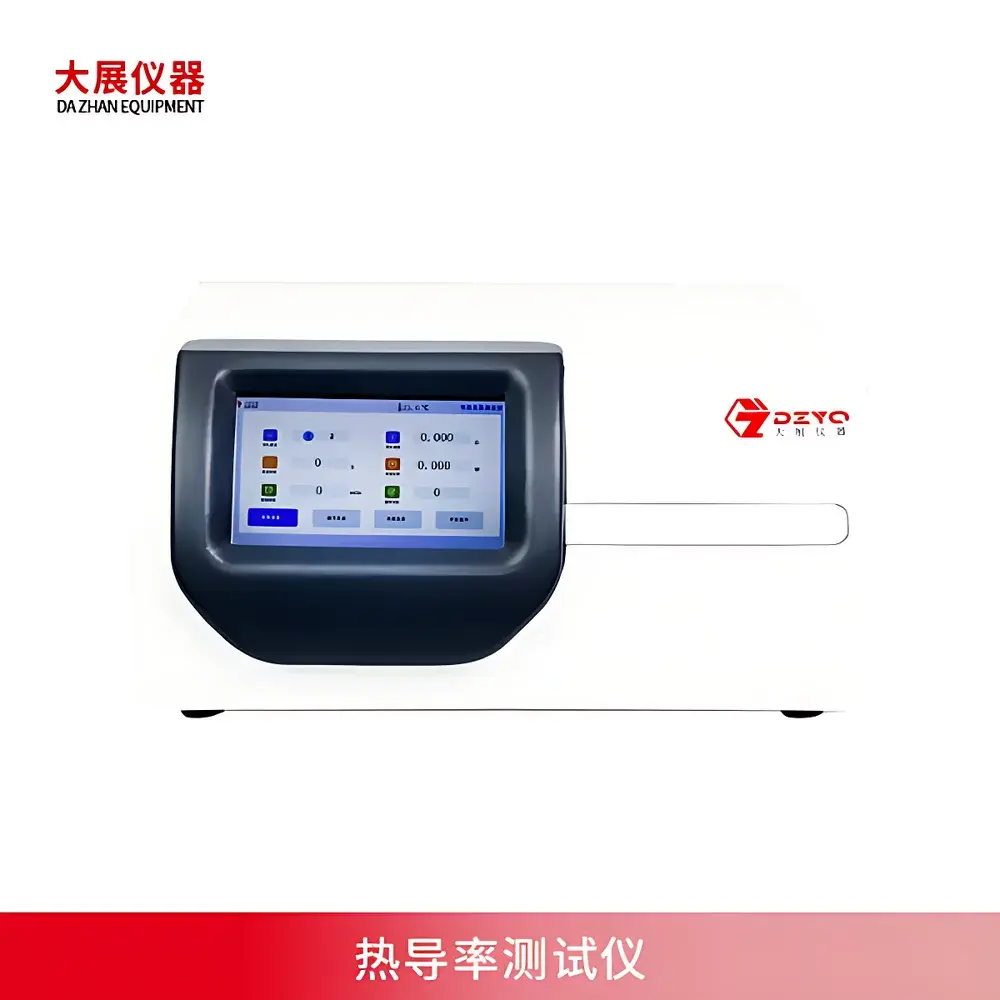
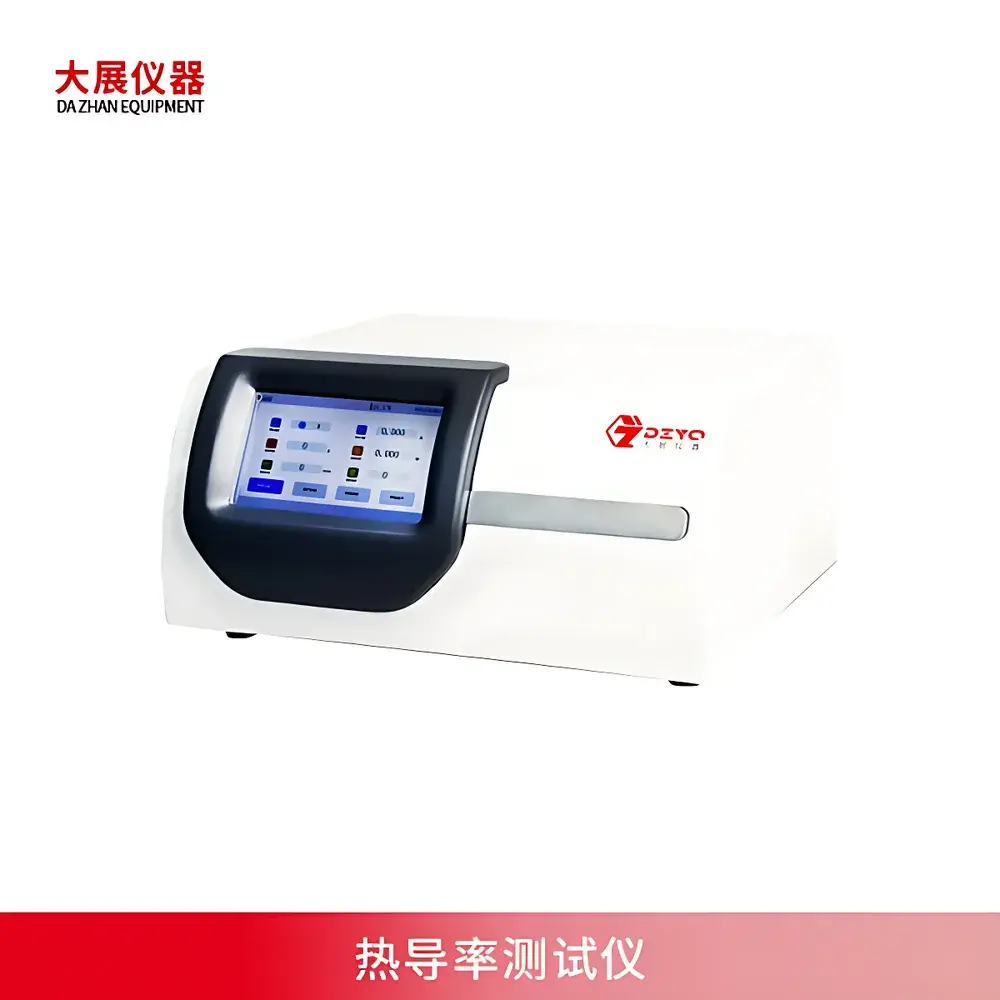
DAZHAN DZDR-AS Automatic Transient Plane Source (TPS) Thermal Conductivity Analyzer
| Brand | DAZHAN |
|---|---|
| Origin | Jiangsu, China |
| Manufacturer Type | Authorized Distributor |
| Country of Origin | China |
| Model | DZDR-AS |
| Instrument Type | Transient Plane Source (TPS) Method |
| Sample Throughput | Single-sample per test |
| Test Environment | Ambient temperature (with optional environmental chamber integration) |
| Thermal Conductivity Range | 0.00001–50 W/(m·K) |
| Temperature Range | –30 °C to 200 °C |
| Resolution | 0.00001 W/(m·K) |
| Repeatability | ≤1% RSD |
| Accuracy | ±2% (traceable to NIST-certified reference materials) |
| Sample Forms | Solids (bulk, thin films, foams), liquids, powders, pastes, gels, and elastomers |
| Probe Configuration | Dual high-precision TPS sensors (standard) |
| Minimum Solid Sample Dimensions | 15 mm × 15 mm × 7.5 mm (Probe #1) |
| Liquid/Powder Sample Volume | 18 mL via dedicated fixture |
| Measurement Time | ≤160 s per test |
| Power Consumption | <300 W |
| Display | 7-inch color capacitive touchscreen interface |
| Control Architecture | Bidirectional software–instrument communication (USB/Ethernet) |
Overview
The DAZHAN DZDR-AS Automatic Transient Plane Source (TPS) Thermal Conductivity Analyzer is an engineered solution for precise, rapid, and versatile thermal property characterization across research laboratories, quality control departments, and material development facilities. Based on the internationally standardized transient plane source method (ISO 22007-2:2015), the instrument measures thermal conductivity (λ), thermal diffusivity (α), and specific heat capacity (cp) through a controlled, short-duration Joule heating pulse applied to a symmetrically embedded sensor sandwiched between two identical sample halves—or in contact with a single surface for non-symmetric configurations. The resulting transient temperature response is captured at microsecond resolution and fitted to analytical solutions of the one-dimensional heat conduction equation in infinite media. This first-principles approach eliminates steady-state equilibration delays and enables reliable quantification of thermal transport properties without assumptions about boundary conditions or contact resistance—provided appropriate sample preparation and probe calibration protocols are followed.
Key Features
- Fully automated baseline compensation and power modulation—eliminates manual gain adjustment and reduces operator-dependent variability.
- Dual-probe architecture supporting both high-resolution low-conductivity measurements (down to 10−5 W/(m·K)) and high-conductivity metals (up to 50 W/(m·K)), with selectable probe geometries optimized for solid block, thin film, or bulk powder testing.
- Bidirectional control interface: real-time instrument operation via integrated 7-inch color touchscreen and remote command via PC-based software—enabling script-driven batch testing, parameter logging, and synchronized multi-instrument workflows.
- Expanded thermophysical output: in addition to λ and α, the upgraded firmware and analysis engine compute cp using the relation cp = λ / (αρ), where density ρ is user-input or imported from external databases.
- Modular thermal environment compatibility: standard operation at ambient conditions; optional integration with programmable Peltier or liquid-circulated chambers (–30 °C to 200 °C) for temperature-dependent property mapping.
- Robust mechanical design with vibration-damped baseplate and electromagnetic shielding—critical for low-power signal integrity during ultra-low-conductivity measurements (e.g., aerogels, polymer foams, insulating coatings).
Sample Compatibility & Compliance
The DZDR-AS accommodates heterogeneous material forms without morphological preprocessing: rigid solids (metals, ceramics, composites), compliant polymers, granular powders, Newtonian and non-Newtonian liquids, viscoelastic gels, and semi-solid pastes. Each sample type engages a purpose-designed fixture—solid clamps with adjustable pressure, liquid cuvettes with meniscus control, and powder compaction cells ensuring reproducible packing density. All measurement protocols align with ISO 22007-2 for transient methods and ASTM D5470 for thermal transmission properties of thermally conductive materials. Data acquisition and reporting support audit-ready documentation per GLP and GMP requirements, including full metadata stamping (operator ID, timestamp, calibration certificate ID, environmental logs), electronic signatures, and 21 CFR Part 11–compliant audit trails when used with validated software configuration.
Software & Data Management
The proprietary DAZHAN TPS Studio software provides a unified platform for instrument control, real-time visualization, curve fitting, uncertainty propagation, and comparative analytics. Raw voltage–time datasets are stored in HDF5 format with embedded metadata, enabling traceability and third-party reprocessing. Built-in fitting algorithms apply inverse modeling to extract λ and α simultaneously from a single transient curve, with residual diagnostics and confidence interval estimation. Export options include CSV, Excel, and PDF reports compliant with internal SOPs or external regulatory submissions. Version-controlled software updates are delivered via secure HTTPS, and local deployment supports air-gapped network environments common in defense and pharmaceutical labs.
Applications
- Thermal interface material (TIM) qualification for electronics cooling—validating performance under compressive load and thermal cycling.
- Development of phase-change materials (PCMs) and battery thermal management systems—mapping λ(θ) across operational temperature ranges.
- Quality assurance of insulation products (aerogels, mineral wool, vacuum panels) per EN 12667 and ASTM C518.
- Characterization of nanocomposite polymers, carbon-fiber laminates, and additive-manufactured metal parts for aerospace and automotive applications.
- R&D of thermoelectric materials, where precise λ and α inputs feed ZT figure-of-merit calculations.
- Academic studies in soft matter physics, colloidal science, and food rheology—where thermal response correlates with microstructural evolution.
FAQ
What standards does the DZDR-AS comply with for thermal conductivity measurement?
The instrument implements the transient plane source method per ISO 22007-2:2015 and supports validation against certified reference materials traceable to NIST SRM 1470 (fused quartz) and SRM 1469 (stainless steel).
Can the DZDR-AS measure anisotropic materials?
Yes—by rotating the sample relative to the probe orientation and performing orthogonal measurements, directional thermal conductivity tensors can be approximated for layered composites or crystalline specimens.
Is sample contact resistance compensated during analysis?
The dual-sensor symmetric configuration inherently minimizes interfacial resistance effects; additional correction models are available in software for asymmetric single-sided tests using known contact conductance estimates.
How is calibration verified over time?
A built-in self-test routine validates sensor resistance, heater response linearity, and thermistor sensitivity before each session; annual recalibration is recommended using DAZHAN-certified reference kits.
Does the system support automated temperature ramping during measurement?
When paired with an external environmental chamber (optional), the software synchronizes temperature setpoints with measurement triggers, enabling continuous λ(T) profiling without manual intervention.



