
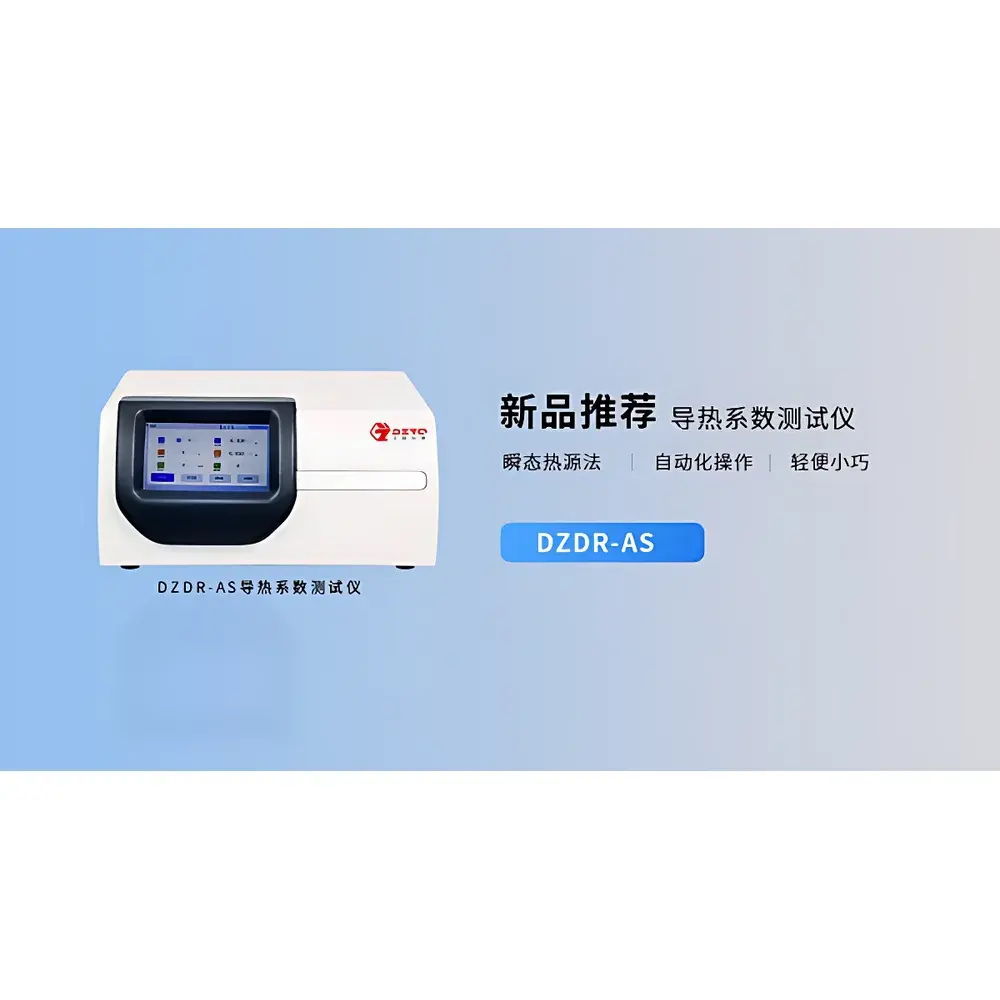
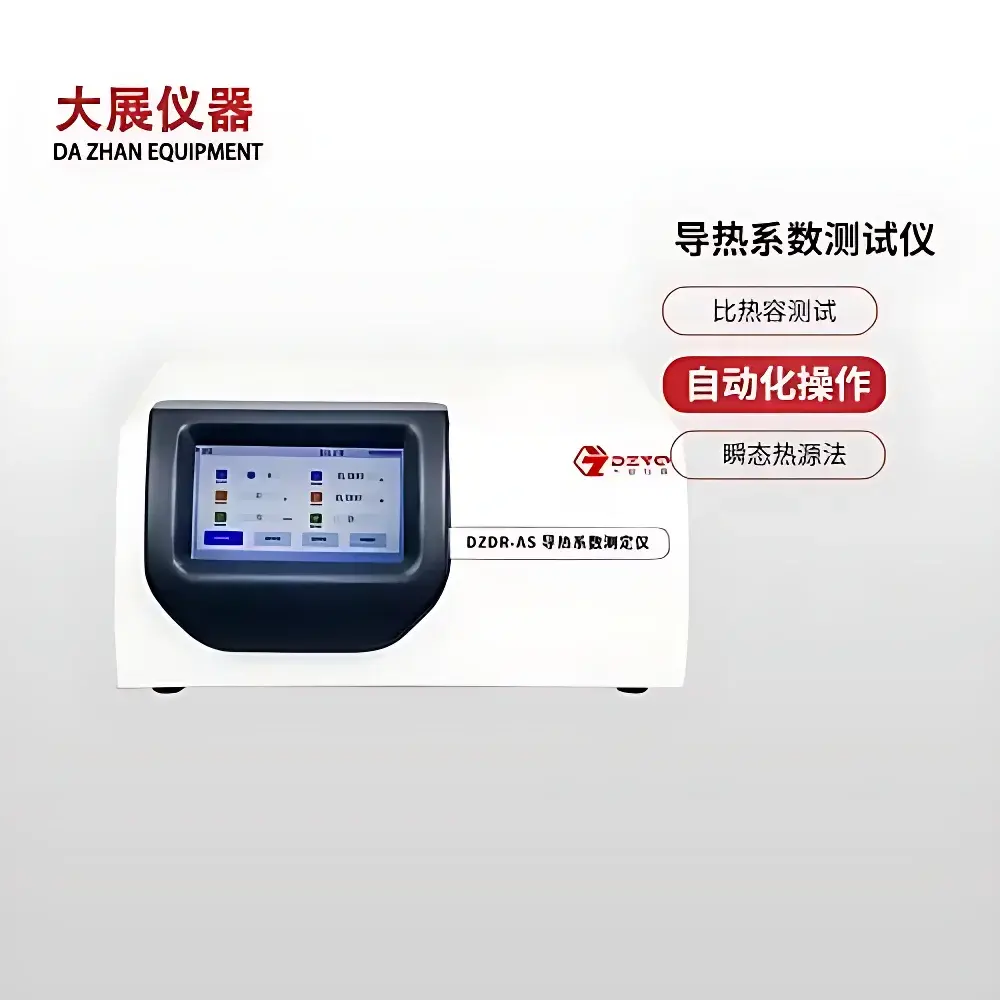
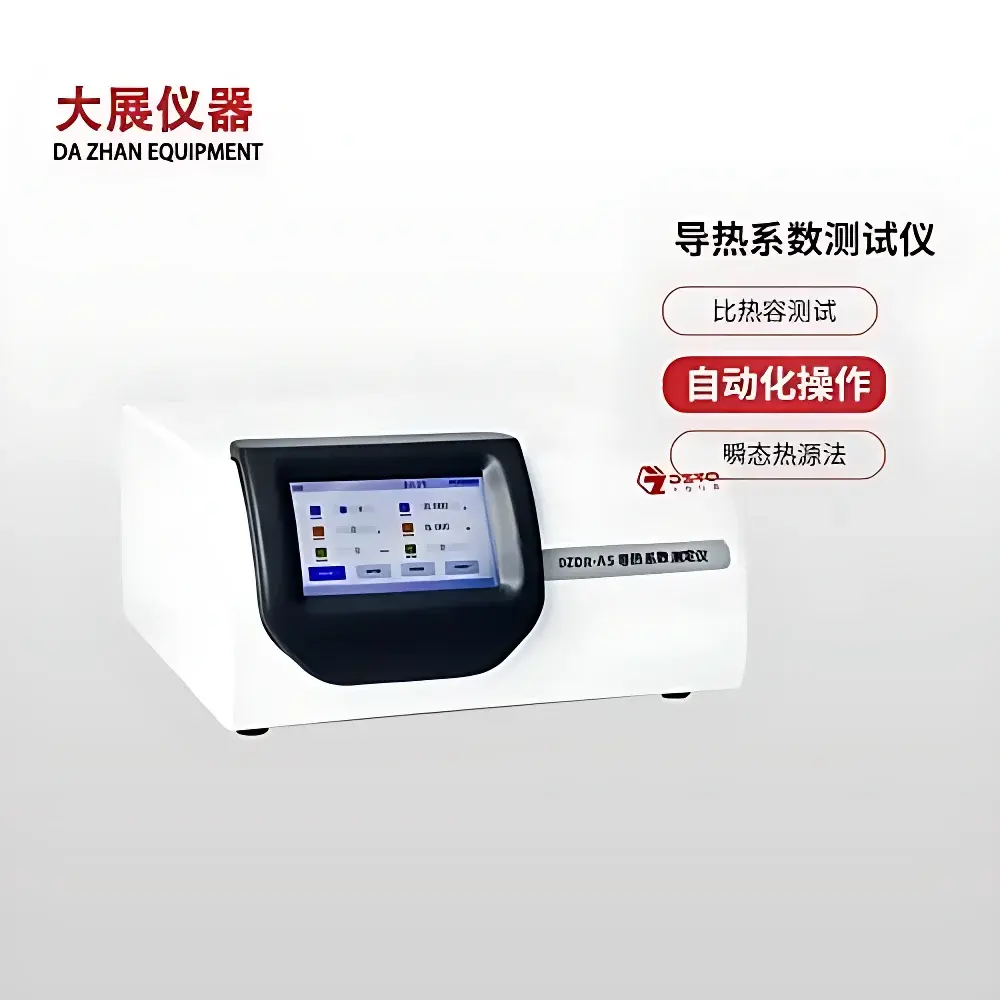
DAZHAN DZDR-AS Transient Plane Source (TPS) Thermal Conductivity Analyzer
| Brand | DAZHAN |
|---|---|
| Origin | Jiangsu, China |
| Manufacturer Type | Authorized Distributor |
| Country of Origin | China |
| Model | DZDR-AS |
| Instrument Type | Transient Plane Source (TPS) Method |
| Sample Throughput | Single sample per test |
| Test Environment | Ambient temperature |
| Thermal Conductivity Range | 0.00001–50 W/(m·K) |
| Resolution | 0.0001 W/(m·K) |
| Repeatability | ≤1% |
| Accuracy | ±0.00001 W/(m·K) |
| Test Atmosphere | Ambient air (no controlled atmosphere) |
| Temperature Range | −30 °C to 200 °C |
| Sample Forms Supported | Solids (bulk, metallic), liquids, powders, pastes, gels, thin films, and aerogels |
Overview
The DAZHAN DZDR-AS Transient Plane Source (TPS) Thermal Conductivity Analyzer is an advanced, benchtop instrument engineered for high-precision measurement of thermal conductivity and thermal diffusivity across a broad spectrum of materials. It operates on the well-established transient plane source principle—a standardized method defined in ISO 22007-2 and ASTM D7984—where a thin, sandwiched sensor acts simultaneously as both a heat source and a resistance thermometer. Upon application of a short-duration DC current pulse, the sensor generates a controlled thermal perturbation within the sample; the resulting time-dependent temperature rise is recorded with microsecond-level temporal resolution. By fitting the measured temperature-time response to analytical solutions of the one-dimensional heat conduction equation for an infinite medium, the system computes thermal conductivity (λ), thermal diffusivity (α), and—when coupled with density data—volumetric heat capacity (ρcp). This first-principles approach eliminates calibration drift associated with steady-state methods and ensures traceable, physics-based results without reference standards.
Key Features
- Integrated TPS sensor architecture with dual high-accuracy platinum-based probes (standard configuration); optional low-magnetic-susceptibility probes available for testing ferromagnetic or electrically conductive samples.
- Automated baseline compensation and dynamic power modulation—adjusts heating energy in real time based on sample thermal resistance, ensuring optimal signal-to-noise ratio across the full 0.00001–50 W/(m·K) range.
- Full-color capacitive touchscreen interface with intuitive icon-driven navigation; supports bilingual (English/Chinese) firmware and context-sensitive help overlays.
- Bidirectional control architecture: local instrument operation and remote PC-based control via USB 2.0 or Ethernet (TCP/IP), enabling seamless integration into automated lab workflows.
- Compact monolithic chassis (<300 W total power draw) designed for space-constrained QC labs and university research environments; no external chillers or vacuum systems required.
- Thermal stage with Peltier-based active temperature control (−30 °C to 200 °C), programmable ramp rates, and ±0.1 °C stability over 30-minute dwell periods.
Sample Compatibility & Compliance
The DZDR-AS accommodates unrestricted sample geometries and physical states—including rigid solids (metals, ceramics, polymers), flexible films (≥25 µm thickness), granular powders, viscous pastes, colloidal dispersions, and low-viscosity liquids. Standard probe configurations support minimum solid dimensions of 15 mm × 15 mm × 3.75 mm (Probe #1) or 30 mm × 30 mm × 7.5 mm (Probe #2); liquid and powder measurements utilize precision-machined stainless-steel sample holders (18 mL volume) with integrated thermal contact enhancement features. All hardware and software comply with essential requirements of IEC 61000-6-3 (EMC) and IEC 61010-1 (electrical safety). Data acquisition protocols meet ALCOA+ principles for raw data integrity, and audit trail functionality satisfies GLP and GMP documentation requirements per FDA 21 CFR Part 11 when used with validated software configurations.
Software & Data Management
Bundled DAZHAN TPS Analysis Suite v3.2 provides comprehensive post-processing capabilities including automatic curve-fitting with residual diagnostics, multi-sample comparative reporting, and export of λ, α, and ρcp values in CSV, XML, and PDF formats. The software implements NIST-traceable uncertainty propagation algorithms per GUM (JCGM 100:2008), quantifying combined standard uncertainty from sensor calibration, temperature measurement error, timing jitter, and model fit residuals. Raw voltage-vs.-time datasets are stored in HDF5 format with embedded metadata (operator ID, timestamp, environmental conditions, probe serial number), enabling full experimental reproducibility. Optional LIMS integration modules support direct data push to LabVantage, Thermo Fisher SampleManager, and Waters Empower platforms via RESTful API.
Applications
- Quality control of thermal interface materials (TIMs), phase-change composites, and battery electrode coatings in EV and electronics manufacturing.
- R&D characterization of aerogels, nanostructured insulation foams, and bio-based polymer blends for building envelope applications.
- Academic research on phonon transport mechanisms in 2D materials (e.g., graphene oxide films, MXenes) and thermoelectric ceramics.
- Regulatory testing of medical device thermal barriers (ISO 10993-5) and pharmaceutical excipient thermal stability profiles.
- Validation of computational fluid dynamics (CFD) and finite element analysis (FEA) thermal models using experimentally derived λ and α inputs.
FAQ
What standards does the DZDR-AS comply with?
The instrument implements the transient plane source method per ISO 22007-2 and ASTM D7984. Its temperature control subsystem conforms to IEC 60751 (Pt100 sensor accuracy) and its electrical safety design meets IEC 61010-1.
Can the DZDR-AS measure anisotropic materials?
Yes—by orienting the planar sensor parallel or perpendicular to suspected thermal axes and comparing results, users can assess directional conductivity differences in composites, layered structures, and single crystals.
Is density input required for thermal conductivity calculation?
No. Thermal conductivity (λ) is determined directly from the TPS signal. Density is only required if the user selects optional output of volumetric heat capacity (ρcp) or thermal diffusivity (α = λ / ρcp).
How is probe calibration maintained over time?
Each probe is factory-calibrated against NIST-traceable reference materials (e.g., Pyroceram 9606, copper, glycerol). Users may perform periodic verification using supplied calibration check samples; recalibration services are available through DAZHAN’s ISO/IEC 17025-accredited service center.
Does the system support unattended batch testing?
Yes—the software scheduler enables queued execution of up to 99 preconfigured test protocols, with automatic sample identification via barcode scanning (optional hardware add-on).



