
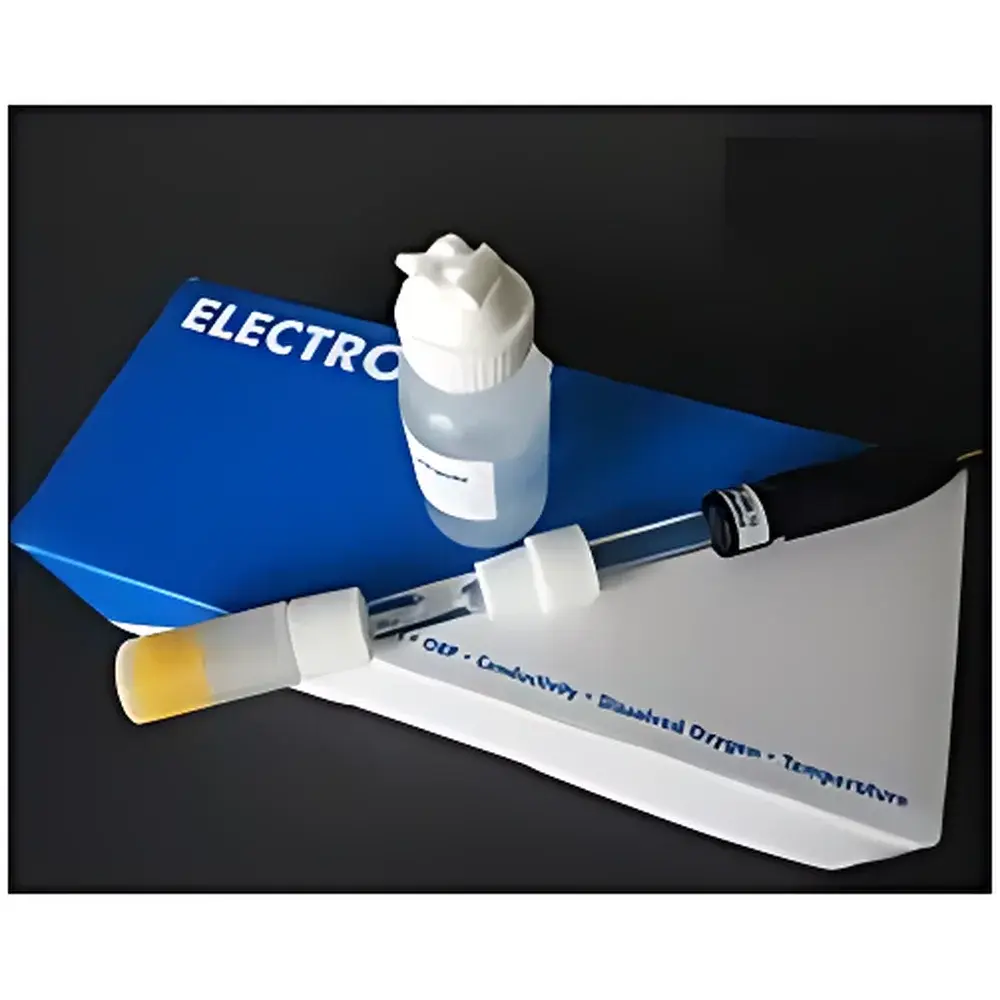
dc-energies Ag/AgCl Double-Junction Reference Electrode & Saturated Calomel Electrode (SCE)
| Brand | dc-energies |
|---|---|
| Origin | Hubei, China |
| Manufacturer Type | Authorized Distributor |
| Origin Category | Domestic (China-manufactured) |
| Model | Ref-Electrode Series |
| Pricing | Available Upon Request |
Overview
The dc-energies Ag/AgCl Double-Junction Reference Electrode and Saturated Calomel Electrode (SCE) are precision electrochemical reference systems engineered for stable, reproducible potential control in potentiometric and voltammetric measurements. Designed to meet the stringent demands of laboratory-based electrochemical research, corrosion studies, battery material characterization, and quality-controlled analytical workflows, these electrodes operate on well-established thermodynamic principles—specifically, the Nernst equation—by maintaining a fixed, known interfacial potential relative to the Standard Hydrogen Electrode (SHE). The double-junction configuration isolates the internal Ag/AgCl element from sample matrix interference through a secondary electrolyte bridge (10% w/w KNO₃), significantly reducing liquid junction potential drift and contamination risk during long-term or complex-media experiments. The SCE variant provides an alternative reference with a defined potential of +0.244 V vs. SHE at 25 °C, while the Ag/AgCl version offers enhanced temperature stability and lower thermal hysteresis compared to mercury-based systems.
Key Features
- Double-junction architecture with outer chamber filled with 10% (w/w) aqueous KNO₃ solution—chemically inert, low-junction-potential electrolyte compatible with chloride-sensitive or protein-rich samples
- Inner compartment contains gelified saturated KCl solution with embedded Ag/AgCl sensing element—minimizes electrolyte depletion and ensures mechanical robustness during agitation or flow-through applications
- High-purity sintered ceramic frit (pore size ~2–5 µm) for controlled, consistent electrolyte leakage rate (~1–2 µL/h), balancing stability and response time
- Chemically resistant polypropylene or PTFE body construction with threaded 10–32 UNF or standard 6 mm OD shaft for secure integration into rotating disk electrode (RDE) cells, electrochemical flow cells, and custom three-electrode setups
- Calibration traceability supported by factory-measured open-circuit potential (OCP) data sheets referenced to SHE at 25 °C, with documented thermal coefficient (−0.6 mV/°C for Ag/AgCl/KCl(sat))
Sample Compatibility & Compliance
These reference electrodes are validated for use across diverse electrochemical environments—including aqueous buffers (pH 1–13), non-aqueous Li-ion battery electrolytes (e.g., 1 M LiPF₆ in EC/DMC), acidic etchants, alkaline fuel cell media, and biological redox systems. The KNO₃ outer junction prevents precipitation when measuring in sulfate-, phosphate-, or sulfide-containing solutions where KCl-based single-junction electrodes would form insoluble salts (e.g., PbSO₄, Ag₃PO₄). All units comply with ISO 80000-9:2019 (quantities and units – physical chemistry) for electrode potential reporting and conform to ASTM E2763-21 guidelines for reference electrode selection in corrosion testing. No mercury content in Ag/AgCl variants supports RoHS-compliant lab operations; SCE units include appropriate handling and disposal documentation per ICH Q5C and local hazardous materials regulations.
Software & Data Management
While inherently analog devices, these electrodes integrate seamlessly with industry-standard potentiostats (e.g., BioLogic SP-300, Gamry Interface 5000E, Pine Research WaveNow) and associated software platforms (EC-Lab®, Framework™, AfterMath®). Their stable output enables high-fidelity potential referencing in automated sequences involving cyclic voltammetry, chronoamperometry, electrochemical impedance spectroscopy (EIS), and multi-step pulse protocols. When deployed in GLP- or GMP-aligned laboratories, the electrodes support audit-ready workflows: batch-specific calibration logs, OCP verification records, and junction integrity checks can be embedded within electronic lab notebooks (ELN) such as LabArchives or Benchling. For FDA 21 CFR Part 11 compliance, users may configure instrument software to timestamp and digitally sign electrode validation events.
Applications
- Electrocatalyst evaluation using rotating disk electrode (RDE) hydrodynamic voltammetry
- In-situ monitoring of electrodeposition kinetics in plating baths and semiconductor CMP slurries
- Corrosion potential mapping of coated alloys in simulated seawater or industrial coolant formulations
- Redox titration endpoint detection in pharmaceutical active ingredient assays (USP )
- Stability testing of solid-state electrolytes via DC polarization and leakage current analysis
- Environmental electroanalysis—including nitrate, heavy metal, and perchlorate sensing in groundwater matrices
FAQ
What is the typical shelf life of the Ag/AgCl double-junction electrode when stored properly?
When kept upright with both junctions immersed in 10% KNO₃ solution at 4–25 °C and protected from light, functional stability exceeds 12 months. Gelified inner KCl maintains integrity for ≥6 months post-opening.
Can this electrode be used in non-aqueous solvents like acetonitrile or propylene carbonate?
Yes—with appropriate outer electrolyte substitution (e.g., 0.1 M TBAP in ACN); however, junction compatibility must be verified experimentally due to differential solvation and viscosity effects on liquid junction potential.
How often should the outer KNO₃ reservoir be refilled?
Refill every 7–10 days under continuous use; visual inspection of electrolyte level and frit clarity is recommended prior to each experimental session.
Is the SCE version supplied with mercury amalgam certified to ISO 6425?
No—this SCE is intended for laboratory reference use only and does not carry diving watch-grade certification; it meets ASTM C1152/C1152M specifications for calomel reference elements in civil engineering test methods.
Do you provide NIST-traceable calibration certificates?
Custom calibration reports against NIST SRM 1796 (Ag/AgCl) are available upon request, including uncertainty budgets per ISO/IEC 17025:2017 Annex A.
Related Products





