
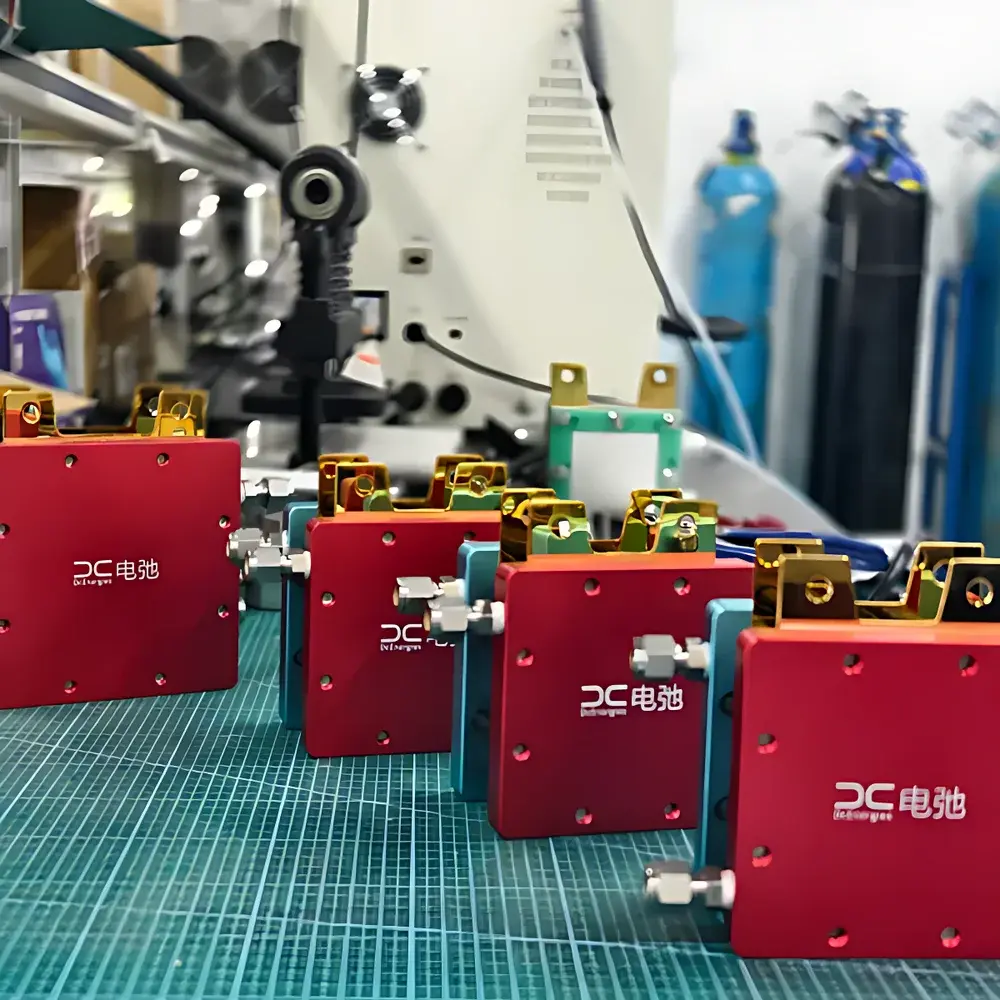
DC-Energies DC-4 Multi-Application Electrochemical Cell Fixture for PEM Fuel Cell, CO₂ Reduction, and Water Electrolysis Testing
| Brand | DC-Energies |
|---|---|
| Model | DC-4 |
| Origin | Hubei, China |
| Construction Material Options | Graphite, Aerospace-Grade Titanium, Pt-Coated Titanium, Nickel Plate |
| Active Area Customization | 1–100 cm² (e.g., 1, 4, 5, 16, 25, 50, 100 cm²) |
| Flow Field Configurations | Single-, 3-, or 10-channel layouts |
| Flow Field Patterns | Serpentine, Parallel, or Rectangular (customizable) |
| Heating Integration | Cartridge Heater or Flexible Heated Foil (optional) |
| Interface Compatibility | Gas Inlet/Outlet Ports, Thermocouple Terminals (e.g., K-type), Current Collector Busbars (gold-plated copper or titanium) |
Overview
The DC-Energies DC-4 is a modular, research-grade electrochemical cell fixture engineered for standardized and reproducible evaluation of membrane electrode assemblies (MEAs) and catalyst layers under controlled operational conditions. Designed for fundamental and applied studies in proton exchange membrane (PEM) fuel cells, anion exchange membrane (AEM) water electrolyzers, and electrocatalytic CO₂ reduction (CO₂RR), the fixture implements a robust compression-sealed architecture that ensures uniform contact pressure across the active area while maintaining gas-tight integrity. Its mechanical design adheres to widely adopted laboratory-scale testing conventions—supporting both ambient and elevated temperature operation (up to 120 °C with integrated heating)—and enables precise control of reactant delivery, thermal management, and electrical current collection. Unlike single-purpose test cells, the DC-4’s configurable geometry accommodates diverse electrode architectures, flow field topologies, and material compatibility requirements, making it suitable for catalyst screening, durability assessment, and kinetic parameter extraction in academic, governmental, and industrial R&D environments.
Key Features
- Modular mechanical assembly with CNC-machined end plates and precision-ground sealing surfaces for repeatable clamping force distribution (adjustable via calibrated torque screws)
- Interchangeable flow field inserts compatible with serpentine, parallel, and rectangular channel patterns—enabling systematic investigation of mass transport effects on polarization behavior
- Multi-area active zone support (1–100 cm²) with standardized porting layout; each configuration maintains consistent gasket compression ratio and current collector alignment
- Thermal integration options include embedded cartridge heaters (for rapid ramp-up) or conformal heated foils (for uniform surface temperature profiles), both with integrated K-type thermocouple ports for real-time monitoring at the MEA interface
- Corrosion-resistant material variants: high-purity graphite (for acidic PEM environments), ASTM B265 Grade 2 titanium (for alkaline AEM systems), Pt-coated Ti (for high-potential OER stability), and nickel plate (for CO₂RR in neutral/alkaline media)
- Dual-side electrical access with low-resistance busbar interfaces (gold-plated copper or titanium), supporting four-wire sensing configurations for accurate IR-compensated voltage measurement
Sample Compatibility & Compliance
The DC-4 fixture supports standard MEA formats including catalyst-coated membranes (CCMs) and gas diffusion electrodes (GDEs), with compatibility extending to thin-film electrodes deposited on conductive substrates. All material selections comply with ASTM D3950 (standard practice for testing fuel cell components) and ISO 14687-2 (hydrogen purity specifications for PEM fuel cells). When configured with Pt-coated titanium or nickel components, the fixture meets corrosion resistance benchmarks outlined in ASTM G31 for immersion testing in aggressive electrolytes. For regulated environments, the mechanical design allows full traceability of assembly parameters—including torque values, gasket lot numbers, and seal compression depth—supporting GLP-compliant documentation workflows. While not a certified instrument per se, the fixture integrates seamlessly with commercial potentiostats/galvanostats compliant with IEC 62040-3 and FDA 21 CFR Part 11 when paired with audit-trail-enabled software platforms.
Software & Data Management
The DC-4 operates as a hardware platform rather than a standalone instrument; thus, data acquisition and control are performed through third-party electrochemical workstations (e.g., BioLogic SP-300, Gamry Interface 5000E, or Pine WaveDriver 200). Its standardized porting and electrical interface facilitate direct integration with LabVIEW, Python (via PyVISA), or MATLAB-based automation scripts. Users may implement custom protocols for cyclic voltammetry, linear sweep voltammetry, chronoamperometry, and impedance spectroscopy (EIS) across frequency ranges from 10 mHz to 1 MHz. All thermocouple, pressure transducer, and current/voltage signals can be time-synchronized using external trigger inputs, enabling multi-parameter correlation analysis essential for mechanistic studies. Raw datasets adhere to the MIAME/MIAPE-inspired metadata schema recommended by the Electrochemical Society for long-term archival and cross-laboratory comparison.
Applications
- Performance benchmarking of low-Pt and Pt-free cathode catalysts in PEM fuel cells under DOE-relevant operating conditions (80 °C, 100% RH, 150–250 kPa backpressure)
- Stability assessment of NiFe LDH and CoPi anodes during alkaline water electrolysis, including accelerated stress tests (ASTs) per IEA Hydrogen TCP guidelines
- Kinetic analysis of Cu-based gas-diffusion electrodes in CO₂RR, with simultaneous product quantification via online GC and Faradaic efficiency calculation
- Investigation of interfacial degradation mechanisms—including carbon corrosion, catalyst dissolution, and membrane thinning—using in situ XRD and Raman coupling through optical access windows (available upon request)
- Validation of computational fluid dynamics (CFD) models for flow field optimization, leveraging the fixture’s geometric fidelity and boundary condition repeatability
FAQ
What active area sizes are available as standard configurations?
Standard active areas include 1, 4, 5, 16, 25, 50, and 100 cm². Custom intermediate sizes (e.g., 10 cm², 36 cm²) are manufacturable upon request with lead-time adjustment.
Can the fixture accommodate liquid-fed CO₂RR electrolyzers with flowing KHCO₃ solutions?
Yes—when equipped with nickel or Pt-coated titanium components and chemically resistant gaskets (e.g., EPDM or Viton), the DC-4 supports continuous-flow aqueous electrolyte operation with integrated liquid inlet/outlet manifolds.
Is thermal insulation included, or must it be added externally?
The base fixture does not include built-in insulation; however, standard mounting holes and flange dimensions allow straightforward integration with commercial furnace sleeves or ceramic fiber wrap kits for thermal containment.
How is electrical isolation maintained between anode and cathode compartments?
Full galvanic isolation is achieved via non-conductive gasket materials (e.g., polyimide or PTFE composites) and insulated fasteners; leakage current remains below 1 nA at 1.8 V under standard test conditions.
Do you provide dimensional drawings and torque specifications for GLP documentation?
Yes—fully annotated STEP files, GD&T-controlled PDF schematics, and a calibration-grade torque protocol document are supplied with each unit to support internal quality system compliance.



