
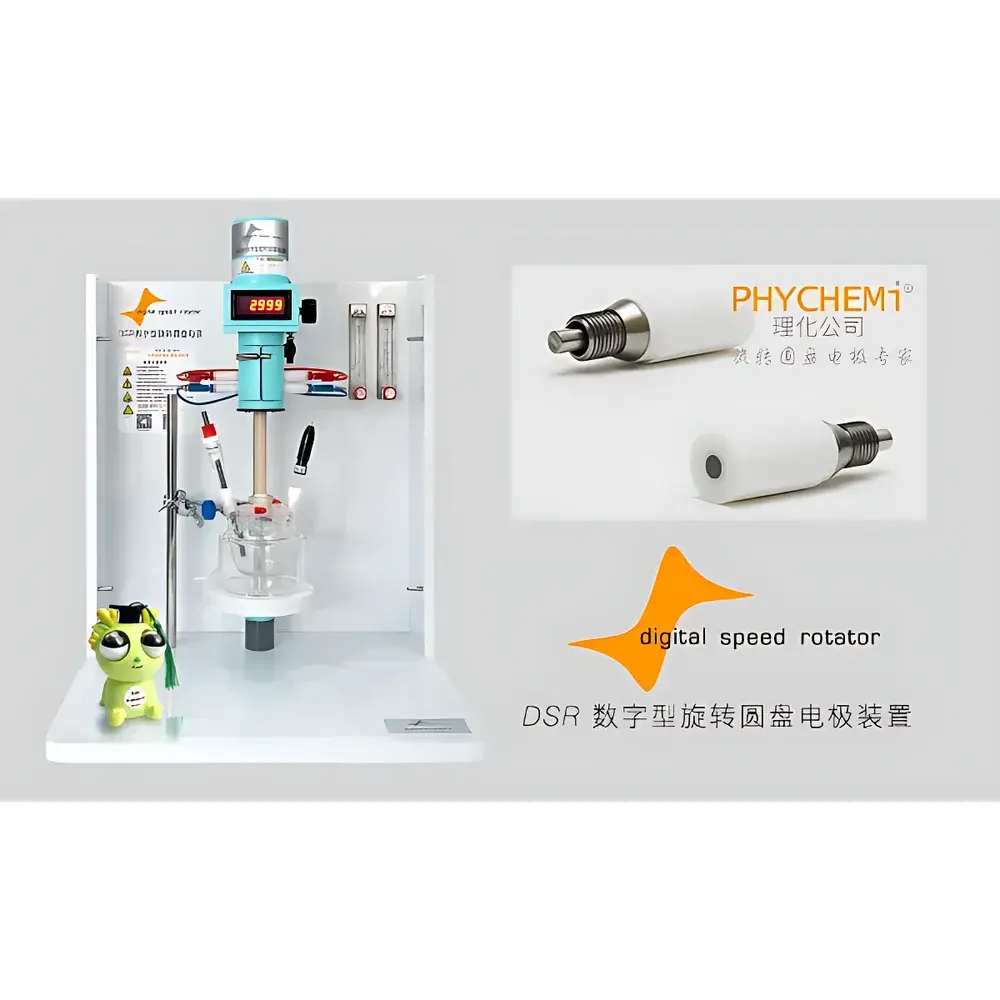
DC-Energies DSR Digital Rotating Disk Electrode (RDE) System
| Brand | DC-Energies |
|---|---|
| Origin | Hubei, China |
| Manufacturer Type | Authorized Distributor |
| Model | DSR Digital RDE System |
| Speed Range | 0–10,000 rpm |
| Motor Power | 20 W |
| Carbon Brush | Silver-carbon (Ag > 80%), low contact resistance, high EMI immunity |
| Rotation Shaft | 170 mm length, 15 mm OD |
| Disk Electrode | Glassy carbon, 5.0 mm disk diameter, 15 mm outer diameter, PTFE or PEEK insulation |
| Ring-Disk Electrode (RDE/RRDE) | Disk diameter 5.61 mm, ring inner diameter 6.25 mm, ring outer diameter 7.92 mm, gap ≤ 320 µm, collection efficiency 37%, dimensional tolerance ±0.01 mm |
| Gas Flow Control | Dual calibrated mass flow meters (inert gas & O₂) |
| Power Supply | DC input, EMI-reduced architecture |
| Compliance | Designed for glovebox integration, explosion-proof enclosure |
| Warranty | 12 months, lifetime technical support |
Overview
The DC-Energies DSR Digital Rotating Disk Electrode (RDE) System is a precision-engineered electrochemical hydrodynamic measurement platform designed for quantitative kinetic and mass-transport studies under controlled convection. Based on the Levich and Koutecký–Levich formalisms, the system enables rigorous determination of electron transfer kinetics, diffusion coefficients, reaction intermediates, and catalyst turnover frequencies—particularly critical in fuel cell catalysis, CO₂ reduction, and water splitting research. Its digitally regulated rotation mechanism ensures stable, reproducible hydrodynamic boundary layers across the electrode surface, supporting both steady-state and transient electrochemical techniques including cyclic voltammetry, linear sweep voltammetry, chronoamperometry, and rotating ring-disk electrode (RRDE) analysis. The DSR integrates seamlessly with commercial potentiostats and electrochemical workstations via analog speed control input and synchronized data acquisition triggers.
Key Features
- Digital speed control chip with ±1 rpm resolution and <0.5% speed drift over 24 h, ensuring high reproducibility in Levich plot construction.
- High-purity silver-carbon brushes (>80% Ag) minimize contact resistance (<5 mΩ) and electromagnetic interference—critical for low-noise current measurement at microampere to milliampere levels.
- Glovebox-compatible modular design: detachable rotation head, compact footprint (≤200 × 150 × 280 mm), and DC-powered operation eliminate mains-borne noise and enable inert-atmosphere operation.
- Explosion-proof housing certified per IEC 60079-0 general requirements for non-sparking enclosures, suitable for O₂-saturated or H₂-containing electrolyte environments.
- Interchangeable shafts and electrode assemblies—including standard RDE, RRDE, and U-CUP–enabled product-collection configurations—support method development across catalyst stability, selectivity, and faradaic efficiency assessment.
- Dual calibrated mass flow meters (0–50 sccm inert gas; 0–25 sccm O₂) allow precise electrolyte deaeration and controlled O₂ saturation—essential for ORR/OER benchmarking per ASTM D7212 and DOE Catalyst Performance Protocols.
Sample Compatibility & Compliance
The DSR accommodates standard three-electrode cells (e.g., 5-port Pyrex or quartz electrochemical cells) as well as custom-designed reactors for high-temperature or pressurized operation (up to 80 °C, ambient pressure). Disk electrodes are supplied in glassy carbon (GC), platinum, gold, or custom substrates upon request; insulating sheaths are available in chemically inert PTFE or high-strength PEEK—both compliant with USP Class VI and ISO 10993-5 cytotoxicity standards. RRDE geometries adhere to strict dimensional tolerances (±0.01 mm disk/ring alignment, ≤320 µm gap), enabling accurate collection efficiency calibration per ASTM G102 and validated against NIST-traceable reference systems. All mechanical and electrical interfaces conform to IEC 61000-6-3 (EMC emission) and IEC 61000-6-2 (immunity) requirements.
Software & Data Management
While the DSR operates as a hardware-peripheral device, it supports bidirectional synchronization with leading electrochemical software platforms—including BioLogic EC-Lab, Pine AfterMath, and Metrohm NOVA—via 0–5 V analog speed command input and TTL-compatible status outputs. Rotation speed logging is embedded into potentiostat data streams, enabling automatic alignment of hydrodynamic conditions with electrochemical transients. For GLP/GMP-aligned labs, the system’s deterministic speed response and traceable calibration protocol support 21 CFR Part 11-compliant audit trails when paired with validated workstation software. Firmware updates and configuration files are distributed through secure, version-controlled repositories accessible to registered institutional users.
Applications
The DSR system is routinely deployed in academic and industrial electrocatalysis laboratories for:
- Kinetic analysis of oxygen reduction (ORR) and oxygen evolution (OER) reactions using Pt/C, Fe–N–C, NiFeOx, and perovskite catalysts—aligned with DOE Hydrogen Program Targets and IEA Task 37 reporting guidelines.
- Faradaic efficiency quantification in CO₂ electroreduction (CO2RR) via in situ RRDE detection of C₂+ intermediates (e.g., glyoxylate, ethylene oxide) and suppression of H₂ crossover.
- Hydrogen evolution reaction (HER) mechanistic studies on MoS₂, NiMo, and doped carbides under acidic/alkaline media.
- Corrosion science applications: Tafel slope extraction, passivation behavior mapping, and inhibitor adsorption isotherm modeling in chloride-containing electrolytes.
- Membrane electrode assembly (MEA) catalyst layer screening—integrated with slurry dispersion (DC ID-4000), electrode polishing (DC REP-180), and ink deposition (DC SEC-1000) workflows.
FAQ
Is the DSR compatible with third-party potentiostats?
Yes—the system accepts 0–5 V analog speed commands and provides TTL-ready status signals, ensuring interoperability with Gamry, Autolab, CHI, and Biologic instruments.
Can the rotation shaft be replaced for high-temperature experiments?
Standard shafts are rated to 80 °C; optional Inconel 600 or ceramic-coated shafts are available for extended thermal operation up to 150 °C.
What is the calibration procedure for RRDE collection efficiency?
Users perform a standard quinone/hydroquinone redox couple experiment per ASTM G102; typical measured collection efficiency is 37.0 ± 0.3% for the supplied geometry.
Does the system support automated potential-step rotation modulation?
Yes—when triggered via external TTL pulse, the DSR achieves <50 ms rotational acceleration to target speed, enabling time-resolved convection-switched experiments.
Are PTFE and PEEK insulator options chemically resistant to HF or molten salt electrolytes?
PTFE is compatible with concentrated HF below 50 °C; PEEK withstands anhydrous LiTFSI/DOL up to 60 °C. Custom ceramic insulation is available for molten carbonate or fluoride salt systems.






