
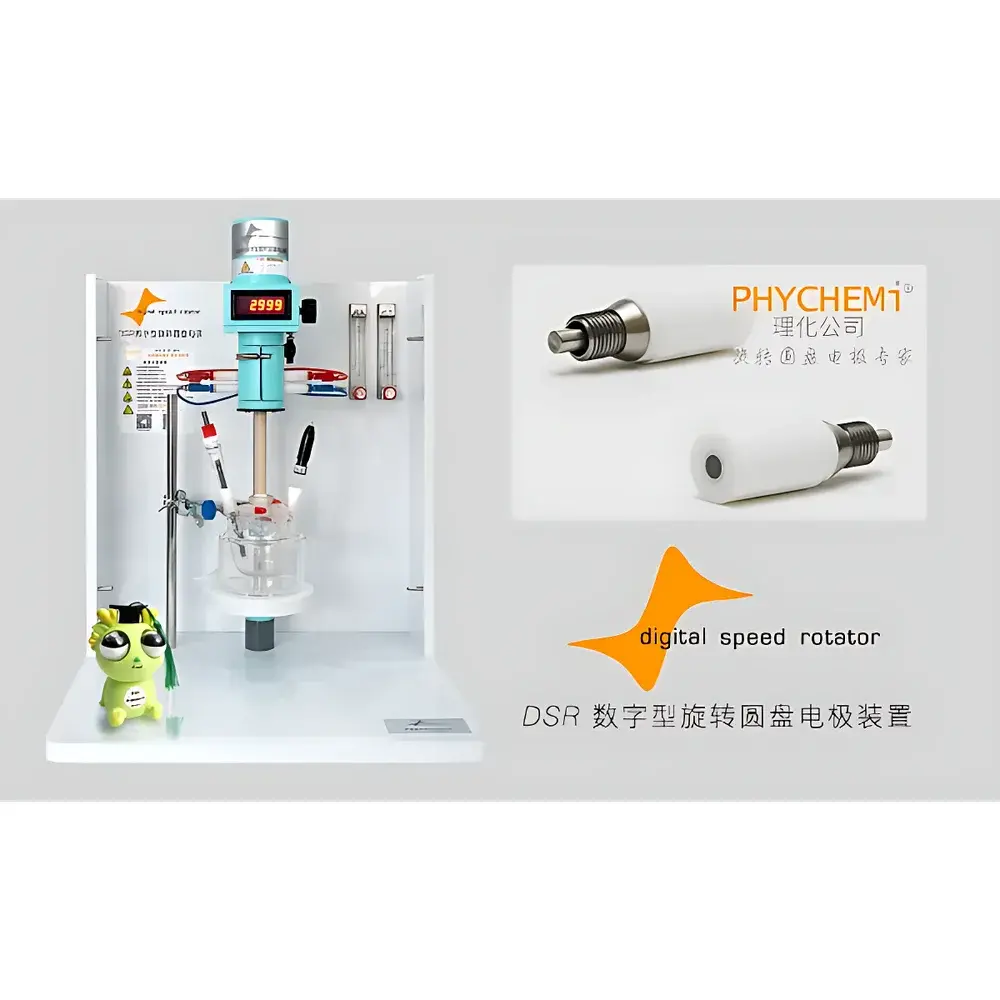
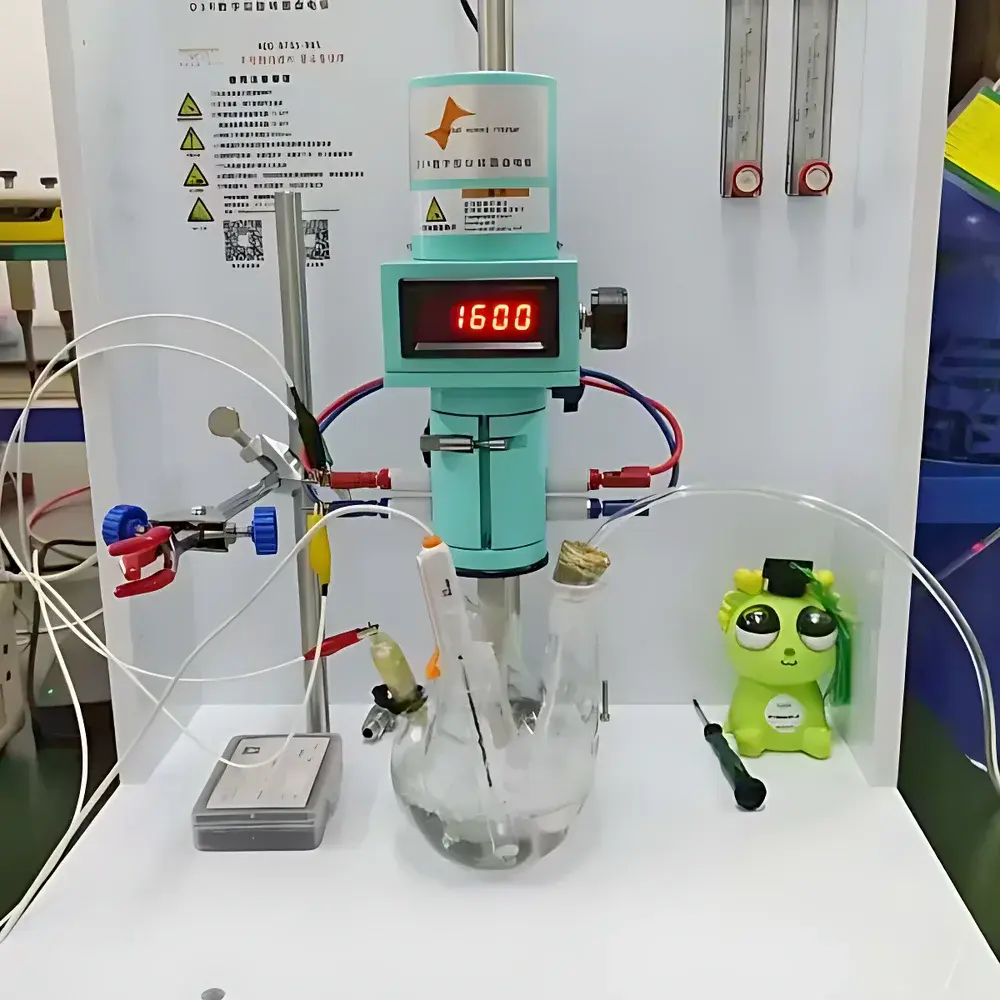
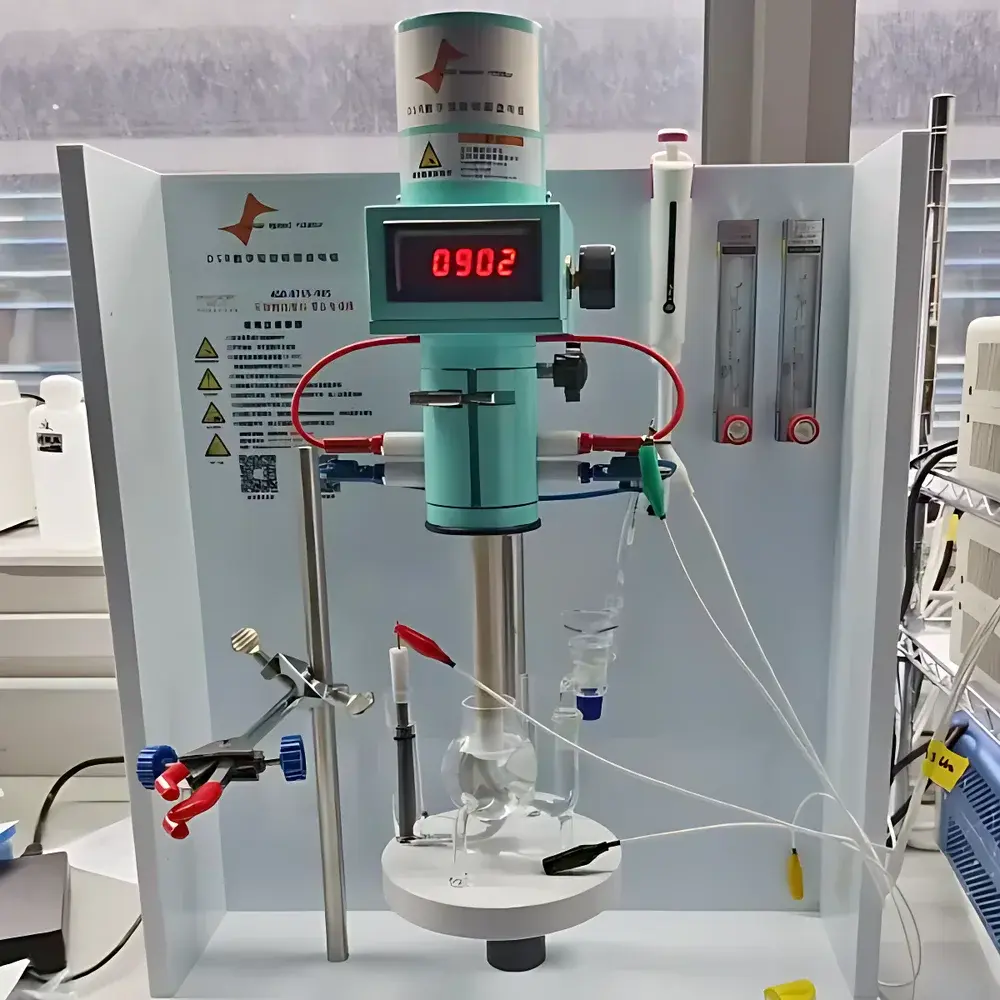
DC-Energies DSR Digital Rotating Disk and Ring-Disk Electrode (RDE/Ring-Disk) System
| Brand | DC-Energies |
|---|---|
| Origin | Hubei, China |
| Model | DSR Digital Rotating |
| Rotation Speed Range | 0–10,000 rpm |
| Motor Power | 20 W |
| Brush Type | Eco-friendly silver-carbon brush |
| Control Architecture | Integrated digital control chip with external signal input interface (compatible with potentiostats/galvanostats) |
| Power Supply | DC-powered, EMI-suppressed design |
| Explosion-Proof Rating | Certified for safe operation in inert-atmosphere gloveboxes |
| Rotating Shaft | 170 mm length, 15 mm OD, modular and glovebox-compatible |
| Disk Electrode | 5.0 mm active diameter, 15 mm total OD, glassy carbon active material, housing in PEEK or PTFE, operating temperature range: ambient to elevated |
| Ring-Disk Electrode | disk diameter 5.61 mm, ring inner diameter 6.25 mm, ring outer diameter 7.92 mm, inter-electrode gap ≤320 µm, dimensional tolerance ±0.01 mm, collection efficiency 37% |
| Cell Compatibility | Standard 5-port electrochemical cell or custom-designed cells |
| Gas Management | Dual mass flow controllers — inert gas (e.g., N₂/Ar) purge and O₂ saturation lines |
| Upgradability | U-CUP interchangeable disk holder enables in-situ electrode replacement and reaction product capture |
| Warranty & Support | 12-month limited warranty, lifetime technical maintenance, free application training and protocol development support |
Overview
The DC-Energies DSR Digital Rotating Disk and Ring-Disk Electrode (RDE/Ring-Disk) System is a precision-engineered electrochemical hydrodynamic instrumentation platform designed for quantitative kinetic and mechanistic analysis of multi-step electron-transfer reactions. Based on the classical Levich-Koutecký formalism, the system leverages controlled convective mass transport—generated by rotation—to decouple diffusion-limited current from kinetic overpotential. Its dual-mode capability (disk-only RDE and ring-disk RDE) enables real-time detection of transient intermediates (e.g., H₂O₂ in ORR, O₂ in OER), quantification of collection efficiency, and validation of reaction pathways under rigorously defined hydrodynamic conditions. The DSR is engineered for reproducible, low-noise operation in both ambient and inert-atmosphere environments—including integration into argon- or nitrogen-purged gloveboxes—making it indispensable for catalyst evaluation in emerging energy technologies.
Key Features
- Digital closed-loop speed control with ±1 rpm accuracy across 0–10,000 rpm range, enabled by a dedicated microcontroller and high-stability DC motor (20 W)
- Low-interference signal transmission architecture using silver-carbon brushes and shielded coaxial cabling, minimizing electrochemical noise and preserving Faradaic fidelity
- Glovebox-ready modular design: detachable rotating shaft (170 mm × 15 mm OD), compact control unit (<200 mm footprint), and quick-connect electrical interfaces
- DC power supply eliminates AC line noise coupling—critical for low-current measurements (nA–µA range) and high-impedance electrolyte systems
- External trigger input port accepts TTL or analog voltage signals from potentiostats (e.g., BioLogic SP-300, Pine Research WaveNow), enabling synchronized potential sweep and rotation ramp protocols
- Explosion-resistant mechanical housing and intrinsically safe circuit design compliant with IEC 60079-0 general requirements for equipment used in explosive atmospheres
- U-CUP electrode holder system allows rapid, tool-free disk exchange—supporting glassy carbon, Pt, Au, Ni, and custom-fabricated disks without recalibration
Sample Compatibility & Compliance
The DSR accommodates standard three-electrode configurations with full compatibility to commercial electrochemical workstations. Disk electrodes feature threaded M6 mounting and hermetic sealing against electrolyte leakage; ring-disk variants maintain strict geometric tolerances (disk/ring alignment ±0.01 mm, gap ≤320 µm) to ensure theoretical collection efficiency (N = 37%) remains within ASTM D7487-15 specified uncertainty limits. All wetted components are constructed from chemically inert PEEK or PTFE—resistant to strong acids (e.g., 1 M H₂SO₄), alkaline media (e.g., 1 M KOH), and organic electrolytes (e.g., 0.1 M TBAPF₆ in acetonitrile). The system supports GLP-compliant documentation when paired with FDA 21 CFR Part 11–enabled software platforms via timestamped rotation log export.
Software & Data Management
While the DSR operates as a hardware-peripheral device, its digital control interface supports bidirectional communication via RS-232 or USB-C (firmware-upgradable). Rotation parameters—including speed setpoint, actual RPM feedback, acceleration profile, and runtime—are logged synchronously with electrochemical data streams using third-party acquisition software (e.g., EC-Lab, AfterMath, NOVA). Exportable CSV logs include ISO 8601 timestamps, enabling post-hoc correlation of hydrodynamic state with voltammetric features (e.g., E₁/₂ shifts, limiting current plateaus). Firmware updates preserve backward compatibility and introduce new operational modes—such as stepped rotation sequences for Koutecký-Levich analysis—without hardware modification.
Applications
- Oxygen reduction reaction (ORR) mechanism studies in proton-exchange membrane fuel cells (PEMFCs), including peroxide yield quantification via ring current integration
- Oxygen evolution reaction (OER) kinetics on transition-metal oxides, with simultaneous pH-controlled electrolyte delivery
- Hydrogen evolution reaction (HER) Tafel analysis under controlled mass transport, distinguishing Volmer–Heyrovsky vs. Volmer–Tafel pathways
- CO₂ electroreduction (CO2RR) selectivity mapping across Cu-based catalysts, correlating local pH gradients with C₂+ product distribution
- Corrosion science: determination of critical pitting potentials and passive film stability in chloride-containing media
- Catalyst stability assessment via accelerated degradation protocols (ADPs) combining potential cycling and rotational stress
- Electrocatalyst screening for metal–air batteries, integrating O₂ saturation control and long-term chronoamperometric monitoring
FAQ
Is the DSR compatible with third-party potentiostats?
Yes—the DSR accepts analog voltage (0–5 V) or TTL-level external triggers for speed control and provides real-time RPM feedback via analog output or serial interface.
Can the ring-disk geometry be customized beyond the standard 5.61/6.25/7.92 mm configuration?
Custom geometries are available upon request; dimensional tolerances remain within ±0.01 mm, and collection efficiency is recalculated and certified per ISO 13689:2012 Annex B.
Does the system support temperature-controlled operation?
The base unit is rated for ambient-to-60°C operation; for elevated-temperature studies (>60°C), optional thermostatted cell jackets and heat-resistant shaft seals are available.
How is calibration verified?
Each unit ships with NIST-traceable rotation calibration certificate (using laser tachometer verification at 100, 1000, 5000, and 10,000 rpm); electrode geometry certification is performed via SEM metrology and included in the delivery dossier.
What maintenance is required?
Brush replacement is recommended every 12 months under continuous use; all consumables (brushes, O-rings, U-CUP inserts) are field-replaceable without tools or service dispatch.





