
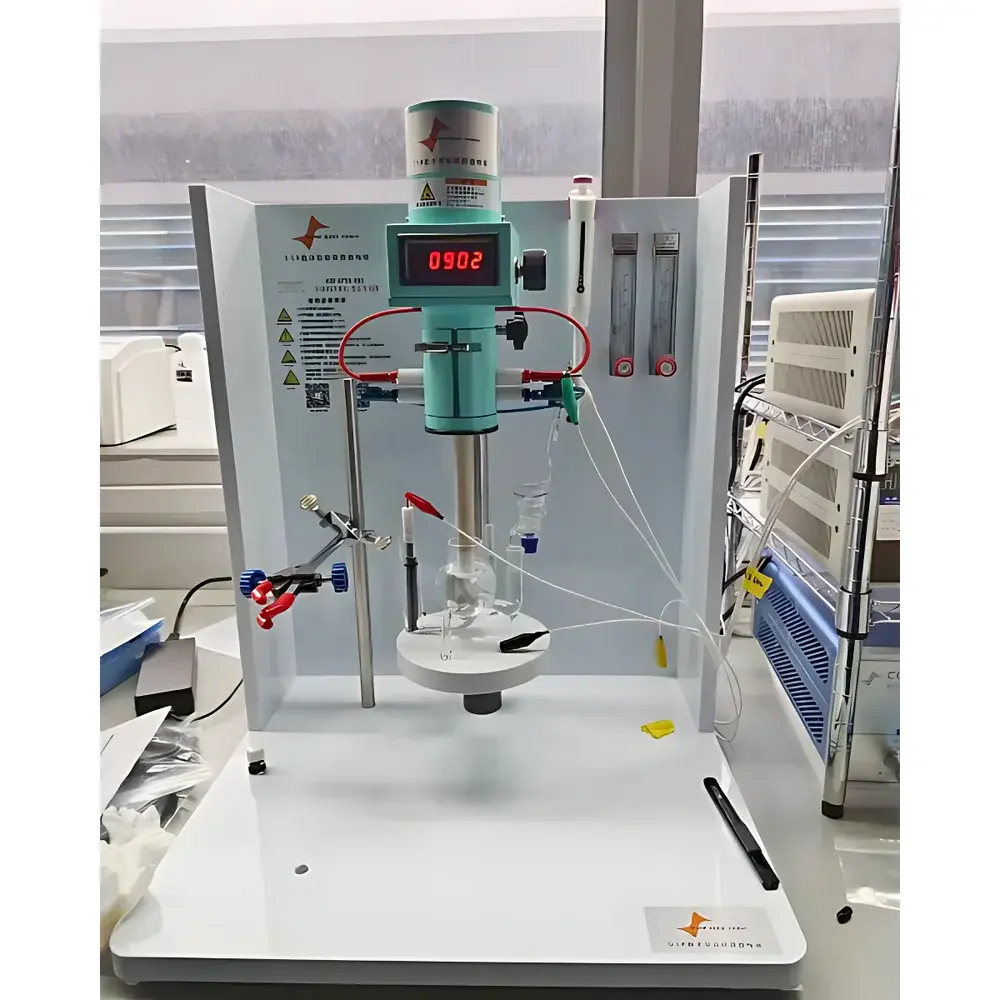
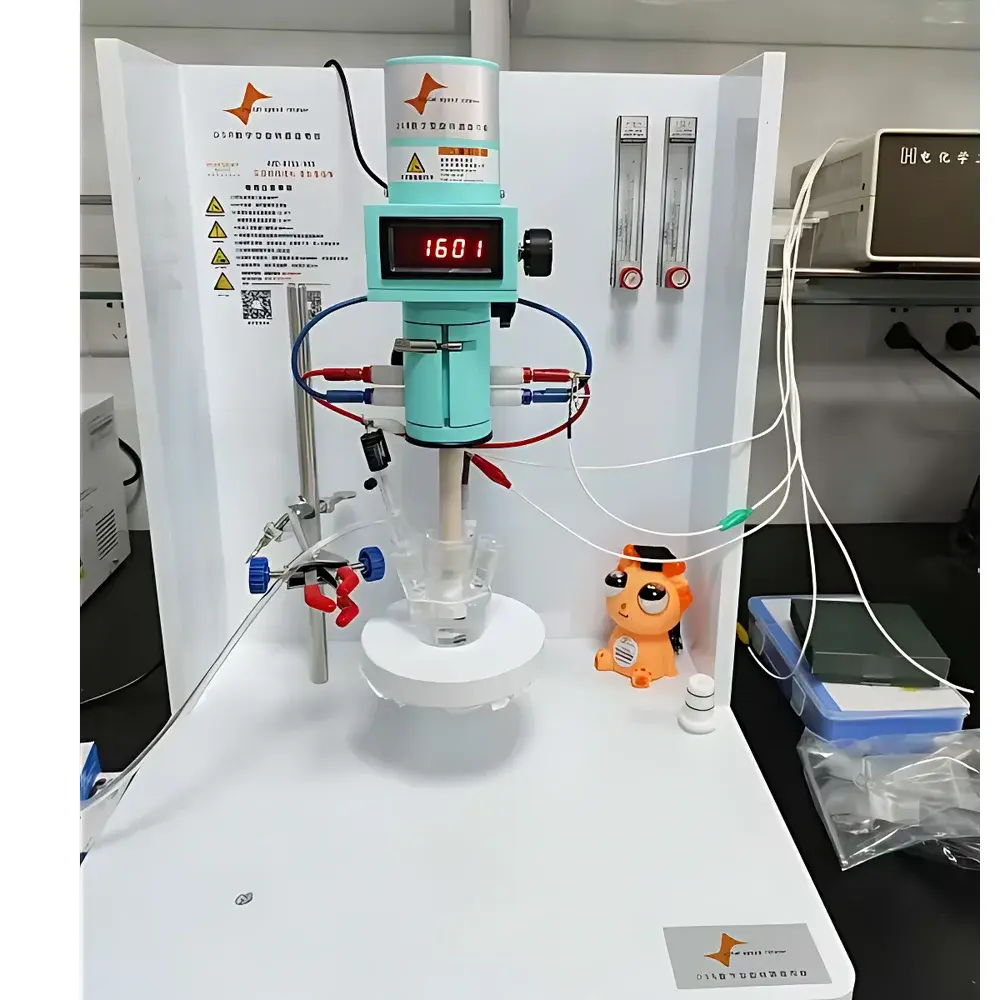
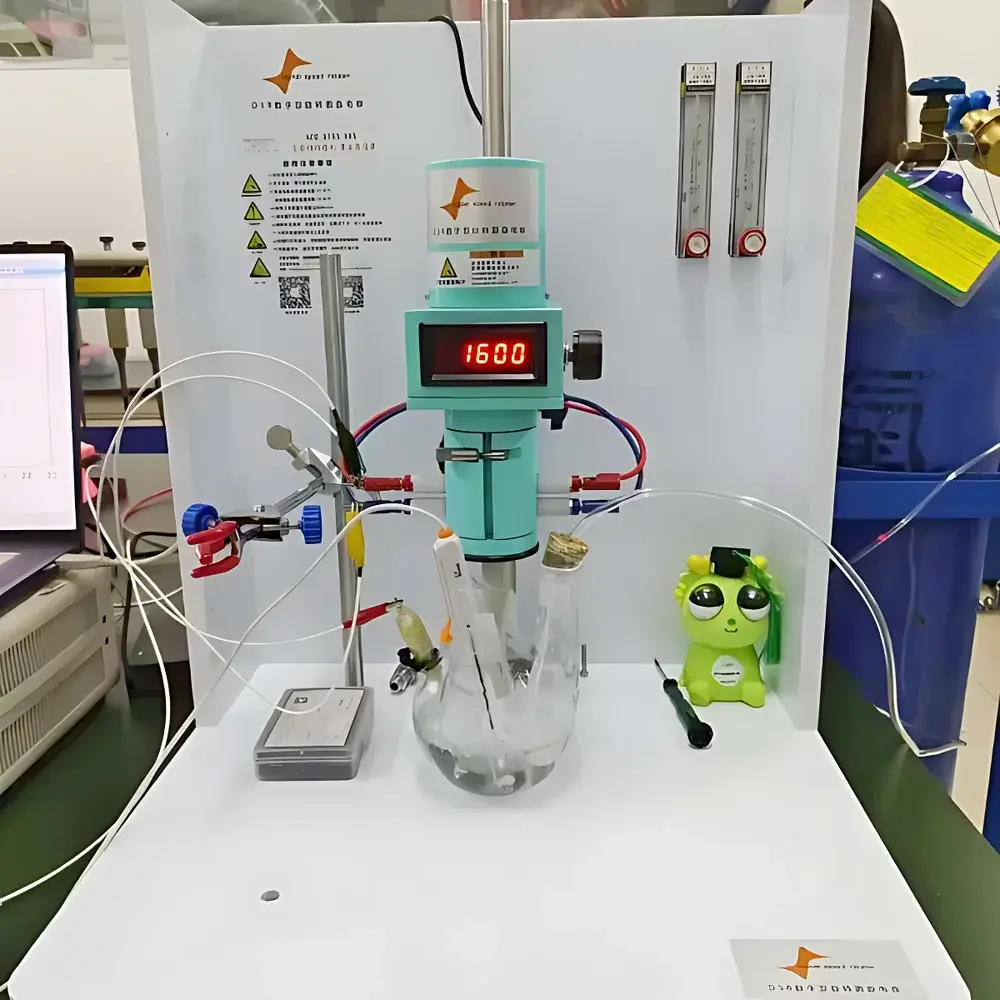
DC-Energies DSR Digital Rotating Ring-Disk Electrode (RRDE) System
| Brand | DC-Energies |
|---|---|
| Model | DSR Digital |
| Type | Rotating Ring-Disk Electrode (RRDE) Instrument |
| Rotation Speed Range | 0–10,000 rpm |
| Motor Power | 20 W |
| Ring-Disk Gap | ≤320 µm |
| Disk Diameter | 5.61 mm |
| Ring Inner/Outer Diameter | 6.25 mm / 7.92 mm |
| Collection Efficiency | 37% |
| Disk Electrode Material | Glassy Carbon |
| Insulator Body Materials | PEEK or PTFE |
| Disk Electrode Diameter (active) | 5.0 mm |
| Shaft Length | 170 mm |
| Shaft Outer Diameter | 15 mm |
| Electrical Contact | Silver-Carbon Brush |
| Power Supply | DC |
| Control | Integrated Digital Microcontroller |
| External Trigger Input | Yes |
| Explosion-Proof Design | Yes |
| Compatible Electrolytic Cells | Standard 5-Port or Custom-Built |
Overview
The DC-Energies DSR Digital Rotating Ring-Disk Electrode (RRDE) System is a precision-engineered electrochemical instrumentation platform designed for quantitative kinetic and mechanistic studies of multi-step redox processes. Based on the fundamental principles of controlled hydrodynamic mass transport, the DSR RRDE enables simultaneous measurement of faradaic current at the rotating disk electrode (RDE) and detection/amplification of transient intermediates or reaction products at the concentric ring electrode. Its operation adheres to Levich and Koutecký–Levich formalisms, allowing rigorous determination of electron transfer numbers, collection efficiency (η = 37%), reaction stoichiometry, and intermediate lifetimes under well-defined laminar flow conditions. Engineered for reproducibility and long-term stability in both ambient and glovebox environments, the DSR system supports advanced research in electrocatalysis, corrosion science, and energy conversion—particularly where quantification of short-lived species (e.g., H₂O₂ in ORR, O₂•⁻ in CO₂RR) is critical.
Key Features
- Digital microcontroller-based speed control with ±1 rpm resolution across 0–10,000 rpm range, ensuring high reproducibility in hydrodynamic boundary layer definition.
- Silver-carbon brush contact interface minimizes electrical noise and signal attenuation—critical for low-current (<10 nA) detection at the ring electrode.
- Modular, glovebox-compatible design with quick-release shaft coupling and tool-free electrode exchange; shaft dimensions (170 mm length × 15 mm OD) ensure compatibility with standard 5-port electrochemical cells and custom reactors.
- DC-powered architecture eliminates AC line interference, enhancing signal-to-noise ratio during potentiostatic/galvanostatic measurements synchronized with rotation.
- External TTL/0–5 V trigger input enables precise temporal alignment between electrochemical waveform generation (e.g., from Biologic SP-300 or Pine AFCBP) and rotational acceleration/deceleration phases.
- Intrinsically safe, explosion-proof mechanical housing compliant with IEC 60079-0 general requirements for equipment used in potentially explosive atmospheres.
- Interchangeable disk electrodes (5.0 mm active diameter, glassy carbon) mounted via precision-machined external thread interface for optimal electrical contact and thermal stability from room temperature up to 80 °C.
Sample Compatibility & Compliance
The DSR RRDE accommodates disk electrodes fabricated from glassy carbon, platinum, gold, or custom substrates—enabling studies across acidic, alkaline, and non-aqueous electrolytes (e.g., 0.1 M KOH, 0.1 M HClO₄, 0.1 M TBAPF₆ in acetonitrile). The ring-disk geometry (disk: 5.61 mm Ø; ring ID/OD: 6.25 mm / 7.92 mm; gap ≤320 µm) is manufactured to ±0.01 mm dimensional tolerance, meeting ASTM E2004-22 specifications for RRDE geometric calibration. Insulator bodies are available in chemically inert PEEK or PTFE—both certified to USP Class VI and ISO 10993-5 for biocompatibility. The system integrates seamlessly with GLP/GMP-compliant workflows: full audit trails (via optional software add-ons), electronic signature support (21 CFR Part 11 ready), and traceable calibration records per ISO/IEC 17025.
Software & Data Management
While the DSR hardware operates independently of proprietary software, it is fully compatible with industry-standard electrochemical platforms including BioLogic EC-Lab, Pine AfterMath, and Metrohm NOVA. Its digital control interface supports SCPI-like command sets over RS-232 or USB-CDC, enabling automated experiment sequencing (e.g., sweep-rate vs. rotation-rate matrices) and synchronization with potentiostat-triggered data acquisition. Raw rotation speed logs, trigger timestamps, and analog ring/disk current inputs can be logged externally using National Instruments DAQ systems or Keysight U1282A multimeters. All firmware updates are delivered via signed binary packages with SHA-256 verification—ensuring integrity and version traceability in regulated environments.
Applications
- Oxygen reduction reaction (ORR) mechanism analysis in PEMFC and AEMFC catalyst development, including H₂O₂ yield quantification and n-value determination.
- Electrocatalytic CO₂ reduction (CO₂RR) pathway discrimination—e.g., detection of CO, formate, or C₂+ intermediates at the ring while varying disk potential.
- Kinetic evaluation of oxygen evolution reaction (OER) and hydrogen evolution reaction (HER) using rotating disk voltammetry coupled with ring collection of evolved gases (with optional gas-permeable membranes).
- Corrosion inhibitor screening via real-time monitoring of metal dissolution intermediates (e.g., Fe²⁺ oxidation products) at the ring electrode.
- Study of coupled chemical-electrochemical (EC’) reactions, such as disproportionation of radical anions or hydrolysis of electrogenerated species.
- Validation of catalyst layer ionomer distribution effects through localized ring current mapping in segmented RDE configurations.
FAQ
What is the certified collection efficiency (η) of the DSR RRDE?
The nominal collection efficiency is 37%, validated via ferrocyanide/ferricyanide redox couple experiments per ASTM E2004-22 Annex A2. Actual η may vary ±1.5% depending on electrolyte viscosity and rotation rate.
Can the DSR be operated inside an argon-filled glovebox?
Yes—the modular, DC-powered design and removable shaft assembly allow full integration into Class 1000 or better inert-atmosphere gloveboxes without modification.
Is the ring-disk gap adjustable?
No—the gap is fixed at ≤320 µm during precision machining and cannot be user-adjusted; this ensures geometric consistency required for Koutecký–Levich analysis.
Does the system support dual-potentiostatic control?
The DSR hardware provides independent electrical access to disk and ring terminals; full dual-channel potentiostatic control requires a two-channel potentiostat (e.g., BioLogic VSP-300) connected via shielded triaxial cabling.
Are replacement disk electrodes available in materials other than glassy carbon?
Yes—custom disk electrodes in Pt, Au, Ni, or boron-doped diamond are available upon request with lead times of 4–6 weeks and full geometric certification reports.




