
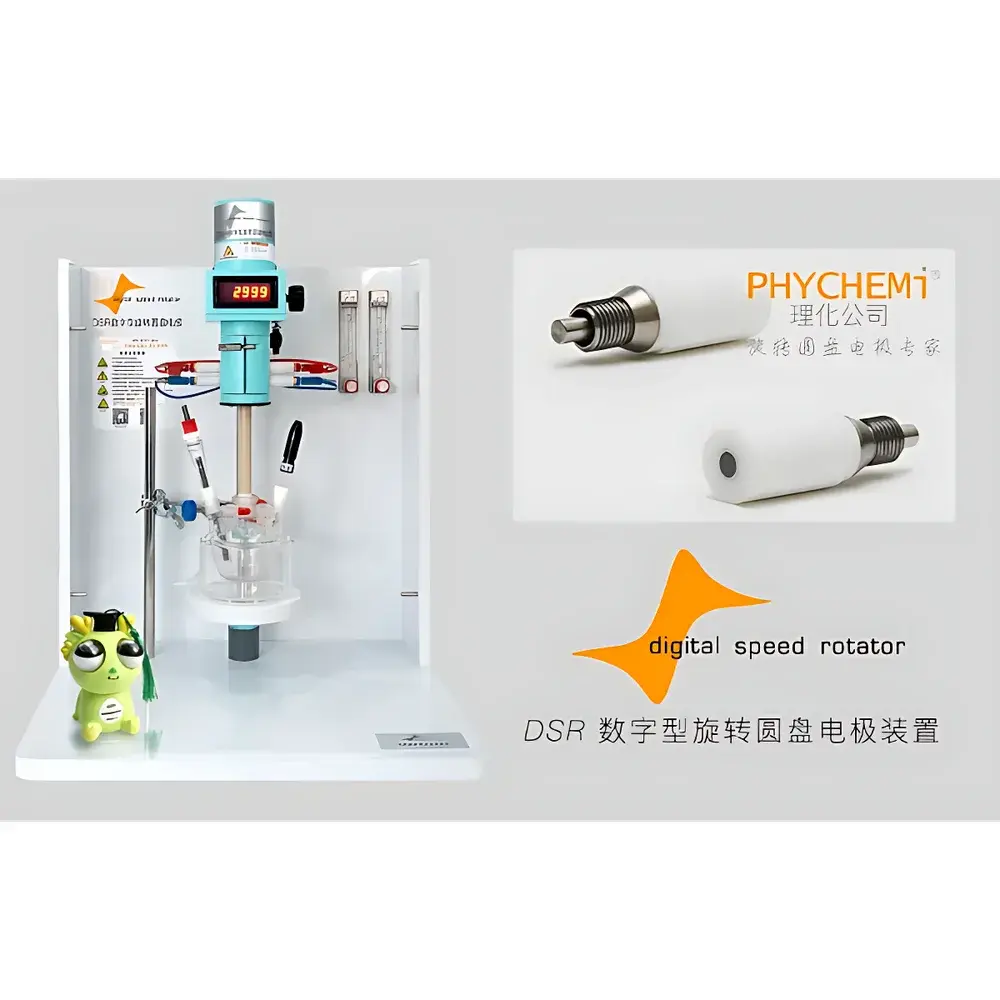
DC-Energies DSR Digital Rotating Ring-Disk Electrode (RRDE) System
| Brand | DC-Energies |
|---|---|
| Model | DSR Digital RRDE |
| Origin | Hubei, China |
| Motor Power | 20 W |
| Max Rotational Speed | 0–10,000 rpm |
| Rotation Shaft Length | 170 mm |
| Shaft Outer Diameter | 15 mm |
| Disk Electrode Material | Glassy Carbon |
| Disk Diameter | 5.0 mm |
| Ring-Disk Gap | ≤320 µm |
| Disk-Ring Dimensional Tolerance | ±0.01 mm |
| Disk Diameter (RRDE) | 5.61 mm |
| Ring Inner Diameter | 6.25 mm |
| Ring Outer Diameter | 7.92 mm |
| Collection Efficiency | 37% |
| Electrode Housing Materials | PEEK or PTFE |
| Electrical Contact | Silver-impregnated carbon brush with low contact resistance and EMI shielding |
| Control Interface | Analog voltage input (0–5 V or 0–10 V) for external speed synchronization with potentiostats |
| Power Supply | DC input (reduces mains-borne noise) |
Overview
The DC-Energies DSR Digital Rotating Ring-Disk Electrode (RRDE) System is a precision-engineered electrochemical hydrodynamic instrumentation platform designed for quantitative kinetic and mechanistic studies in heterogeneous electrocatalysis. Based on the classical Levich-Koutecký theory and controlled-convection electrochemistry, the DSR system enables simultaneous detection and discrimination of short-lived intermediates and stable products via independent potentiostatic control of the disk (generation electrode) and ring (collection electrode). Its digitally regulated rotation ensures high reproducibility in mass-transport-controlled experiments—critical for evaluating catalyst selectivity, electron transfer numbers (n), and peroxide yield in oxygen reduction reactions (ORR), as well as Faradaic efficiency in CO2 reduction (CO2RR) and hydrogen evolution (HER). The system complies with fundamental requirements of ASTM G102 and ISO 17475 for rotating electrode calibration and is routinely deployed in academic labs and industrial R&D centers conducting fuel cell, metal–air battery, and corrosion science investigations under controlled atmospheres.
Key Features
- Digital speed regulation with closed-loop feedback: 0–10,000 rpm range, ±1 rpm accuracy at steady state, enabled by embedded microcontroller and low-noise DC motor drive
- Low-interference silver-carbon brush contact system: Optimized for minimal voltage drop (<5 mΩ) and superior electromagnetic immunity—essential for high-fidelity current transients in fast-scan voltammetry
- Glove-box compatible modular architecture: Detachable shaft and electrode holder allow safe integration into inert-atmosphere environments without compromising mechanical alignment
- Interchangeable electrode assemblies: Standardized M6 threaded interface supports rapid swapping between disk-only, RRDE, and custom geometries—including U-CUP–configured variants for product recirculation studies
- Dual gas flow control: Integrated dual-channel mass flow meters (inert gas + O2) enable precise electrolyte saturation protocols compliant with USP and ASTM D1193 Type I water handling standards
- Explosion-resistant housing: Designed to UL 60079-0 and IEC 60079-1 specifications for use with volatile organic electrolytes and pressurized gas feeds
Sample Compatibility & Compliance
The DSR RRDE accommodates standard three-electrode configurations with compatibility across common electrochemical cells—including five-port parallel-jacketed cells (e.g., Pine Research AFM-5), custom high-temperature cells (up to 80 °C), and sealed anhydrous cells for Li–O2 research. Disk electrodes are fabricated from spectroscopic-grade glassy carbon (GC), with insulating sheaths available in chemically inert PEEK or fluorinated PTFE—both certified to ISO 10993-5 cytotoxicity and ASTM D471 fluid resistance standards. The 37% theoretical collection efficiency (N = 0.37) is validated per Koutecký’s analytical derivation and traceable to NIST SRM 2825 reference materials. All mechanical tolerances—including the ≤320 µm ring-disk gap and ±0.01 mm dimensional repeatability—are verified using calibrated coordinate measuring machines (CMM) per ISO 10360-2.
Software & Data Management
The DSR operates as a hardware-peripheral device synchronized via analog voltage input (0–5 V or 0–10 V) to commercial potentiostats (e.g., BioLogic SP-300, Gamry Interface 5000E, Metrohm Autolab PGSTAT302N). No proprietary software is required; full experimental control and data correlation are achieved within existing electrochemical analysis suites (EC-Lab, Nova, GPES). For GLP/GMP environments, the system supports 21 CFR Part 11-compliant audit trails when paired with validated workstation firmware—enabling electronic signatures, user access logs, and immutable parameter archiving. Raw rotation speed data is timestamped and exportable in CSV format for post-hoc kinetic modeling (e.g., fitting Levich plots or calculating k0 in Tafel analysis).
Applications
- Oxygen reduction reaction (ORR) mechanism studies: Quantification of H2O2 yield and electron transfer number (n) in PEMFC catalyst screening
- CO2 electroreduction selectivity mapping: Discrimination of C1/C2+ products via ring oxidation of adsorbed intermediates
- Hydrogen evolution kinetics: Separation of Volmer–Heyrovsky–Tafel pathways through controlled mass transport
- Corrosion inhibitor evaluation: In situ monitoring of passivation film stability under rotating conditions per ASTM G59
- Lithium–air battery cathode characterization: Real-time detection of superoxide (O2•−) and Li2O2 decomposition intermediates
- Electrocatalyst durability testing: Accelerated stress protocols involving potential cycling under defined hydrodynamic boundary layers
FAQ
What is the theoretical collection efficiency of the DSR RRDE, and how is it validated?
The DSR RRDE has a nominal collection efficiency (N) of 37%, calculated from its geometric dimensions (disk diameter = 5.61 mm, ring inner/outer diameters = 6.25/7.92 mm) and confirmed experimentally using [Fe(CN)6]3−/4− redox couple under Levich conditions.
Can the DSR be used inside an argon-filled glovebox?
Yes—the modular, tool-free disassembly design allows full installation and alignment within Class 1000 inert-atmosphere gloveboxes; all components are vacuum-rated and solvent-resistant.
Is the rotation speed externally programmable during a voltammetric scan?
Yes—via analog voltage input synchronized with potentiostat trigger outputs, enabling dynamic speed ramping (e.g., linear increase from 100 to 5000 rpm during LSV) for transient diffusion-layer analysis.
What electrode materials are supported beyond glassy carbon?
Custom disk/ring substrates—including Pt, Au, Ni, and boron-doped diamond—can be integrated upon request; dimensional specifications remain identical to maintain N-value integrity.
Does the system include calibration documentation traceable to national standards?
Each unit ships with a factory calibration certificate referencing NIST-traceable rotational metrology and electrochemical validation data against ISO 13053-2 benchmark protocols.




