
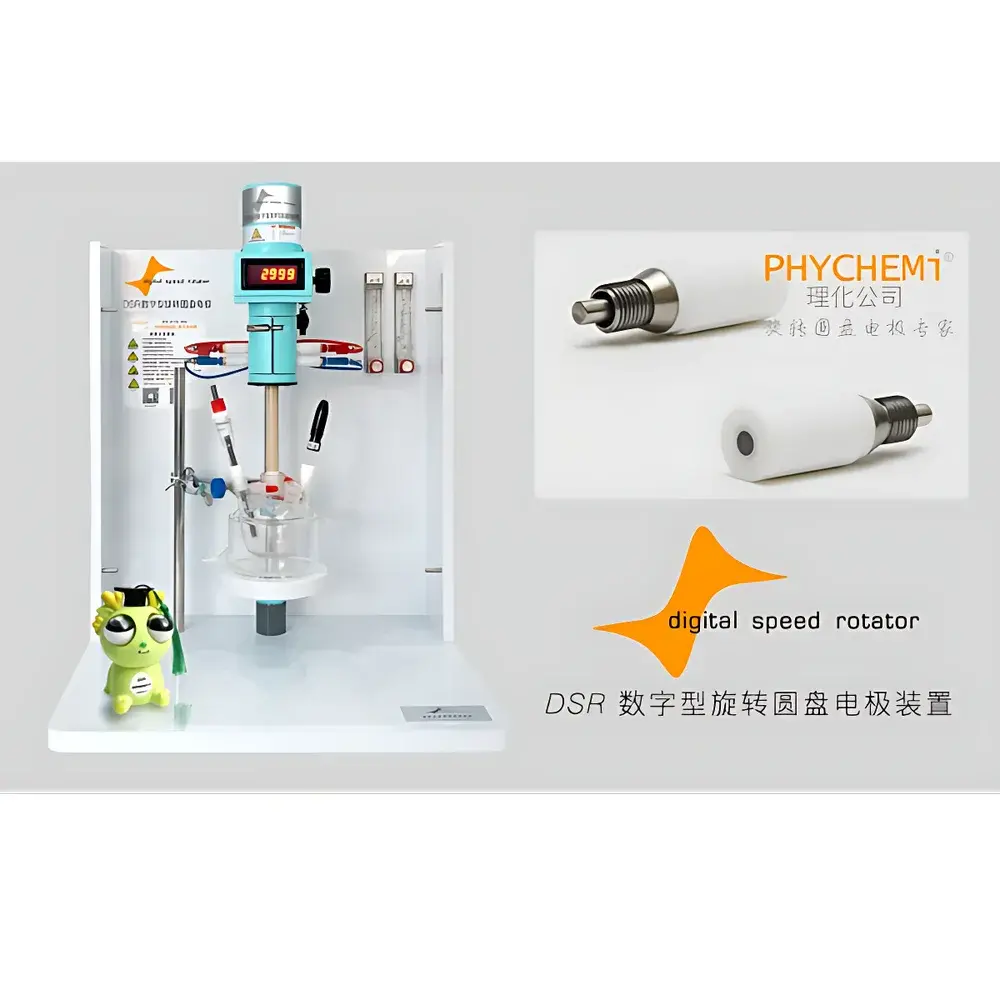
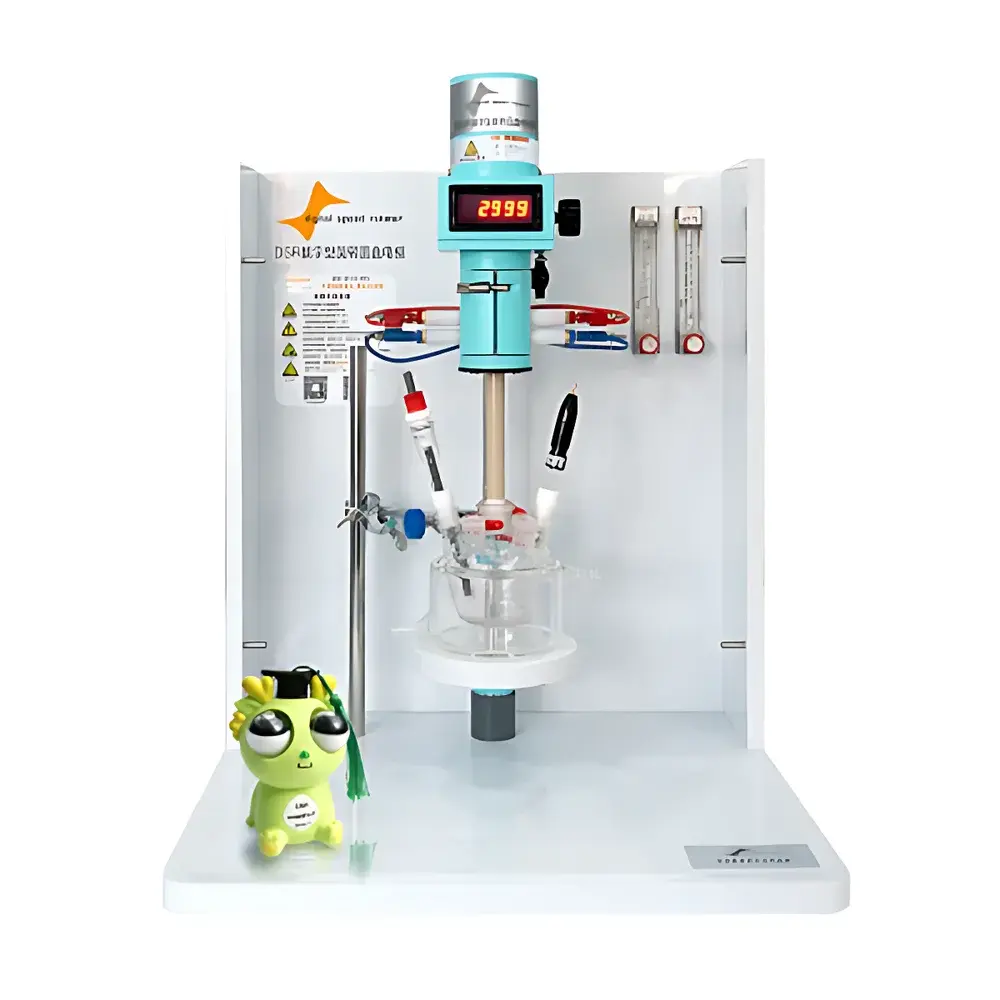
DC-ENERGIES DSR-M Rotating Disk Electrode (RDE) and Rotating Ring-Disk Electrode (RRDE) System
| Brand | DC-ENERGIES |
|---|---|
| Model | DSR-M |
| Electrode Type | Dual-mode RDE/RRDE |
| Disk Material | Glassy Carbon |
| Ring Material | Platinum |
| Disk Diameter | 5.61 mm |
| Ring Inner Diameter | 6.25 mm |
| Ring Outer Diameter | 7.92 mm |
| Ring-Disk Gap | ≤320 µm |
| Collection Efficiency | 37% |
| Rotation Speed Range | 0–10,000 rpm |
| Speed Control Resolution | 1 mV per RPM (default), accuracy < ±1% |
| Motor Power | 20 W |
| Shaft Length | 170 mm |
| Shaft OD | 15 mm |
| Housing Material | Chemical-resistant Polypropylene |
| Interface | Analog voltage input/output (0–10 V), TTL-compatible trigger output |
| Mounting | Modular, glovebox-compatible, detachable shaft and controller |
| Operating Temperature | Ambient (20–25 °C) |
| Compliance | Designed for GLP-compliant electrochemical laboratories |
Overview
The DC-ENERGIES DSR-M Rotating Disk Electrode (RDE) and Rotating Ring-Disk Electrode (RRDE) System is an engineered platform for quantitative kinetic and mechanistic analysis of electrocatalytic processes under controlled hydrodynamic conditions. Based on the Levich and Koutecký–Levich formalisms, the system enables precise mass-transport regulation via laminar flow generation at the electrode surface, allowing deconvolution of charge-transfer kinetics from diffusion-limited currents. The DSR-M supports both standalone RDE operation and dual-channel RRDE detection—where the disk serves as the working electrode for reaction initiation and the concentric ring acts as a collector for transient intermediates or products (e.g., H₂O₂ in ORR, O₂ in OER, or CO in CO₂RR). Its modular architecture integrates seamlessly with commercial potentiostats (e.g., BioLogic SP-300, Pine Research WaveDriver, Metrohm Autolab), supporting synchronized potential control, rotation modulation, and real-time current acquisition.
Key Features
- High-fidelity rotational control: 0–10,000 rpm range with analog voltage input (0–10 V), enabling waveform-synchronized speed modulation (sine, square, ramp) for transient hydrodynamic studies.
- Low-noise electrical interface: Silver-plated carbon brushes ensure contact resistance < 50 mΩ and signal integrity up to 500 mA, minimizing baseline drift and current measurement uncertainty.
- Glovebox-ready design: Fully disassemblable unit with PP base, detachable 170 mm shaft (15 mm OD), and threaded electrode holders—optimized for inert-atmosphere electrochemistry (Li–O₂, Na–CO₂, anhydrous electrolytes).
- Precision-machined RRDE geometry: Disk (5.61 mm Ø, glassy carbon) and ring (Pt, 6.25–7.92 mm ID–OD) fabricated to ±0.01 mm tolerance; inter-electrode gap ≤320 µm ensures theoretical collection efficiency of 37% (validated per ASTM G102 Annex A3).
- Dual operational modes: Switch between RDE-only configuration for Levich analysis and RRDE mode for product detection—without hardware reconfiguration.
- Real-time diagnostics: LED-display controller with manual knob adjustment and analog tachometer output (0–10 V) for external data logging or closed-loop feedback integration.
Sample Compatibility & Compliance
The DSR-M accommodates standard three-electrode cells (e.g., 50–100 mL H-cells, custom microfluidic cells) and interfaces directly with common reference electrodes (Ag/AgCl, Hg/HgO) and counter electrodes (Pt wire, graphite rod). All wetted components—including the Teflon-insulated electrode head, polypropylene base, and stainless-steel shaft—exhibit full resistance to aqueous KOH, H₂SO₄, LiTFSI/DOL:DME, and acidic/alkaline PEM electrolytes. The system meets mechanical safety standards for rotating equipment (IEC 61000-6-4 EMI immunity) and is routinely deployed in laboratories adhering to ISO/IEC 17025 quality management systems. When used with validated electrochemical workstations, it supports audit-ready data capture compliant with FDA 21 CFR Part 11 (electronic signatures, operator traceability, immutable records) when paired with appropriate software modules.
Software & Data Management
The DSR-M operates without proprietary firmware—its analog I/O architecture ensures compatibility with third-party control environments including LabVIEW, MATLAB Data Acquisition Toolbox, Python (PyVISA, NIDAQmx), and EC-Lab (BioLogic). Rotation speed can be programmed synchronously with potentiostatic sweeps (e.g., LSV, CV) or stepped sequences. For RRDE experiments, dual-channel current acquisition (disk + ring) permits calculation of collection efficiency, faradaic yield, and intermediate stability indices (e.g., %H₂O₂ selectivity in ORR). Raw analog outputs are digitized via external DAQ systems (e.g., National Instruments USB-6211) at ≥10 kS/s, preserving temporal resolution for fast kinetic events. Exported datasets conform to ASTM E2821 standard formats for electrochemical metadata tagging.
Applications
- Oxygen reduction reaction (ORR) mechanism studies in fuel cell catalyst screening, including quantification of 2e⁻ vs. 4e⁻ pathways via ring current integration.
- Oxygen evolution reaction (OER) and hydrogen evolution reaction (HER) kinetics under rotating conditions to extract Tafel slopes and exchange current densities independent of ohmic drop.
- CO₂ electroreduction (CO₂RR) product distribution analysis—detecting C₁ (CO, formate) and C₂+ (ethylene, ethanol) intermediates at the ring while controlling disk potential.
- Corrosion science: Evaluation of inhibitor efficiency through rotating cylinder electrode (RCE)-equivalent mass transfer control and polarization resistance mapping.
- Electrocatalyst stability testing: Accelerated degradation protocols using potential-step rotation-modulated chronoamperometry (PS-RCA).
- Electrochemical sensor development: Calibration of rotating-disk-based amperometric biosensors under defined convection regimes.
FAQ
What is the theoretical collection efficiency of the DSR-M RRDE, and how is it verified?
The nominal collection efficiency is 37%, calculated from geometric parameters per the classic Levich equation. It is experimentally confirmed using the [Fe(CN)₆]³⁻/⁴⁻ redox couple at pH 7, with disk oxidation and ring reduction yielding a stable ratio of ring-to-disk limiting currents.
Can the DSR-M be used inside an argon-filled glovebox?
Yes—the fully modular design allows separation of motor housing (kept outside) and electrode assembly (inserted inside), with feedthrough-compatible cabling for rotation control and signal transmission.
Is the disk electrode replaceable, and what materials are supported?
Yes—U-CUP interchangeable disk cartridges support glassy carbon, platinum, gold, nickel, and custom sputtered catalysts (e.g., NiFe LDH, CoP, MnOₓ); all maintain identical thermal expansion and sealing profiles.
Does the system support automatic speed ramping during a voltammetric scan?
Yes—via analog voltage sweep input (e.g., from a function generator or potentiostat’s auxiliary output), enabling continuous ω¹ᐟ²-dependent current normalization in real time.
What maintenance is required for long-term reliability?
Annual brush replacement and shaft bearing lubrication with perfluoropolyether grease (e.g., Krytox GPL 205) are recommended; no recalibration is needed due to factory-trimmed analog gain stability.
Related Products





