
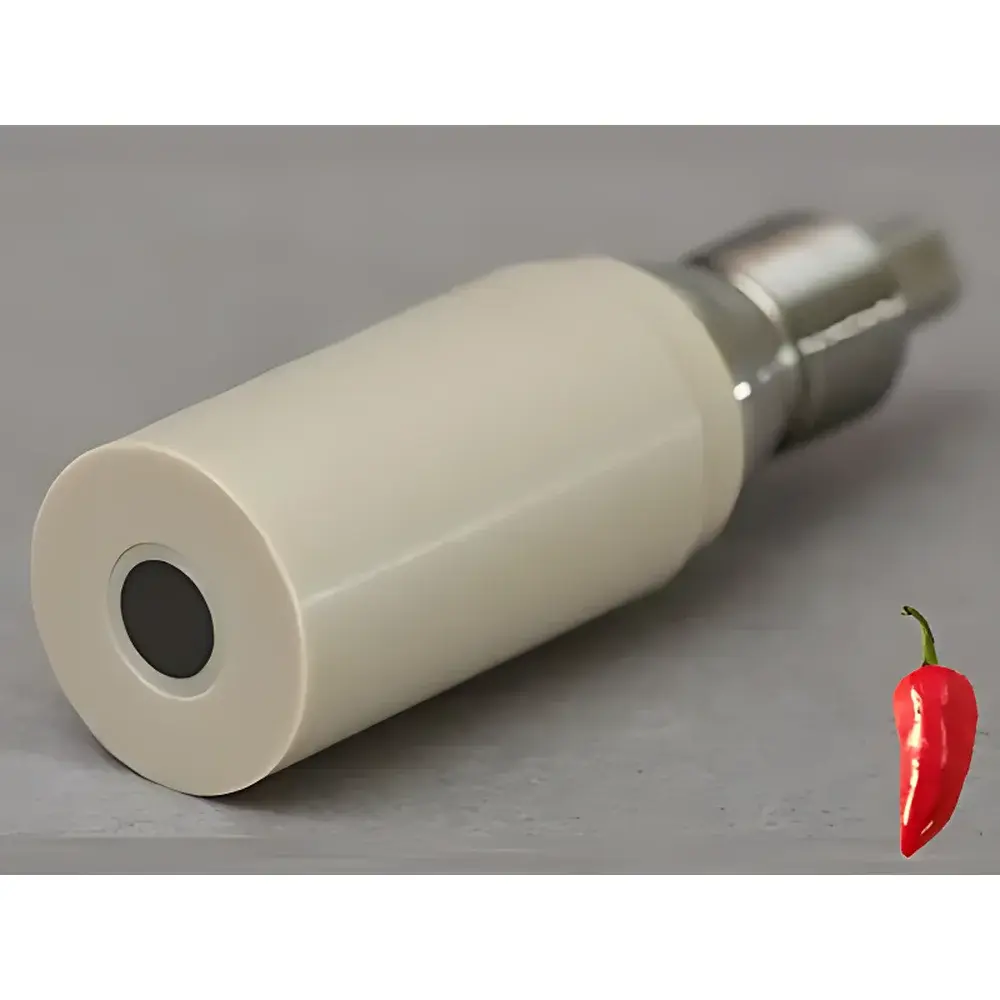
dc-energies E5 High-Temperature Rotating Disk Electrode (RDE) System
| Brand | dc-energies |
|---|---|
| Material Options | Glassy Carbon (GC), Gold (Au), Platinum (Pt) |
| Operating Temperature Range | Up to 80 °C |
| Disk Electrode Diameter | 5.0 mm |
| Overall Electrode Outer Diameter | 15 mm |
| Housing Material | PEEK (Polyether Ether Ketone) |
| Electrical Contact | Precision External Thread Interface |
| Compliance | Designed for ASTM G102, ISO 17475, and electrochemical kinetic studies under controlled hydrodynamic conditions |
Overview
The dc-energies E5 High-Temperature Rotating Disk Electrode (RDE) System is an engineered electrochemical measurement platform designed for quantitative kinetic and mass-transport analysis under thermally elevated, hydrodynamically controlled conditions. Based on the classical Levich equation and Koutecký–Levich formalism, this RDE system enables precise determination of electron transfer rates, diffusion coefficients, and reaction mechanisms in heterogeneous electrocatalysis, corrosion science, and fuel cell electrode characterization. Unlike ambient-temperature RDEs, the E5 variant integrates a thermally stable PEEK housing and high-purity inert electrode materials (glassy carbon, platinum, or gold), allowing sustained operation at temperatures up to 80 °C—critical for accelerating reaction kinetics, reducing solution viscosity effects, and simulating real-world operating environments such as PEM electrolyzer anodes or high-temperature aqueous battery interfaces.
Key Features
- Thermally robust construction with PEEK insulating body rated for continuous use at ≤80 °C, offering superior dimensional stability and chemical resistance compared to standard polymeric housings.
- Precision-machined disk electrodes (5.0 mm active diameter) fabricated from high-density, low-defect glassy carbon, polycrystalline platinum, or single-crystal gold—each batch certified for surface homogeneity and electrochemical reproducibility.
- Optimized hydrodynamic geometry: 15 mm outer diameter ensures mechanical compatibility with standard rotating shaft adapters (e.g., Pine Research, BASi, Metrohm Autolab) while maintaining laminar flow profile adherence per Levich theory.
- External-threaded electrical interface minimizes contact resistance and eliminates signal drift during extended rotational operation; torque-spec compliant assembly ensures repeatable ohmic coupling across multiple experiments.
- No internal seals or O-rings—eliminates thermal degradation pathways and prevents electrolyte ingress into the shaft interface, enhancing long-term reliability in aggressive media (e.g., hot KOH, concentrated H2SO4, molten salt precursors).
Sample Compatibility & Compliance
The E5 RDE supports a broad range of electrochemical media, including aqueous electrolytes (pH 0–14), non-aqueous solvents (acetonitrile, DMF, propylene carbonate), and moderately viscous ionic liquids up to 80 °C. Its inert material set ensures minimal background current and negligible catalytic interference—essential for accurate Tafel slope extraction and rotating ring-disk electrode (RRDE) coupling. The system conforms to ASTM G102–19 (Standard Practice for Calculation of Corrosion Rates), ISO 17475:2004 (Electrochemical impedance spectroscopy for coated metals), and supports GLP-compliant experimental protocols when paired with validated potentiostats and temperature-controlled cells. No moving parts reside within the electrode body, simplifying cleaning validation and eliminating calibration drift associated with thermal expansion mismatches.
Software & Data Management
While the E5 RDE is a passive transducer requiring external rotation control and electrochemical instrumentation, it is fully interoperable with industry-standard platforms—including BioLogic EC-Lab, Gamry Framework, and CH Instruments software suites—enabling synchronized acquisition of rotation speed, potential sweep, and current response. When used with potentiostats supporting analog tachometer input and temperature feedback loops, the system supports automated Koutecký–Levich linearization, Arrhenius activation energy mapping, and multi-speed polarization curve generation. All raw data files retain embedded metadata (rotation rate, temperature setpoint, electrode material ID), facilitating audit-ready traceability per FDA 21 CFR Part 11 requirements when deployed in regulated QC/QA laboratories.
Applications
- Quantitative evaluation of oxygen reduction reaction (ORR) and hydrogen evolution reaction (HER) kinetics on novel catalysts under accelerated thermal conditions.
- Diffusion-controlled current modeling in battery electrolyte screening (e.g., Li-S, Zn-air) at elevated temperatures to assess ion transport limitations.
- Corrosion rate quantification in simulated geothermal brines or industrial cooling water systems operating near 80 °C.
- Electrocatalyst stability assessment via chronoamperometry and cyclic voltammetry under thermally stressed hydrodynamic regimes.
- Method development for USP and EP 2.2.44-compliant electrochemical impurity profiling in pharmaceutical intermediates.
FAQ
What electrode materials are available for the E5 RDE, and how are they qualified?
Glassy carbon, platinum, and gold disk electrodes are supplied with certificate of conformance specifying density uniformity (±0.5% by pycnometry), surface roughness (Ra < 0.02 µm per profilometry), and cyclic voltammetric response in standard redox couples (e.g., 1 mM K3[Fe(CN)6] in 0.1 M KCl).
Can the E5 RDE be used with rotating ring-disk electrode (RRDE) configurations?
Yes—the 5.0 mm disk diameter and 15 mm outer dimension match industry-standard RRDE rotator collet specifications; compatible with Pine Research AFMSRCE and BASi RE series rotators.
Is PEEK housing chemically resistant to hot acidic or alkaline solutions?
PEEK exhibits excellent resistance to concentrated H2SO4, HNO3, and NaOH up to 80 °C; however, prolonged exposure to >50% w/w HF or chlorosulfonic acid is not recommended.
How is temperature control implemented during RDE experiments?
The E5 RDE itself does not include integrated heating; it is intended for use with externally heated electrochemical cells (e.g., jacketed three-electrode cells with circulating thermostats) where bulk solution temperature is monitored and stabilized independently.
Does the E5 RDE require recalibration after thermal cycling?
No—its all-metal disk-to-shaft interface and zero-compliance PEEK housing eliminate thermal hysteresis; geometric alignment remains invariant across repeated 25–80 °C cycles, preserving Levich constant fidelity.




