
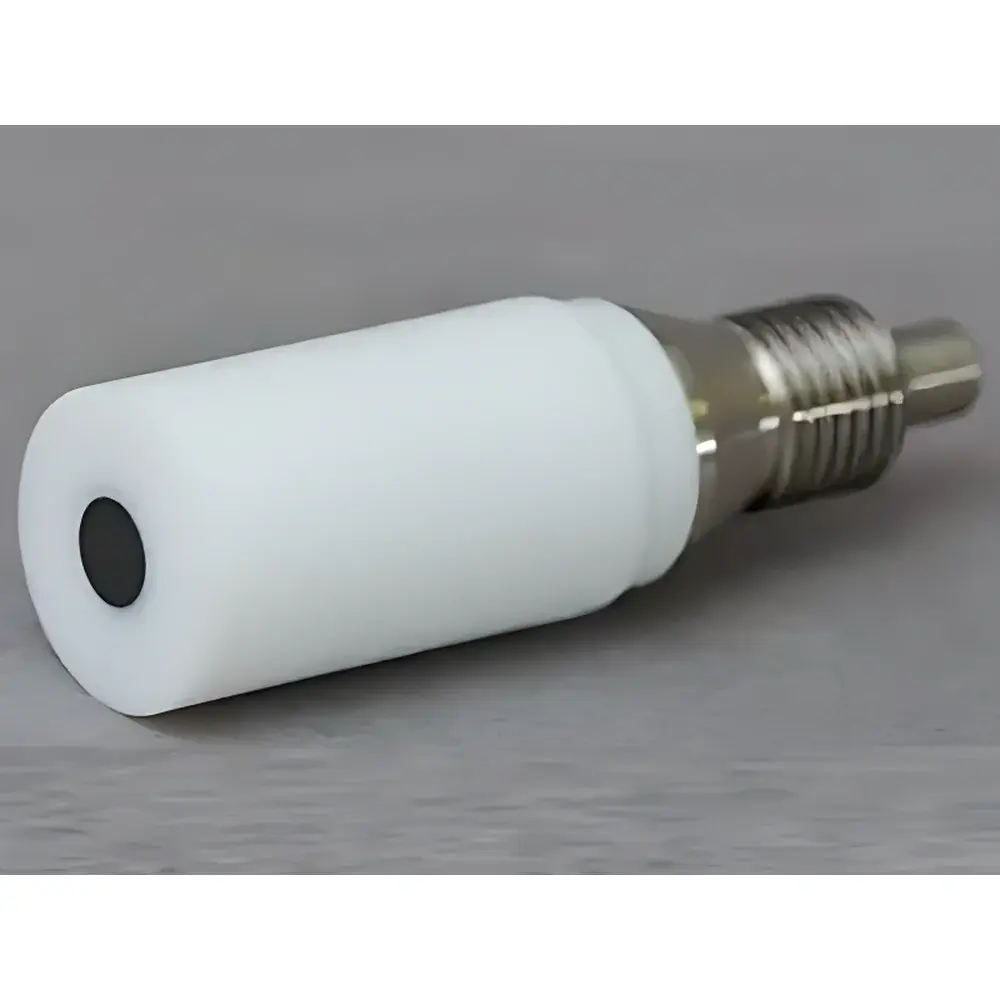
dc-energies E5GC Glassy Carbon Rotating Disk Electrode (RDE) Accessory
| Brand | dc-energies |
|---|---|
| Origin | Hubei, China |
| Manufacturer Type | Authorized Distributor |
| Instrument Category | Domestic |
| Model | E5GC |
| Electrode Material | Glassy Carbon (GC), Optional Au/Pt variants |
| Disk Diameter | 5.0 mm |
| Overall Outer Diameter | 15 mm |
| Operating Temperature Range | 10–25 °C |
| Housing Material | PTFE (Polytetrafluoroethylene) |
| Mounting Interface | External Threaded Stem |
| Compatibility | DSR Series Rotating Disk/Ring-Disk Electrode Holders |
| Instrument Type | Electrochemical Working Electrode Accessory |
Overview
The dc-energies E5GC Glassy Carbon Rotating Disk Electrode (RDE) is a precision-engineered electrochemical working electrode designed for controlled hydrodynamic voltammetry and kinetic analysis in fundamental and applied electrochemistry. Based on the classical Levich equation and Koutecký–Levich formalism, the RDE enables quantitative separation of diffusion-controlled and kinetic current components by imposing well-defined laminar flow at the electrode surface through controlled rotation (typically 100–10,000 rpm). This electrode is fully compatible with the dc-energies DSR-series rotating disk and rotating ring-disk electrode (RRDE) holders, allowing seamless integration into standard three-electrode electrochemical cells. Its 5.0 mm active glassy carbon disk—encapsulated in chemically inert polytetrafluoroethylene (PTFE)—ensures mechanical stability, low background current, wide potential window (−1.0 to +1.2 V vs. Ag/AgCl in aqueous media), and reproducible electron transfer kinetics across repeated experiments.
Key Features
- Glassy carbon (GC) disk with certified density homogeneity and low porosity, delivering high electrochemical reversibility and minimal capacitive interference.
- PTFE housing with external threaded stem design ensures robust mechanical coupling to DSR rotators, minimizing vibration-induced signal noise and improving rotational stability at high speeds.
- Standardized outer diameter (15 mm) and axial alignment geometry guarantee interchangeability with dc-energies DSR-1000, DSR-2000, and DSR-3000 motorized rotator systems without recalibration.
- Chemical resistance validated in aggressive electrolytes including concentrated H₂SO₄ (up to 6 M), HNO₃, KOH (up to 10 M), and organic solvents (acetonitrile, DMF), enabling corrosion studies and battery electrolyte characterization.
- Thermally stable operation within 10–25 °C ambient range; no internal heating or active temperature control required—optimized for benchtop laboratory use under ISO/IEC 17025-compliant environmental conditions.
Sample Compatibility & Compliance
The E5GC RDE supports heterogeneous electron transfer investigations across diverse sample classes: aqueous and non-aqueous redox couples (e.g., Fe(CN)₆³⁻/⁴⁻, Ru(NH₃)₆³⁺/²⁺), oxygen reduction reaction (ORR) catalysts, Li-ion battery cathode slurries, electroplating bath additives, and passivation layers on stainless steel or aluminum alloys. It conforms to ASTM D1148 (standard practice for electrochemical corrosion testing), ISO 16773-2 (electrochemical impedance spectroscopy for coatings), and supports GLP-aligned data acquisition when paired with potentiostats compliant with FDA 21 CFR Part 11 (audit trail, electronic signature, and data integrity controls). No CE or RoHS certification is claimed, as this is a component-level accessory—not a standalone instrument.
Software & Data Management
While the E5GC RDE itself contains no embedded electronics or firmware, it is fully interoperable with industry-standard electrochemical software platforms—including BioLogic EC-Lab®, Pine AfterMath®, Metrohm NOVA, and Gamry Framework—when used with compatible potentiostats (e.g., Biologic SP-300, Gamry Interface 5000P, Metrohm Autolab PGSTAT302N). Rotation speed is externally controlled via analog/digital input from the rotator driver unit; real-time synchronization between potential sweep and rotation rate is achieved using TTL triggering or software-defined ramp profiles. All acquired chronoamperometric, cyclic voltammetric, and Levich plot datasets are exportable in ASCII (.txt), CSV, or binary formats for post-processing in MATLAB, Python (SciPy/NumPy), or OriginLab.
Applications
- Kinetic evaluation of oxygen reduction reaction (ORR) and hydrogen evolution reaction (HER) catalysts for PEM fuel cells and water electrolyzers.
- Diffusion coefficient determination of redox species in novel battery electrolytes (e.g., LiTFSI in ether-based solvents).
- Electrodeposition mechanism studies of Cu, Ni, and Co thin films under forced convection.
- Corrosion rate quantification of pipeline steels in simulated seawater using Tafel extrapolation and polarization resistance methods.
- Validation of mass transport models in microfluidic electrochemical reactors and flow-through electrodes.
FAQ
Is the E5GC RDE compatible with rotating ring-disk electrode (RRDE) measurements?
Yes—the E5GC disk electrode shares identical mechanical interface dimensions and rotational axis alignment with dc-energies’ E5RR series ring-disk electrodes, enabling direct substitution in DSR RRDE holders without recalibration.
Can the PTFE housing withstand hydrofluoric acid (HF) exposure?
No. While PTFE exhibits excellent resistance to most mineral acids and bases, it is not recommended for prolonged contact with >0.1% HF solutions due to potential surface etching and compromised sealing integrity.
What is the recommended cleaning protocol between experiments?
Mechanical polishing with 0.05 µm alumina slurry on a microcloth pad, followed by sonication in ultrapure water (15 min), ethanol (10 min), and acetone (5 min), then air-drying under nitrogen stream.
Does dc-energies provide calibration certificates for individual E5GC electrodes?
No. As a passive electrode accessory, the E5GC does not undergo metrological calibration; users are advised to verify performance via benchmark redox systems (e.g., 5 mM K₃Fe(CN)₆ in 0.1 M KCl) prior to critical experiments.
Is thermal expansion mismatch between GC and PTFE a concern during long-term rotation?
Not under specified operating conditions (10–25 °C). The CTE difference is mitigated by the low-stress compression fit and absence of adhesive bonding—verified over >500 h cumulative runtime in accelerated aging tests.



