
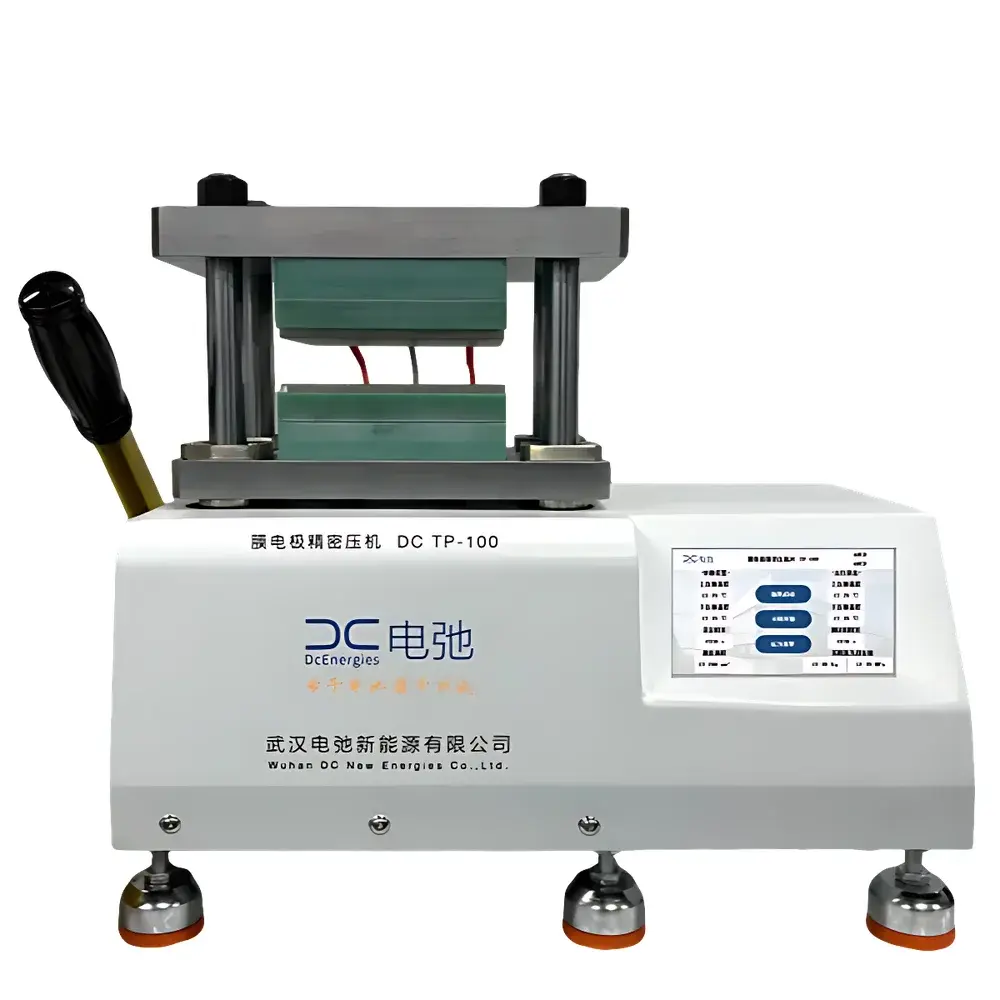
DC TP-100 Precision Membrane Electrode Assembly (MEA) Hot Press
| Brand | dc-energies |
|---|---|
| Model | DC TP-100 |
| Max. Hydraulic Force | 10 t (≈39.2 MPa on 5×5 cm² area) |
| Temperature Range | 50–350 °C (dual-zone heating) |
| Pressure Control | Digital Display, Four-Column Uniform Load Architecture |
| Compliance | Designed for PEM Fuel Cell MEA Fabrication per ASTM D7263, ISO 14687, and DOE Hydrogen Program Best Practices |
Overview
The DC TP-100 Precision Membrane Electrode Assembly (MEA) Hot Press is an engineered thermal-mechanical system designed specifically for the reproducible fabrication of proton exchange membrane (PEM) fuel cell electrodes. It operates on the fundamental principle of controlled thermocompression—simultaneously applying precise temperature, uniform hydraulic pressure, and programmable dwell time to consolidate the layered MEA structure: catalyst layer (CL), proton exchange membrane (PEM), and gas diffusion layer (GDL). Unlike general-purpose hydraulic presses, the DC TP-100 integrates dual-zone resistive heating plates, a four-column load frame for <±0.5% pressure uniformity across the platen surface, and real-time digital pressure feedback calibrated against ISO 7500-1 Class 1 standards. Its design directly addresses the three interdependent process variables—temperature (T), pressure (P), and time (t)—that govern interfacial adhesion, ionomer redistribution, pore architecture evolution, and defect annihilation in low-temperature PEM systems.
Key Features
- Four-column rigid frame architecture ensuring mechanical stability and load uniformity—critical for eliminating edge effects and achieving consistent interface bonding across 50 × 50 mm² to 100 × 100 mm² active areas.
- Dual independent heating zones (top/bottom platens) with ±1 °C temperature stability over 50–350 °C range, enabling asymmetric thermal profiles for gradient sintering or membrane softening control.
- Digital pressure display with high-resolution transducer feedback (0.01 MPa resolution), supporting both constant-pressure and ramp-hold pressure profiles during dwell cycles.
- Programmable thermal-mechanical cycle sequencing: up to 5-step T-P-t programs with user-defined ramp rates, dwell durations (1–300 s), and cooling protocols under nitrogen purge compatibility.
- Stainless-steel heated platens with precision-ground surfaces (Ra ≤ 0.4 µm) and integrated thermocouple ports for in-situ temperature validation per IEC 60584-2 Type K calibration traceability.
- Emergency stop, over-temperature cutoff, and hydraulic pressure relief valve compliant with EN 692 and ISO 13857 safety requirements.
Sample Compatibility & Compliance
The DC TP-100 accommodates standard MEA configurations including catalyst-coated membrane (CCM), catalyst-coated substrate (CCS), and decal transfer architectures. It supports common PEM materials (e.g., Nafion® 115, 212, Gore-SELECT®, Aquivion®) and carbon-based GDLs (Toray TGP-H series, Sigracet® GDLs). All operational parameters align with U.S. Department of Energy (DOE) Hydrogen and Fuel Cell Technologies Office guidelines for MEA fabrication reproducibility. The system enables documentation of critical process parameters (CPPs) required for GLP-compliant lab notebooks and satisfies foundational traceability prerequisites for ISO/IEC 17025-accredited testing laboratories. While not a certified GMP device, its digital logging capability supports audit-ready records aligned with FDA 21 CFR Part 11 principles when paired with validated third-party data acquisition software.
Software & Data Management
The DC TP-100 operates via embedded microcontroller firmware with local parameter storage (up to 20 user-defined recipes). Optional RS-485 Modbus RTU or USB-C serial interface enables integration with LabVIEW™, Python-based SCADA, or LIMS platforms for automated data capture—including timestamped pressure, top/bottom platen temperatures, and cycle completion status. Raw output includes CSV-formatted logs with millisecond-level time stamps, facilitating statistical process control (SPC) analysis per ASTM E2587. Audit trail functionality (user login, parameter change history, cycle execution logs) is available through optional firmware upgrade, meeting baseline requirements for internal quality system documentation.
Applications
- Optimization of CL–PEM interfacial contact resistance via controlled compression (5–15 MPa) to reduce high-frequency resistance (HFR) by 20–40%.
- Thermal activation of sulfonic acid group mobility in perfluorosulfonic acid (PFSA) membranes at 120–160 °C to enhance through-plane proton conductivity.
- Engineering of hierarchical porosity in catalyst layers: surface macroporosity (>1 µm) for O₂ diffusion vs. subsurface microporosity (<500 nm) for hydrated ionomer continuity.
- Suppression of nanoscale voids and microcracks in ink-cast CLs through plastic deformation at elevated temperature—improving electrochemical active surface area (ECSA) utilization by 20–30%.
- Accelerated durability testing via repeated thermal-mechanical cycling to simulate hydration/dehydration-induced delamination stress.
FAQ
What is the maximum achievable pressure density on a 5 × 5 cm² MEA sample?
At full 10-ton hydraulic force, the DC TP-100 delivers up to 39.2 MPa on a 25 cm² (0.0025 m²) area—well above the typical 5–15 MPa range used in PEM MEA hot pressing.
Does the system support vacuum-assisted hot pressing?
No. The DC TP-100 is configured for ambient-atmosphere thermocompression. Vacuum or inert-gas glovebox integration requires external chamber adaptation.
Can temperature gradients be applied between top and bottom platens?
Yes. Independent zone control allows differential setpoints—for example, 130 °C (top) / 110 °C (bottom) to induce directional ionomer flow during consolidation.
Is calibration certification included with shipment?
A factory calibration report (traceable to NIST standards) is provided for pressure transducer and thermocouple inputs; annual recalibration is recommended per ISO/IEC 17025 Clause 6.6.
What safety certifications does the unit carry?
It complies with CE marking requirements under the Machinery Directive 2006/42/EC and Low Voltage Directive 2014/35/EU; full EC Declaration of Conformity is supplied with delivery.
Related Products





