
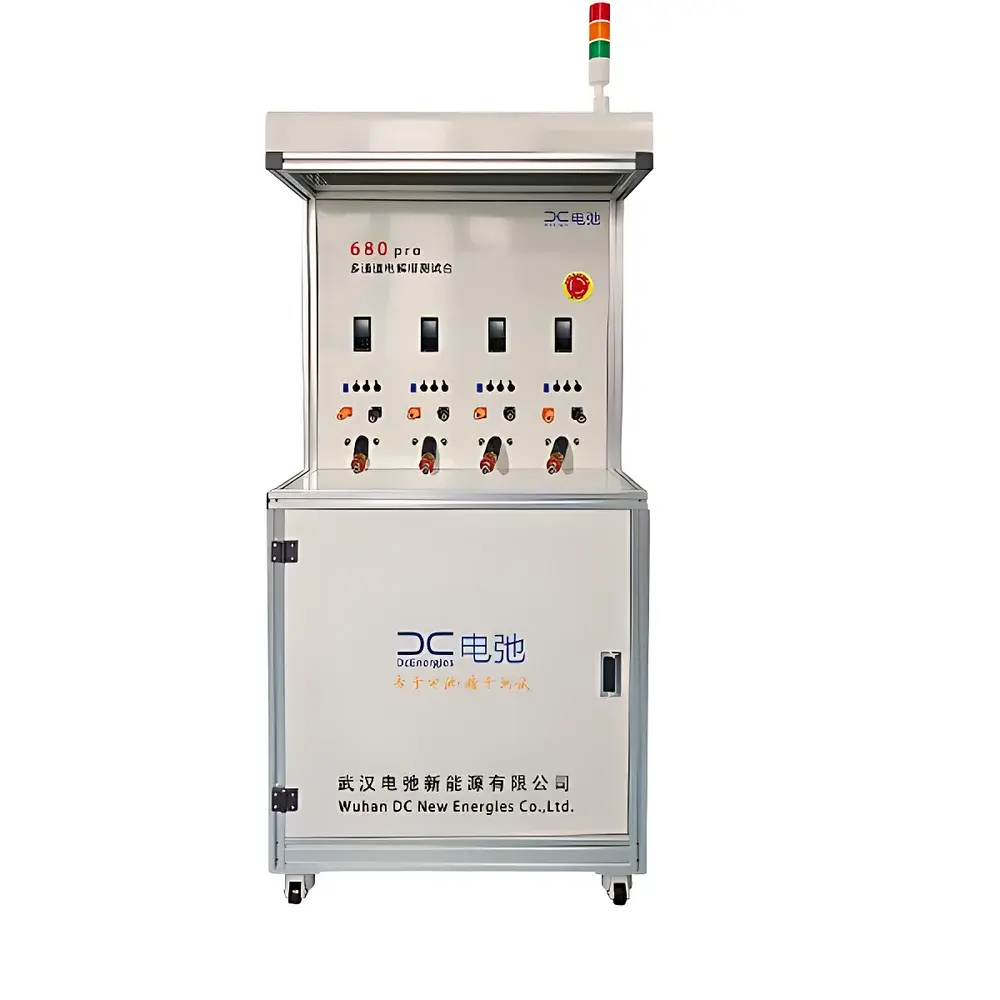
DC680 Multi-Channel Electrolyzer Testing Station
| Brand | DC-Energies |
|---|---|
| Origin | Hubei, China |
| Manufacturer Type | Authorized Distributor |
| Country of Origin | China |
| Model | DC680 |
| Quotation | Upon Request |
| Compatibility | PEM, AEM (optional), ALK |
| Channels | 4 |
| Flow Control Range | 50–500 mL/min |
| Temperature Control Range | RT +5°C to 90°C |
| Conductivity Measurement | 0.01–20 µS/cm |
| Voltage Range | 0–5 V |
| Power per Channel | 300 W or 500 W |
| Current Range | 0–60 A or 0–100 A |
| Internal Resistance Range | 0.1 mΩ–30 Ω |
| AC Impedance Frequency | Fixed 1 kHz |
| pH Measurement (for AEM) | 0–14 |
| Water Replenishment | Automatic + Manual |
| Backpressure Control | High-Precision Regulator |
| Gas Conditioning | Integrated Condensation, Drying & Filtration Modules |
Overview
The DC680 Multi-Channel Electrolyzer Testing Station is an engineered platform designed for systematic evaluation and performance validation of proton exchange membrane (PEM), anion exchange membrane (AEM), and alkaline (ALK) electrolyzers under controlled laboratory conditions. Built upon a modular electrochemical test architecture, the system implements galvanostatic, potentiostatic, and dynamic polarization protocols in accordance with ASTM D7282, ISO 20109, and IEC 62282-7-1 standards for water electrolysis systems. Its core measurement methodology integrates real-time current–voltage (I–V) profiling, high-resolution gas flow quantification via calibrated thermal mass flow meters, and synchronized thermal–electrochemical monitoring to deliver reproducible, traceable data essential for catalyst screening, membrane durability assessment, and stack-level efficiency benchmarking.
Key Features
- Multi-technology compatibility: Native support for PEM, AEM, and ALK electrolyzer cells—no hardware reconfiguration required between chemistries.
- Four independent, electrically isolated channels with full parameter autonomy: each channel features dedicated voltage/current sourcing, temperature regulation, and gas flow control.
- High-fidelity gas metrology: Dual-channel thermal mass flow meters (H₂ and O₂) calibrated to ±0.5% FS accuracy, coupled with integrated condensation traps, desiccant dryers, and particulate filters to ensure clean, moisture-free gas stream analysis.
- Precision pressure management: Digital backpressure regulators maintain stable differential pressures across the cell (±0.02 bar repeatability), critical for evaluating membrane crossover and gas diffusion layer performance.
- Real-time electrochemical impedance spectroscopy (EIS) capability at fixed 1 kHz frequency, enabling rapid internal resistance tracking and contact degradation diagnostics without interrupting DC operation.
- Embedded safety architecture: Hardware-enforced interlocks monitor overvoltage, overcurrent, overtemperature, gas leakage, and coolant failure—automatically initiating safe shutdown per IEC 61508 SIL-2 requirements.
Sample Compatibility & Compliance
The DC680 accommodates standard 5 cm², 10 cm², and 25 cm² MEA-based single cells, as well as custom-sized planar electrolyzer assemblies up to 100 cm² active area. All fluidic interfaces use Swagelok SS-316 fittings and perfluoroelastomer (FFKM) seals rated for >1000 h exposure to hot KOH and acidic PEM environments. The system complies with GLP-aligned documentation practices—including electronic audit trails, user access controls, and versioned test method storage—and supports 21 CFR Part 11–compliant data integrity workflows when deployed with optional secure software licensing.
Software & Data Management
The proprietary DC-TestSuite v4.x software provides a deterministic, low-latency acquisition framework capable of logging ≥5 data points per second per channel (voltage, current, temperature, flow rate, pressure, conductivity, pH). Test configuration uses a checkbox-driven interface—eliminating script syntax errors—while enabling simultaneous setup of ramp, hold, pulse, and cyclic protocols across all four channels. Real-time dashboards display primary metrics (cell voltage, Faradaic efficiency, energy consumption kWh/kg-H₂) alongside secondary indicators (ohmic drop, Tafel slope, ΔT across GDL). Historical datasets are stored in HDF5 format with embedded metadata (operator ID, calibration timestamps, environmental logs), supporting cross-experiment comparison and export to MATLAB, Python (Pandas), or LIMS via standardized CSV/JSON APIs.
Applications
- Catalyst activity mapping across voltage sweeps and current densities (0.1–2.0 A/cm²).
- Membrane hydration dynamics studies using in-situ conductivity and backpressure modulation.
- Accelerated stress testing (AST) of AEM ionomers under variable pH and temperature gradients.
- System-level efficiency analysis: calculation of system voltage efficiency, hydrogen production rate (NL/min), and specific energy consumption (kWh/Nm³-H₂).
- Quality assurance for MEA manufacturing: batch-to-batch consistency validation via automated I–V curve overlay and statistical process control (SPC) charting.
- Academic research on bubble-induced overpotential, two-phase flow distribution, and interfacial charge transfer kinetics.
FAQ
Can the DC680 operate with both PEM and AEM cells without hardware modification?
Yes. The system’s fluidic manifold, electrode wiring topology, and electrolyte conditioning modules are chemically agnostic—only software-defined parameters (e.g., pH setpoint, conductivity threshold, gas detection logic) require adjustment.
Is remote monitoring supported?
Yes. DC-TestSuite includes OPC UA server functionality for integration into industrial SCADA or lab-wide IoT platforms, with TLS 1.2 encryption and role-based API access.
What calibration certificates are provided?
Each unit ships with NIST-traceable calibration reports for flow meters, thermocouples, and voltage/current sensors, valid for 12 months from shipment date.
Does the system support transient load cycling?
Yes. Programmable current/voltage ramps down to 10 ms resolution enable dynamic response characterization, including startup/shutdown transients and grid-following duty cycles.
How is data integrity ensured during long-duration tests (e.g., 1000+ hours)?
Continuous write buffering, periodic checksum validation, and automatic failover to redundant SSD storage prevent data loss; all raw acquisitions are timestamped with GPS-synchronized UTC clocks.





