
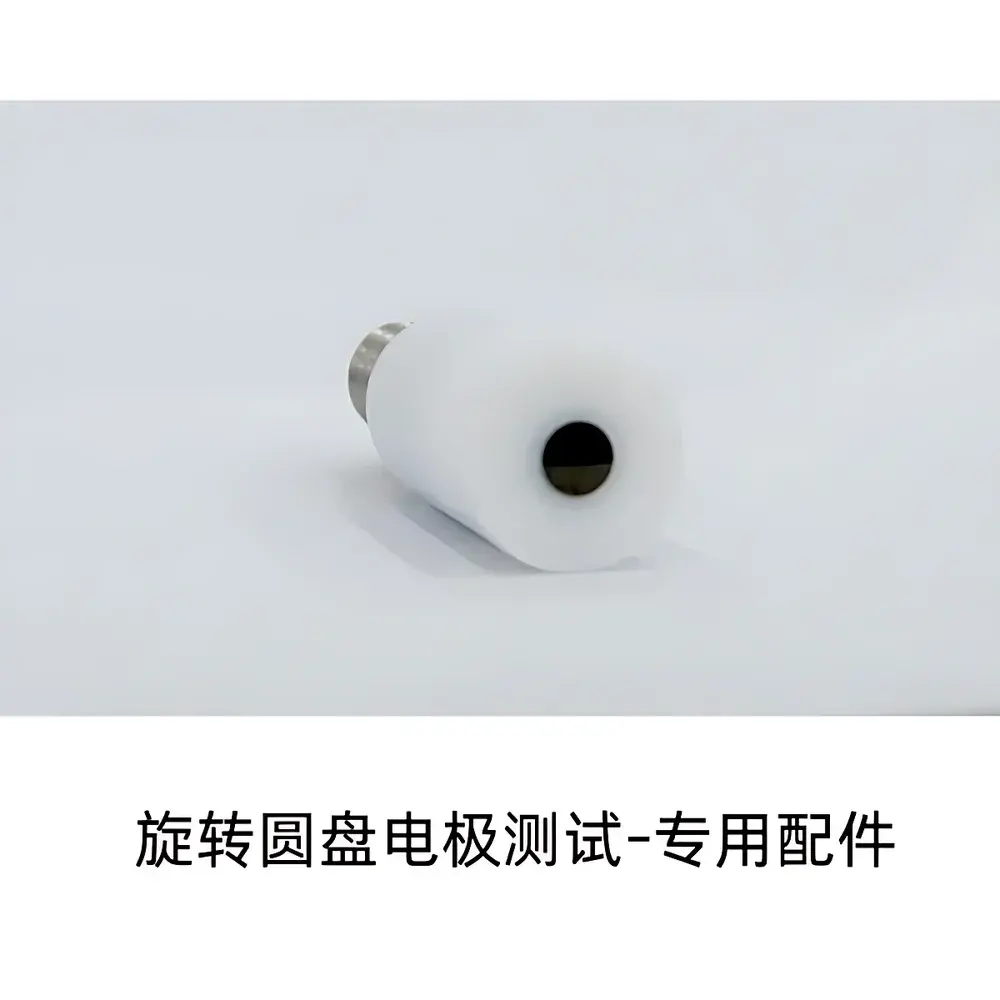
DCGCPT Rotating Ring-Disk Electrode (RRDE) by DC-Energies
| Brand | DC-Energies |
|---|---|
| Disk Material | Glassy Carbon |
| Disk Diameter | 5.0 mm |
| Ring Outer Diameter | 15.0 mm |
| Shroud Material | PTFE |
| Max Rotation Speed | 2500 rpm |
| Operating Temperature Range | 10–25 °C |
| Origin | Hubei, China |
| Type | Electrochemical Instrument Accessory |
Overview
The DCGCPT Rotating Ring-Disk Electrode (RRDE) is a precision-engineered electrochemical accessory designed for advanced kinetic and mechanistic studies in heterogeneous electron transfer processes. Based on the classical rotating electrode hydrodynamics described by Levich and later extended by Schumagin and others, the RRDE configuration enables simultaneous detection and quantification of short-lived intermediates generated at the disk electrode—by capturing them via controlled convection onto the concentric ring electrode. This dual-electrode architecture provides intrinsic time resolution without external scanning, making it indispensable for investigating catalytic oxygen reduction (ORR), hydrogen evolution (HER), CO₂ reduction (CO₂RR), and redox mediation pathways under well-defined mass-transport conditions. The DCGCPT variant features a glassy carbon (GC) disk with a precisely defined 5.0 mm active diameter and a PTFE-insulated shroud (15.0 mm outer diameter), ensuring mechanical stability, chemical inertness, and minimal edge effects during high-speed rotation.
Key Features
- Glassy carbon disk (5.0 mm active diameter) with low background current, high electrochemical stability, and reproducible surface renewal upon polishing.
- Concentric ring geometry integrated within a single, monolithic PTFE shroud (15.0 mm OD), minimizing inter-electrode gap variation and enabling consistent collection efficiency calibration.
- Rated maximum rotational speed of 2500 rpm—compatible with standard commercial rotators (e.g., Pine Research, BASi, or CHI systems) equipped with K-type or magnetic coupling interfaces.
- Optimized thermal design supporting stable operation within 10–25 °C ambient range; avoids thermal drift-induced baseline instability during prolonged chronoamperometric or cyclic voltammetric experiments.
- PTFE body offers exceptional resistance to strong acids (e.g., 0.1 M HClO₄), alkaline media (e.g., 0.1 M KOH), and organic electrolytes (e.g., acetonitrile/LiClO₄), meeting requirements for both aqueous and non-aqueous electrocatalysis workflows.
Sample Compatibility & Compliance
The DCGCPT RRDE is validated for use with standard three-electrode electrochemical cells (e.g., 10–50 mL volume, Luggin capillary placement ≤ 2× disk radius). It supports conventional aqueous electrolytes (pH 0–14), protic and aprotic organic solvents, and ionic liquid-based media. Its construction adheres to ISO 13485-aligned manufacturing controls for laboratory instrumentation accessories. While not a standalone instrument, the electrode complies with functional safety expectations outlined in IEC 61010-1 for laboratory electrical equipment when used with certified potentiostats. Data generated using this RRDE may support GLP-compliant reporting when paired with 21 CFR Part 11-enabled software platforms and documented calibration procedures (e.g., collection efficiency determination via ferrocyanide/ferricyanide redox couple per ASTM E2397-19).
Software & Data Management
The DCGCPT RRDE does not include embedded firmware or proprietary software. It operates transparently with all major electrochemical workstation platforms—including Metrohm Autolab NOVA, BioLogic SP-300, Gamry Framework, and Pine AfterMath—enabling full control over disk/ring potential sequencing (e.g., dual-channel potentiostatic mode), rotation speed ramping, and synchronized data acquisition. Time-stamped current transients from both electrodes are recorded at user-defined sampling rates (up to 1 MHz on supported hardware), allowing post-experiment calculation of collection efficiency (N), diffusion-layer thickness (δ), and kinetic rate constants via Levich-Koutecký analysis. Audit trails, metadata tagging (e.g., temperature, electrolyte batch ID), and export to CSV/HDF5 formats are supported through host software, facilitating traceability in regulated environments.
Applications
- Quantitative evaluation of ORR selectivity (H₂O₂ yield %) in fuel cell catalyst screening.
- In situ detection of reactive oxygen species (ROS) and radical intermediates during photoelectrocatalytic water oxidation.
- Steady-state kinetic analysis of enzyme-modified electrodes (e.g., glucose oxidase kinetics under substrate-limited flow).
- Validation of computational electrochemistry models requiring experimental validation of simulated flux profiles.
- Method development for USP and related stability-indicating assays involving redox-active pharmaceuticals.
FAQ
What is the geometric collection efficiency (N) of the DCGCPT RRDE?
The nominal collection efficiency is determined empirically for each unit via the [Fe(CN)₆]³⁻/⁴⁻ redox couple in 1 M KNO₃ and typically falls within 0.37–0.42. A certificate of calibration is available upon request.
Can the disk be re-polished in-house?
Yes—the glassy carbon surface is fully renewable using standard 0.05 µm alumina slurry on microcloth, followed by ultrasonic rinsing in deionized water and ethanol.
Is the electrode compatible with acidic perchloric acid electrolytes?
Yes—PTFE insulation and GC disk exhibit no observable degradation in 0.1 M HClO₄ over 24 h continuous rotation at 2000 rpm.
Does DC-Energies provide NIST-traceable calibration documentation?
Calibration data is traceable to internal reference standards aligned with NIST SRM 1921b (potassium ferricyanide); full uncertainty budgets are supplied with certified units.
What torque specification is recommended for mounting on a rotator shaft?
Maximum tightening torque: 0.25 N·m. Over-torquing may deform the PTFE shroud and compromise ring-disk alignment.
Related Products







