
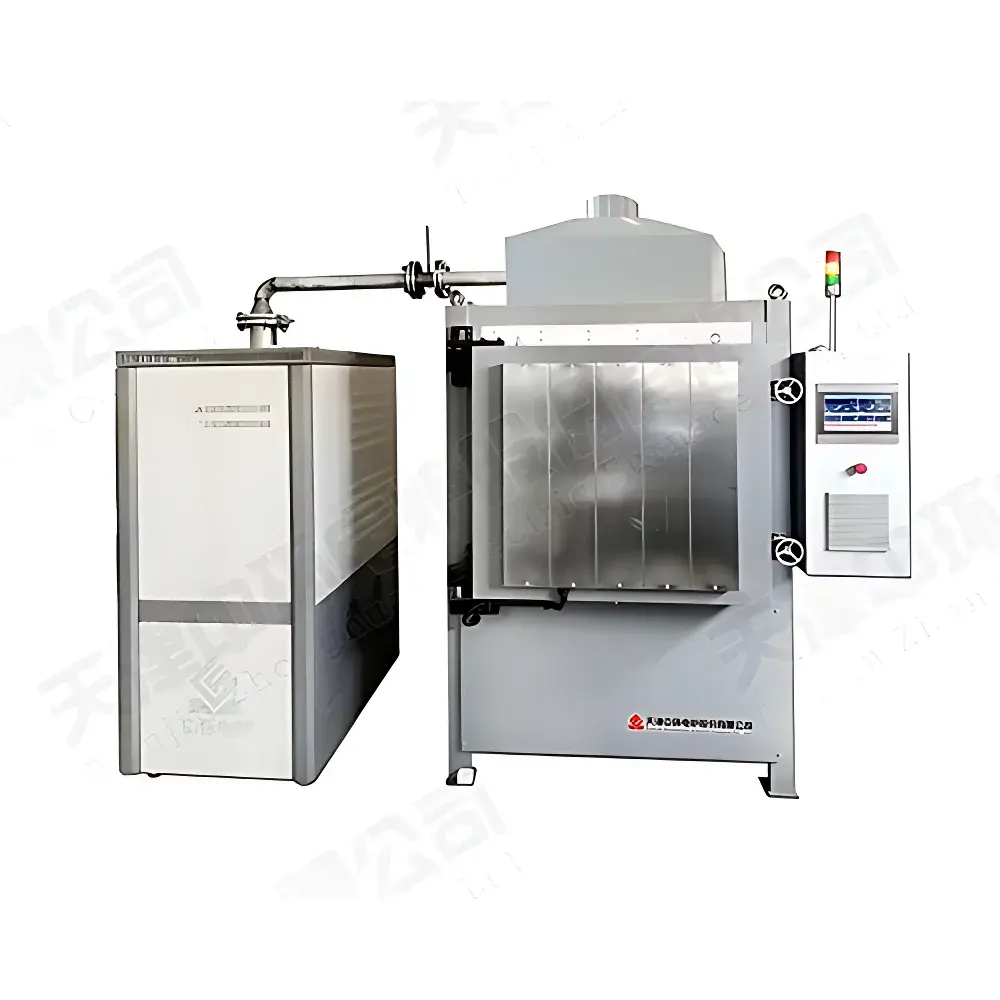
Debinding and Pre-Sintering Integrated Furnace – ZHX-P95116 by ZHONGHUAN FURNACE
| Brand | ZHONGHUAN FURNACE |
|---|---|
| Origin | Tianjin, China |
| Model | ZHX-P95116 |
| Rated Temperature | 1200 °C |
| Working Temperature | 1100 °C |
| Control Accuracy | ±1 °C |
| Chamber Dimensions (L×W×H) | 420×530×430 mm |
| Chamber Volume | 95 L |
| Heating Power | 18 kW (total system: 30 kW) |
| Voltage | 380 V, 3-phase |
| Heating Element | HRE Alloy Wire |
| Chamber Lining | Morgan TJM Refractory Bricks |
| Thermal Control | Triple-Zone + Dual-Preheating Hot-Zone Architecture |
| Safety Features | Pressure-Actuated Debinding Port, Door-Interlocked Power Cut-off, Over-Temperature Protection |
| Compliance | Designed for GLP-compliant thermal processing in R&D and pilot-scale production |
Overview
The ZHONGHUAN FURNACE ZHX-P95116 Debinding and Pre-Sintering Integrated Furnace is an engineered thermal processing system designed for controlled, sequential thermal treatment of advanced ceramic components—specifically optimized for debinding (organic binder removal), pre-sintering, and final sintering within a single, programmable thermal cycle. It operates on a convection-enhanced, multi-zone resistive heating principle, utilizing HRE alloy heating elements embedded in a high-purity Morgan TJM refractory brick chamber. The furnace employs a triple-temperature-zone architecture coupled with dual-stage preheating airflow management to ensure uniform thermal distribution across the entire load during low-temperature (800 °C) densification stages. This design minimizes thermal gradients, suppresses carbon residue formation, and prevents warping or bloating in sensitive multilayer ceramic structures such as LTCC substrates, MLCCs, and AlN-based power modules.
Key Features
- Triple-zone + dual-preheating thermal field control enables precise decoupling of debinding and sintering kinetics—critical for maintaining dimensional stability in fine-pitch LTCC circuits and thin-film piezoelectric actuators.
- Morgan TJM refractory brick chamber lining ensures long-term structural integrity, minimal particulate shedding, and consistent emissivity—essential for reproducible thermal profiles in ISO/IEC 17025-accredited laboratories.
- Automated pressure-responsive debinding port actuation: integrated pressure sensor triggers automatic venting when internal chamber pressure exceeds user-defined thresholds (e.g., during rapid binder pyrolysis), preventing blistering or delamination.
- Door interlock circuitry cuts main power upon door opening—complying with IEC 61000-6-2 EMC immunity requirements and EN 60519-1 safety standards for industrial heating equipment.
- Standard manual program controller supports up to 30-segment ramp-hold profiles; optional touchscreen HMI adds audit trail logging, recipe management, and remote parameter monitoring via Ethernet/IP.
- Surface temperature rise limited to <45 °C at ambient conditions due to optimized multi-layer insulation—meeting OSHA 1910.304(c)(2)(ii) surface safety guidelines.
Sample Compatibility & Compliance
The ZHX-P95116 accommodates a broad spectrum of ceramic feedstocks requiring staged thermal decomposition and solid-state diffusion, including but not limited to: LTCC green tapes (DuPont 951, Heraeus CT2000), MLCC barium titanate compacts, AlN and Si₃N₄ substrate wafers, ZrO₂ watch casings and dental prosthetics, PZT-based MEMS transducers, and binder-jetted or stereolithography-derived 3D-printed ceramic preforms. All thermal cycles are fully traceable and support 21 CFR Part 11-compliant electronic signatures when configured with optional data-logging firmware. The furnace meets ASTM C1171 (standard test method for thermal shock resistance of advanced ceramics) preconditioning requirements and supports process validation per ISO 9001:2015 clause 8.5.1.
Software & Data Management
The integrated control system records real-time temperature, pressure, and power consumption data at 1-second intervals. Logged datasets are timestamped, digitally signed, and exportable in CSV or XML format for integration into LIMS or MES platforms. Optional PID auto-tuning functionality reduces commissioning time for new material recipes. All firmware updates are cryptographically signed and validated prior to installation. Audit trails include operator ID, parameter changes, alarm events, and cycle completion status—fully aligned with GLP Annex 11 and GMP Annex 11 documentation requirements.
Applications
- Low-temperature debinding of polymer-bound LTCC and alumina substrates prior to co-firing with metal paste layers.
- Controlled pyrolysis of PVDF/PVP binders in MLCC tape casting without residual carbon contamination.
- Two-step thermal treatment of ZrO₂ dental blanks: slow ramp to 600 °C for wax removal, followed by rapid heating to 1100 °C for grain growth inhibition.
- Pre-sintering of AlN heat spreaders to achieve >60% theoretical density before HIP or hot pressing.
- Thermal conditioning of oxygen sensor zirconia electrolytes under controlled partial pressure of O₂ (when used with optional gas manifold).
- R&D-scale densification trials for additively manufactured SiC optical mirrors and ferrite antenna cores.
FAQ
Can this furnace be validated for GMP manufacturing environments?
Yes—the ZHX-P95116 supports IQ/OQ documentation packages, including thermocouple calibration certificates (NIST-traceable), temperature uniformity mapping reports (per AMS2750E Zone 2), and alarm response verification protocols.
Is inert atmosphere capability available?
Standard configuration includes N₂ purge ports; optional mass flow controllers and residual oxygen analyzers enable precise O₂ partial pressure control down to 10 ppm.
What maintenance intervals are recommended for the refractory chamber?
Morgan TJM bricks require visual inspection every 200 operational hours; typical service life exceeds 5,000 hours at ≤1100 °C continuous operation.
Does the system support remote diagnostics?
With optional Ethernet module, technicians can access live diagnostics, historical trend plots, and firmware version status via secure HTTPS interface.
How is temperature uniformity verified across the working zone?
Uniformity is characterized using a 9-point thermocouple array per AMS2750E, with maximum deviation ≤±3 °C at 1100 °C steady state.



