
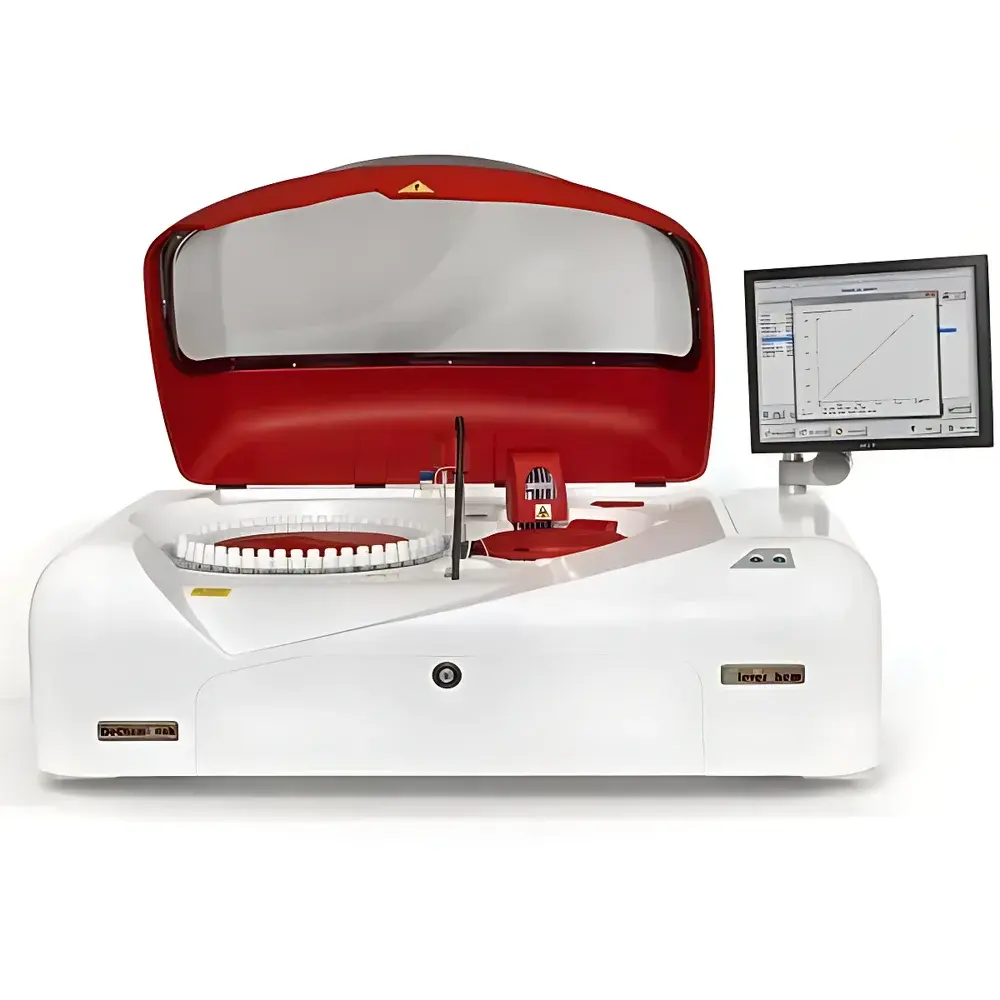
DeChem-Tech CleverChem 380 Automated Tobacco Composition Analyzer
| Brand | DeChem-Tech |
|---|---|
| Origin | Germany |
| Model | CleverChem-380 |
| Sample Capacity | 119 positions |
| Reagent Positions | 49 (with refrigerated storage) |
| Optical Cell | 64-position quartz cuvette carousel, 1 cm pathlength |
| Throughput | up to 350 samples/hour |
| Dilution Range | 1–100× in-cuvette dilution |
| Cleaning | 8-step ultrasonic cuvette washing station with optical validation |
| Detection Principle | Photometric colorimetry (absorbance measurement at defined wavelengths) |
| Software | Dual-language (English/Chinese), compliant with GLP data integrity requirements |
| Waste Management | Sealed waste sensing and containment system |
| Compliance | Methods aligned with China National Tobacco Industry Standards (e.g., YC/T series) |
Overview
The DeChem-Tech CleverChem 380 Automated Tobacco Composition Analyzer is a dedicated discrete photometric analyzer engineered for high-throughput, regulatory-compliant analysis of critical chemical constituents in tobacco leaf, stem, extract, and processed tobacco materials. It operates on the principle of endpoint or kinetic colorimetric reactions—where analytes (e.g., nitrate, phosphate, nicotine, ammonium, chloride) react with specific reagents to form chromophores whose absorbance intensity at defined wavelengths is directly proportional to concentration. Unlike continuous-flow or segmented-flow systems, the CleverChem 380 employs a true discrete cuvette-based architecture: each sample and reagent combination is dispensed into an individual quartz cuvette, incubated under controlled temperature, and measured via high-stability photodiode array detection. This design eliminates cross-contamination, ensures precise reaction timing, and supports multi-parameter simultaneous analysis without method interference—making it especially suited for complex, matrix-rich tobacco matrices requiring method-specific incubation conditions.
Key Features
- Discrete cuvette-based photometry with 64-position quartz cuvette carousel (1 cm pathlength), individually validated for optical clarity prior to reuse
- Automated 8-step ultrasonic cleaning protocol with post-wash optical verification to guarantee baseline stability and inter-run reproducibility
- Integrated in-cuvette dilution capability (1–100×), enabling automatic over-range correction and standard curve generation without manual intervention
- 119-sample capacity with programmable priority queuing and real-time status tracking; supports unattended overnight runs
- 49 reagent positions housed in a thermally regulated compartment (4–12 °C), configurable per method requirement
- Intelligent liquid-level and obstruction sensing across all fluidic paths, coupled with audible/visual fault alerts and error-logging for preventive maintenance
- Micro-dosage precision: consumes ≤2% of reagent and sample volume compared to conventional manual wet chemistry—reducing consumables cost and hazardous waste generation
- Full walk-away automation: from aspiration and reagent addition to incubation, mixing, photometric reading, and waste disposal
Sample Compatibility & Compliance
The CleverChem 380 accepts clarified tobacco extracts, acid digests (e.g., HNO₃/H₂O₂ microwave digestates), and aqueous leachates following standardized pretreatment (filtration, centrifugation, pH adjustment). Its modular method library includes validated protocols for ammonia-N, nitrate-N, total nitrogen (Kjeldahl digestion integration optional), orthophosphate, total phosphorus, sulfate, chloride, nicotine (via bromination or UV-Vis), reducing sugars (Lane-Eynon), total sugars (phenol-sulfuric acid), hydrogen cyanide (pyridine-barbituric acid), volatile alkaloids, and cyanide. All embedded methods conform to China National Tobacco Corporation standards (YC/T 22–2017, YC/T 160–2019, YC/T 378–2010), and are adaptable to ISO 11095 (calibration using reference materials), ASTM D5179 (nitrate in plant tissue), and AOAC 985.24 (total sugar in agricultural products). Instrument operation logs, audit trails, electronic signatures, and raw absorbance data export comply with GLP and internal QA/QC documentation requirements.
Software & Data Management
The CleverChem Control Suite provides dual-language (English/Chinese) interface with intuitive workflow navigation, method editor, and calibration manager. It supports true blank correction—separate sample blank and reagent blank subtraction—to eliminate matrix and reagent background effects. All analytical results are timestamped, linked to sample ID and method version, and stored in a relational SQLite database with configurable backup intervals. Raw absorbance spectra, reaction kinetics curves, and dilution history are retained for full traceability. Export formats include CSV, PDF analytical reports, and XML for LIMS integration. The software meets essential data integrity criteria per ALCOA+ principles and supports 21 CFR Part 11 readiness when deployed on validated Windows OS environments with user access controls and electronic signature configuration.
Applications
This analyzer serves core quality control and R&D functions across the tobacco value chain: leaf grading laboratories verifying curing efficiency via nitrate/nitrite ratios; manufacturing QC labs monitoring sugar-to-alkaloid balance in cut filler blends; regulatory testing centers performing compliance checks against national limits for HCN and nitrosamines precursors; and agronomy research units assessing fertilizer response through N-P-K uptake profiling. Its ability to quantify both inorganic ions (Cl⁻, SO₄²⁻, NO₃⁻) and organic biomarkers (nicotine, reducing sugars) within a single run significantly reduces turnaround time versus sequential single-analyte platforms. The system also supports method development for emerging tobacco-related analytes—including amino acids and polyphenols—via customizable reaction protocols and wavelength selection.
FAQ
What sample preparation is required prior to analysis?
Tobacco samples must undergo homogenization, extraction (e.g., hot water or dilute acid), and clarification via filtration (0.45 µm) or centrifugation. Digestion is required only for total nutrient determination (e.g., total N, P).
Can the instrument perform simultaneous multi-analyte analysis on one sample?
Yes—each sample is sequentially assayed for up to 12 parameters in a single run, with independent reaction timing and wavelength selection per method.
Is the system compatible with external LIMS or ERP systems?
Yes—CSV and XML data exports support automated ingestion into laboratory information management systems; optional OPC UA or REST API integration is available upon request.
How is calibration maintained across long-term operation?
Calibration curves are generated per batch using certified reference materials; drift correction is supported via periodic recalibration checks and cuvette optical validation.
What safety certifications does the instrument hold?
The system complies with IEC 61010-1 (electrical safety), EN 61326-1 (EMC), and incorporates sealed waste containment meeting GHS hazard communication standards for handling cyanide- and formaldehyde-containing reagents.



