
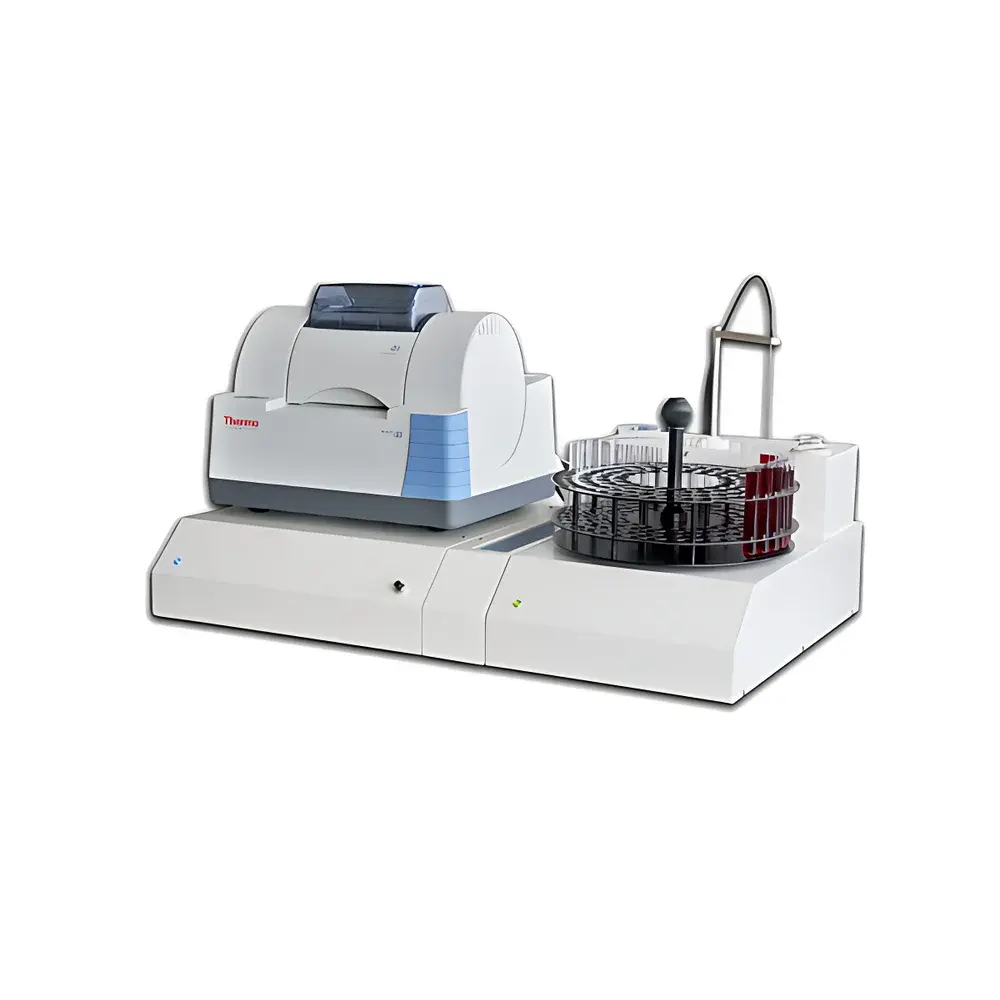
DeChem-Tech CleverChem F.U.V. Fully Automated UV-Vis/FTIR Wine & Must Analyzer
| Brand | DeChem-Tech |
|---|---|
| Origin | Germany |
| Instrument Type | Discrete Analyzer (Flow-Based Spectrophotometric Analyzer) |
| Model | CleverChem F.U.V. |
| Wavelength Range | 200–850 nm |
| Sample Volume per Test | 10 mL |
| Reagent Positions | N/A (Reagent-free operation for core wine parameters) |
| Flow Cell Pathlength | 0.20 mm |
| Light Source | Deuterium + Tungsten-Halogen UV/Vis Lamp (2000 h lifetime) |
| FTIR Resolution | < 0.4 cm⁻¹ |
| UV-Vis Spectral Resolution | 0.25 nm |
| Detector | 2048-pixel CCD array (200 × 14 µm/pixel) |
| Temperature Control Range | 5–35 °C |
| Dimensions (Analyzer Unit) | 35 × 28 × 26 cm (W×D×H) |
| Weight | 10 kg |
| Compliance | Designed for GLP-compliant wine laboratories |
Overview
The DeChem-Tech CleverChem F.U.V. is a benchtop discrete analyzer engineered specifically for quantitative chemical analysis of grape must, fermenting juice, and finished wine. Unlike conventional flow injection or segmented-flow analyzers, the CleverChem F.U.V. integrates dual optical detection modalities—UV-Vis absorption spectroscopy (200–850 nm) and Fourier-transform infrared (FTIR) spectroscopy—within a single, compact platform. It operates on the principle of multivariate calibration using chemometric models trained on reference datasets of certified wine and must samples. The system performs direct, reagent-free measurements by acquiring full spectral profiles and applying partial least squares (PLS) regression to extract concentrations of key enological parameters. Its architecture eliminates sample derivatization, dilution, or pre-filtration for most assays—enabling rapid (<10 s per parameter), high-reproducibility analysis while preserving native matrix integrity. Designed for routine use in winery QC labs, research institutions, and regulatory testing facilities, the instrument meets the operational demands of ISO 2173 (fruit juice analysis), OIV Method 10A/09 (wine alcohol determination), and ASTM D7260 (spectroscopic quantification in complex beverages).
Key Features
- Hybrid optical engine combining high-resolution UV-Vis (0.25 nm spectral resolution) and mid-IR FTIR (<0.4 cm⁻¹ resolution) detection in one chassis
- Reagent-free operation for >20 core wine parameters—including ethanol (% v/v), total acidity (TA), volatile acidity (VA), pH, reducing sugars, malic acid, tartaric acid, lactic acid, CO₂, SO₂ (free and total), glycerol, acetaldehyde, and color intensity (IPT at 280 nm)
- Integrated temperature-controlled fluidic circuit with PTFE-lined peristaltic pumping, inline 30–50 µm filtration, and automatic rinse cycles
- 0.20 mm pathlength quartz flow cell optimized for undiluted red wine analysis—eliminates need for dilution or decolorization
- Deuterium + tungsten-halogen dual-source lamp with 2000-hour rated lifetime and long-term photometric stability (<2×10⁻⁵ ΔA at 230 nm)
- Modular FTIR optical bench featuring Michelson interferometer with air-bearing mirror translation, DTGS detector, and Ge/KBr beamsplitter (7800–350 cm⁻¹)
- Full-spectrum acquisition and storage in standardized SPC format; all raw spectra and processed results archived with timestamp, operator ID, and method version
- Intuitive multi-language GUI with role-based access control, password-protected method editing, and automated calibration validation workflows
Sample Compatibility & Compliance
The CleverChem F.U.V. accepts undiluted grape must, white wine, rosé, and red wine samples (10 mL volume per analysis). Its optical design accommodates turbid matrices up to 40 NTU without signal degradation, making it compatible with samples filtered via MustTech vacuum filtration units (recommended for FTIR-grade clarity). The system complies with Good Laboratory Practice (GLP) requirements through built-in audit trails, electronic signature support, and secure data export formats (ASCII, Microsoft Access .accdb, and vendor-neutral .SPC). Calibration libraries are traceable to NIST-certified reference materials and validated per OIV and EU Regulation No. 1308/2013 Annex VII standards. Optional 21 CFR Part 11 compliance packages include electronic record integrity controls, user authentication logs, and change history tracking for all analytical methods and calibration updates.
Software & Data Management
CleverChem Control Software provides unified management of hardware modules, method execution, calibration, and reporting. All analyses generate three-tiered outputs: (1) quantitative results in tabular format with uncertainty estimates, (2) full UV-Vis and FTIR spectra stored as .SPC files for retrospective reprocessing, and (3) metadata-enriched CSV exports compatible with LIMS integration. Chemometric models are editable via embedded PLS editor; users may add new parameters by importing reference datasets and training custom regressions. The software supports scheduled calibration verification, drift correction routines, and automated flagging of out-of-spec results based on configurable limits. Data backups are encrypted and time-stamped; revision history maintains version control for all methods, calibrations, and spectral libraries.
Applications
The CleverChem F.U.V. serves critical functions across the enological value chain: real-time monitoring of fermentation kinetics (sugar depletion, acid profile shifts, ethanol accumulation), pre-bottling QC for VA, SO₂, and CO₂ compliance, varietal authenticity screening via NIR fingerprinting, and research into phenolic maturation (IPT, anthocyanin profiling). It replaces multiple standalone instruments—including titrators, enzymatic assay kits, gas chromatographs, and traditional spectrophotometers—reducing labor, consumable costs, and inter-method variability. Winemakers deploy it for daily must evaluation prior to inoculation, while national wine control laboratories utilize it for statutory testing under OIV and EU regulatory frameworks. Its robustness and low maintenance footprint make it suitable for mobile lab deployments during harvest season.
FAQ
Does the CleverChem F.U.V. require chemical reagents for standard wine assays?
No—core parameters (ethanol, TA, VA, pH, organic acids, sugars, CO₂) are measured reagent-free using calibrated spectral models. Only specialized assays (e.g., sulfite speciation beyond total SO₂) may require minimal reagent addition.
Can the instrument analyze unfiltered red wine directly?
Yes—the 0.20 mm pathlength quartz flow cell and integrated 30–50 µm inline filter enable direct analysis of typical red wine samples without centrifugation or membrane filtration.
Is method validation required after installation?
Yes—DeChem-Tech provides initial qualification protocols (IQ/OQ/PQ), and users must perform site-specific performance verification using matrix-matched reference standards per ISO/IEC 17025 guidelines.
How is data integrity ensured for regulatory submissions?
Raw spectra, processed results, calibration logs, and operator actions are cryptographically timestamped and stored in immutable archives. Optional 21 CFR Part 11 mode enables electronic signatures and audit trail review.
What maintenance is required for long-term reliability?
Lamp replacement every ~2000 hours, annual FTIR alignment verification, and quarterly cleaning of fluidic pathways and sampling probe. No optical realignment or detector recalibration is needed under normal operation.
Related Products




