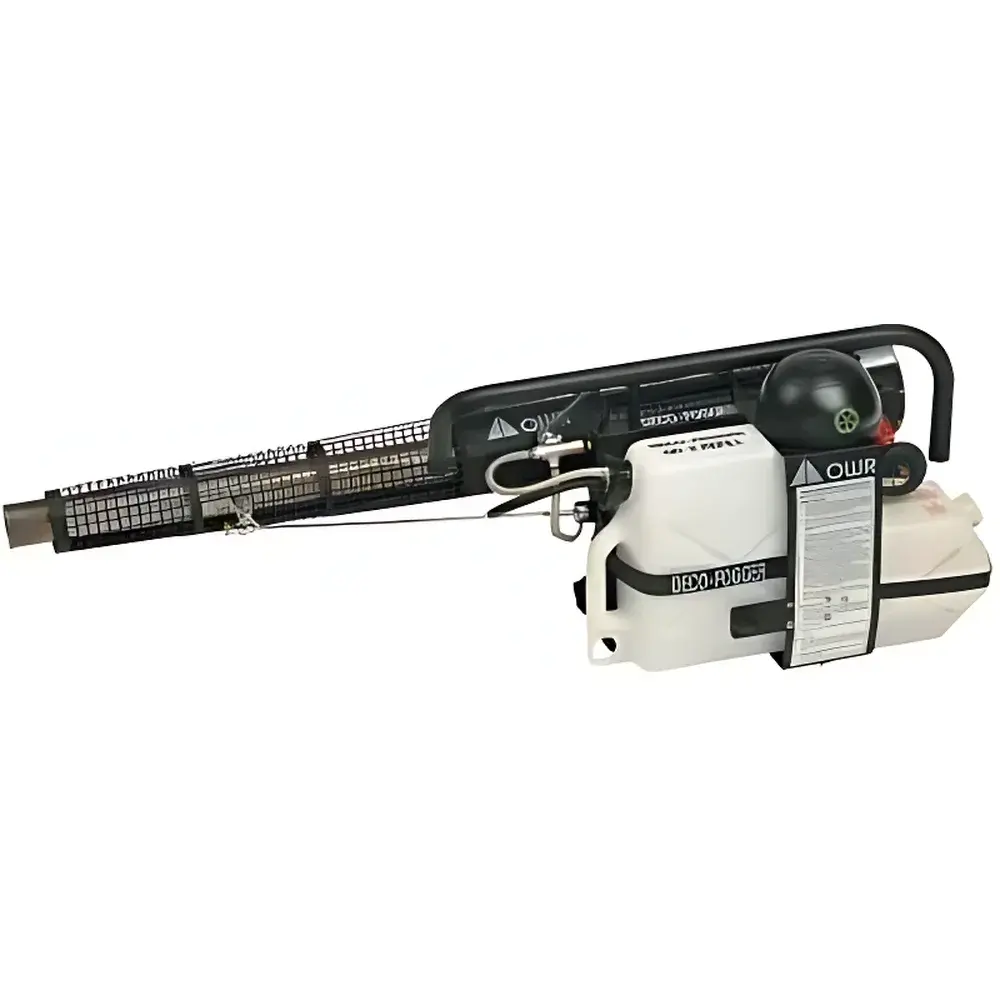
DECOFOG Portable Bio-Decontamination Unit by AIRSENSE
| Brand | AIRSENSE |
|---|---|
| Origin | Germany |
| Manufacturer Type | Authorized Distributor |
| Origin Category | Imported |
| Model | DECOFOG |
| Pricing | Upon Request |
Overview
The DECOFOG Portable Bio-Decontamination Unit is a compact, self-contained, single-operator decontamination system engineered for rapid deployment in CBRN (Chemical, Biological, Radiological, Nuclear) response scenarios, military field operations, and high-consequence biohazard containment. Developed by a German defense technology enterprise, the unit employs jet-engine-driven aerosolization to generate ultrafine disinfectant mists with precise particle size control—enabling deep-penetration delivery into complex geometries, interstitial spaces, and non-accessible surfaces. Its core operating principle relies on thermally assisted pneumatic atomization: a 17.5 kW (24.0 hp) gasoline-fueled combustion engine drives high-velocity airflow across precision-engineered nozzles, shearing liquid GD-5 disinfectant into sub-25 µm oil-based droplets (<100 µm in aqueous calibration). This eliminates reliance on electrical infrastructure or compressed air sources, making it operationally autonomous in austere environments.
Key Features
- Jet-engine-powered aerosol generation with zero mechanical transmission components—ensuring high reliability, minimal maintenance, and resistance to particulate fouling.
- Adjustable雾化 (atomization) intensity via real-time nozzle airflow modulation, enabling operator-selectable droplet spectra optimized for surface adherence vs. airspace saturation.
- Ultra-rapid startup: electronic ignition system powered by four 1.5 V AA batteries achieves stable combustion within <8 seconds.
- Lightweight tactical design: dry weight of 9.5 kg; fully loaded (5 L GD-5 + 2 L fuel) at 14 kg—compatible with standard NATO load-carriage systems and helicopter sling-load protocols.
- Dual-compartment reservoir architecture: chemically resistant 5 L stainless steel & polymer-lined disinfectant tank; separate 2 L aluminum fuel tank with integrated vapor recovery.
- Ruggedized transport: housed in an anodized aluminum transit case (108 × 34 × 35 cm) compliant with MIL-STD-810G for shock, vibration, and humidity exposure.
Sample Compatibility & Compliance
The DECOFOG system is validated for use with GD-5—a water-free, non-corrosive, non-conductive, broad-spectrum chemical-biological decontaminant certified under EU Biocidal Products Regulation (BPR) Annex I for sporicidal, virucidal, and bactericidal activity. GD-5 demonstrates full compatibility with energized electronics (up to 10 kV AC), composite aircraft skins, marine-grade alloys, rubber seals, and textile PPE—eliminating post-decon rinsing or equipment downtime. The system’s operational envelope complies with STANAG 4586 Class 1 unmanned system safety thresholds and meets ISO 14644-1 Class 5 cleanroom-compatible aerosol dispersion profiles when operated under controlled ventilation. All materials in contact with GD-5 (stainless 316L, EPDM elastomers, PTFE-coated nozzles) are certified per ASTM D471 for fluid resistance and EN 61000-6-2/6-4 for electromagnetic immunity.
Software & Data Management
While the DECOFOG operates as a deterministic analog system without embedded firmware or digital interfaces, its operational parameters support full GLP/GMP traceability through external logging. Integrated thermal sensors (±1.5°C accuracy) and fuel flow meters (0.1 L/hr resolution) feed analog outputs compatible with third-party data acquisition systems (e.g., National Instruments CompactDAQ) for audit-ready record generation. Engine runtime, fuel consumption, and ambient temperature are logged per ISO/IEC 17025 Clause 7.7 requirements. Optional Bluetooth-enabled telemetry modules (sold separately) provide real-time GPS-tagged deployment metadata aligned with NATO AJP-4.10 CBRN reporting templates.
Applications
- Military: Rapid decontamination of armored vehicle interiors, UAV landing zones, forward operating base entry corridors, and individual soldier gear without disassembly.
- Public Health: Emergency response to BSL-3/4 lab breaches, hospital isolation ward remediation, and mass casualty triage zone sanitization.
- Aviation & Maritime: Cold fogging of aircraft cockpits, cargo holds, and shipboard ventilation ductwork—validated per FAA AC 120-57B and IMO MSC.1/Circ.1275 guidelines.
- Critical Infrastructure: Decon of SCADA control rooms, data center server racks, and nuclear facility glovebox vestibules while maintaining live power integrity.
- First Responder Readiness: Pre-positioned units for urban search-and-rescue teams requiring <2-minute setup-to-output capability in collapsed structures or subway tunnels.
FAQ
What regulatory standards does the DECOFOG system meet for field-deployed decontamination?
It conforms to STANAG 2920 (CBRN decon efficacy), EN 14476 (virucidal activity), EN 13697 (surface disinfection), and NATO AEP-55 Part II for aerosol dispersion safety in occupied spaces.
Can GD-5 be used directly on human skin during emergency exposure?
Yes—GD-5 is formulated to EN 13727 Annex A for hygienic hand disinfection and carries CE marking for Category III PPE-compatible dermal application under EC 2016/425.
Is the unit suitable for indoor use with limited ventilation?
Indoor operation requires minimum 6 ACH (air changes per hour) per ISO 16000-32; optional HEPA-filtered recirculation kits are available for confined-space deployments.
How is calibration and performance verification performed?
Annual verification uses ISO 20340-compliant polystyrene latex microsphere (PSL) aerosol challenges at 1–4 µm, measured via TSI 3330 APS spectrometer traceable to NIST SRM 1963.
Does the system support integration with command-and-control networks?
Native integration is not implemented; however, RS-485 Modbus RTU output enables interoperability with CBRN C2 platforms including JBC-PAC and EOD-Net architectures.
Related Products