
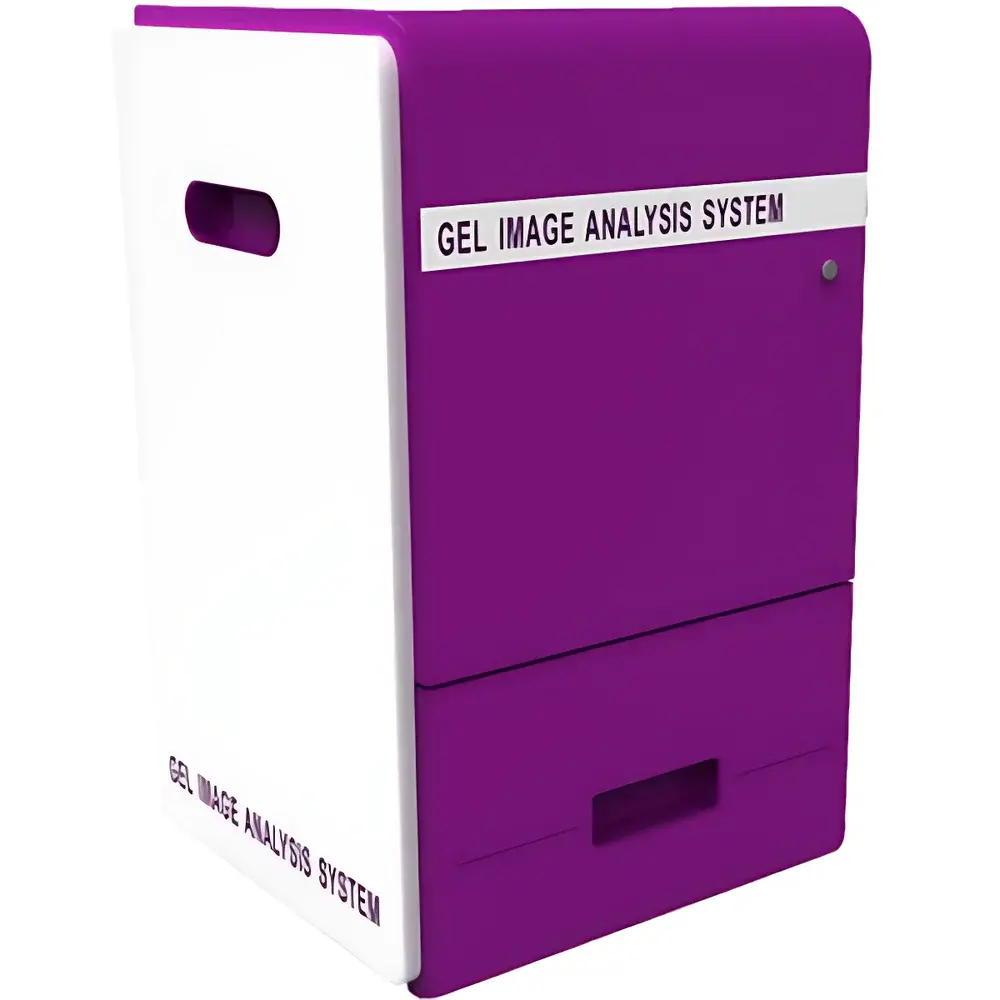
DELEITE Geliant-D503 Gel Imaging System
| Brand | DELEITE |
|---|---|
| Origin | Shanghai, China |
| Manufacturer Type | Authorized Distributor |
| Product Category | Domestic |
| Model | Geliant-D503 |
| Instrument Type | Standard Gel Imaging System |
| CCD Resolution | 2592 × 1944 (5.03 MP) |
| Bit Depth | 16-bit (65,536 gray levels) |
| Dynamic Range | 65,536 gray levels |
| CCD Sensor Size | 13.48 mm × 10.11 mm |
| Pixel Size | 5.2 µm × 5.2 µm |
| Detection Sensitivity | ≤ 0.02 ng double-stranded DNA (ethidium bromide staining) |
| Signal-to-Noise Ratio | 69.8 dB |
| Lens | Imported 6× motorized zoom lens, f/1.2, focal length 8–48 mm |
| Transmission UV Source | Standard 302 nm (high-efficiency ballast, η > 80%, rated lamp life ≥ 40,000 on/off cycles) |
| Transmission White Light | Adjustable-intensity LED uniform illuminator |
| Transmission Blue Light | Optional 470 nm |
| Reflected UV | Optional 254 nm / 365 nm |
| Reflected White Light | Dual-side high-brightness cold LED |
| UV Transilluminator Area | 210 mm × 260 mm |
| Visible Light Transilluminator Area | 210 mm × 260 mm |
| Integrated Gel Cutting Hood | Standard |
| Control Architecture | Fully programmable microprocessor-controlled module (lens zoom/focus/aperture, transmission/reflection illumination, cutting light) |
| Auto UV Shut-off | Configurable timer (1–60 min inactivity) |
| Enclosure | Light-tight dark chamber with interlocked UV safety cutoff |
| Software | DELEITE GelCapture & GelAnalyzer Suite (free lifetime installation, updates, remote training, and on-site support per contractual agreement) |
Overview
The DELEITE Geliant-D503 Gel Imaging System is a fully integrated, microprocessor-controlled digital imaging platform engineered for reproducible, quantitative analysis of nucleic acids and proteins resolved by electrophoresis. It employs a high-sensitivity scientific-grade CCD sensor coupled with an f/1.2 motorized zoom lens to maximize photon capture under low-light fluorescence conditions—critical for detecting faint bands in ethidium bromide-, SYBR®- or GelRed®-stained gels. The system operates on the principle of fluorescence excitation and emission capture: nucleic acid or protein-bound dyes are excited by precisely filtered UV or visible light sources, and emitted photons are collected through a calibrated optical path, digitized at 16-bit depth, and processed using standardized intensity normalization algorithms. Designed for routine QC, academic research, and teaching laboratories, the Geliant-D503 meets fundamental requirements for GLP-compliant documentation, including timestamped image metadata, exposure parameter logging, and audit-ready file export.
Key Features
- Scientific-grade CCD sensor with 5.03 megapixel resolution (2592 × 1944), 5.2 µm pixel pitch, and quantum efficiency of 0.78—optimized for low-light fluorescence detection.
- 16-bit analog-to-digital conversion delivering 65,536 discrete gray levels and a dynamic range exceeding 65,536:1, enabling linear quantification across wide signal intensities.
- Fully motorized 6× zoom lens (8–48 mm, f/1.2) with automated focus and aperture control—eliminating manual alignment drift and ensuring repeatable magnification across users and sessions.
- Dual-mode illumination architecture: standard 302 nm UV transilluminator with >80% electrical-to-optical efficiency and ≥40,000-cycle lamp endurance; adjustable white-light LED transilluminator for Coomassie- or silver-stained gels; optional 470 nm blue-light and 254/365 nm reflected UV modules.
- Interlocked light-tight enclosure with automatic UV shutoff upon door opening and programmable idle-time shutdown (1–60 min), satisfying IEC 61000-4-2 and ANSI Z136.1 safety guidelines.
- Integrated gel-cutting hood with UV-blocking acrylic shield and dedicated illumination—enabling safe, precise excision without sample relocation or ambient light contamination.
Sample Compatibility & Compliance
The Geliant-D503 supports a broad spectrum of electrophoretic formats and detection chemistries. It is validated for agarose and polyacrylamide gels stained with ethidium bromide, SYBR® Gold/Green/Safe, GelRed®, GelGreen®, OliGreen®, PicoGreen®, Fluorescein, Texas Red, Flamingo™, Oriole™, Krypton™, and SYPRO® Ruby. Protein applications include Coomassie Brilliant Blue, silver stain, copper/zinc-based stains, and fluorescent dyes applied to gels, blots, and microarrays. For microbiological use, it accommodates Petri dish colony counting and dot-blot hybridization analysis. All optical components—including the 590 nm emission filter—are certified to ISO 9001-manufactured tolerances. The system complies with electromagnetic compatibility (EMC) standards per EN 61326-1 and carries CE marking for laboratory instrumentation.
Software & Data Management
The bundled DELEITE GelCapture & GelAnalyzer software suite provides end-to-end workflow control—from hardware parameter scripting to publication-ready reporting. GelCapture enables synchronized control of illumination source selection, exposure time (1 ms–60 s), lens zoom/focus/aperture, and real-time histogram preview. GelAnalyzer implements ISO/IEC 17025-aligned 1D electrophoresis analysis: automatic lane and band detection via edge-enhanced thresholding; manual correction tools for ambiguous migrations; customizable molecular weight standards (linear, quadratic, or spline interpolation); integrated densitometry with background subtraction and relative quantification (normalized to reference bands or total lane intensity). All results—including raw TIFFs, annotated images, and Excel-compatible .csv reports—are timestamped, user-ID tagged, and stored with full EXIF metadata. Software updates maintain compatibility with Windows 10/11 and support FDA 21 CFR Part 11–compliant electronic signatures when deployed with institutional authentication infrastructure.
Applications
- Quantitative DNA/RNA fragment analysis in PCR, restriction digestion, and cloning workflows.
- Protein expression profiling and purity assessment in SDS-PAGE and native PAGE.
- Western blot signal validation and semi-quantitative comparison of target protein abundance.
- Colony-forming unit (CFU) enumeration in microbial assays using agar plate imaging.
- Dot/slot blot hybridization signal intensity calibration for nucleic acid or antibody binding studies.
- Educational demonstration of electrophoretic mobility, staining kinetics, and fluorescence physics principles.
FAQ
What is the minimum detectable DNA mass under standard ethidium bromide staining?
The system reliably detects double-stranded DNA bands containing ≥0.02 ng, measured using 100 bp DNA ladder under optimized exposure (302 nm UV, 15 s exposure, f/1.2 aperture).
Is the software compatible with networked lab environments and LIMS integration?
Yes—GelAnalyzer exports structured data (band intensity, MW, % volume) in .csv and .xlsx formats; custom API hooks are available for middleware integration upon request.
Does the system support Good Manufacturing Practice (GMP) documentation requirements?
While not GMP-certified out-of-the-box, the software’s audit trail (user log, parameter history, image hash) and electronic signature readiness align with Annex 11 and ALCOA+ data integrity principles when configured with institutional IT governance.
Can third-party filters be installed for alternative fluorophores?
Yes—the filter wheel accepts standard 25 mm threaded filters; recommended alternatives include 535/40 nm (for SYBR Green), 610/20 nm (for Texas Red), and 460/40 nm (for DAPI), all requiring matching excitation source configuration.
What maintenance is required for long-term optical performance?
Annual calibration of CCD dark current and flat-field correction is recommended; lens elements require only periodic dust-free wiping with optical-grade tissue and ethanol—no internal servicing is needed under normal operation.
Related Products




