
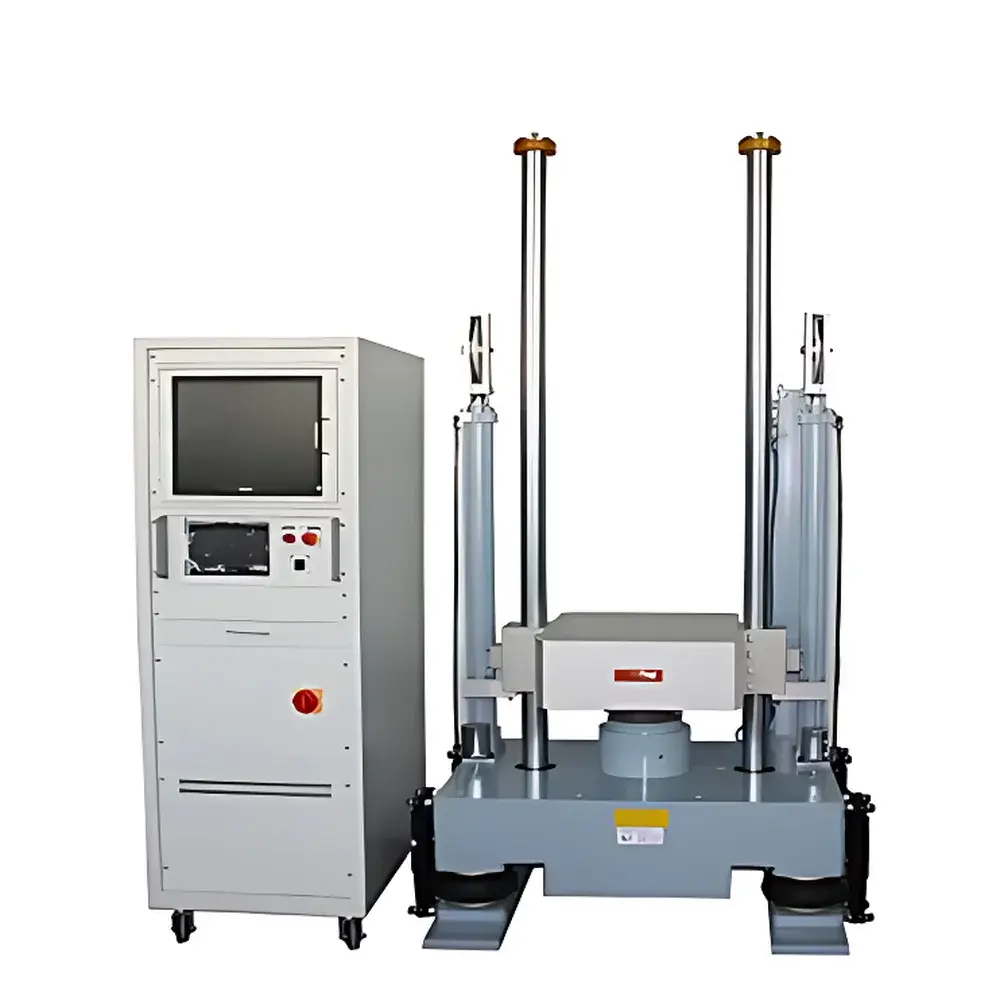
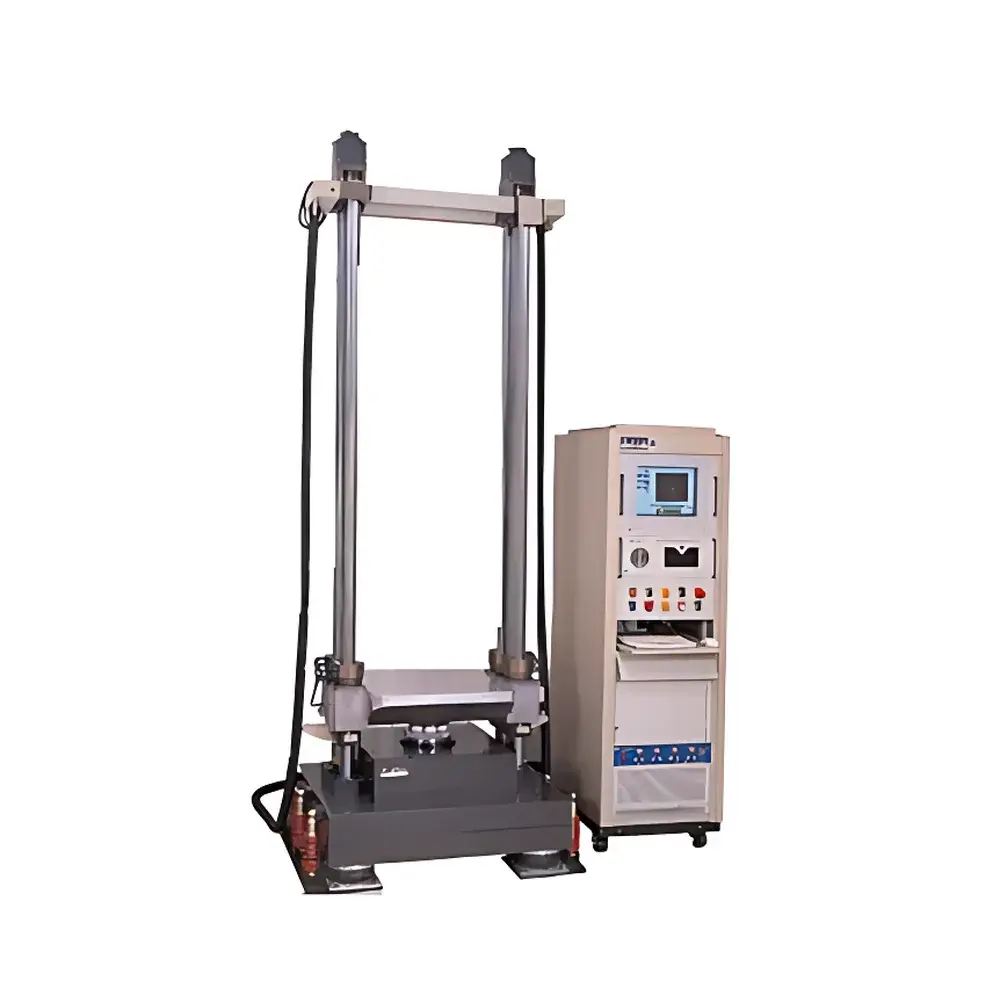
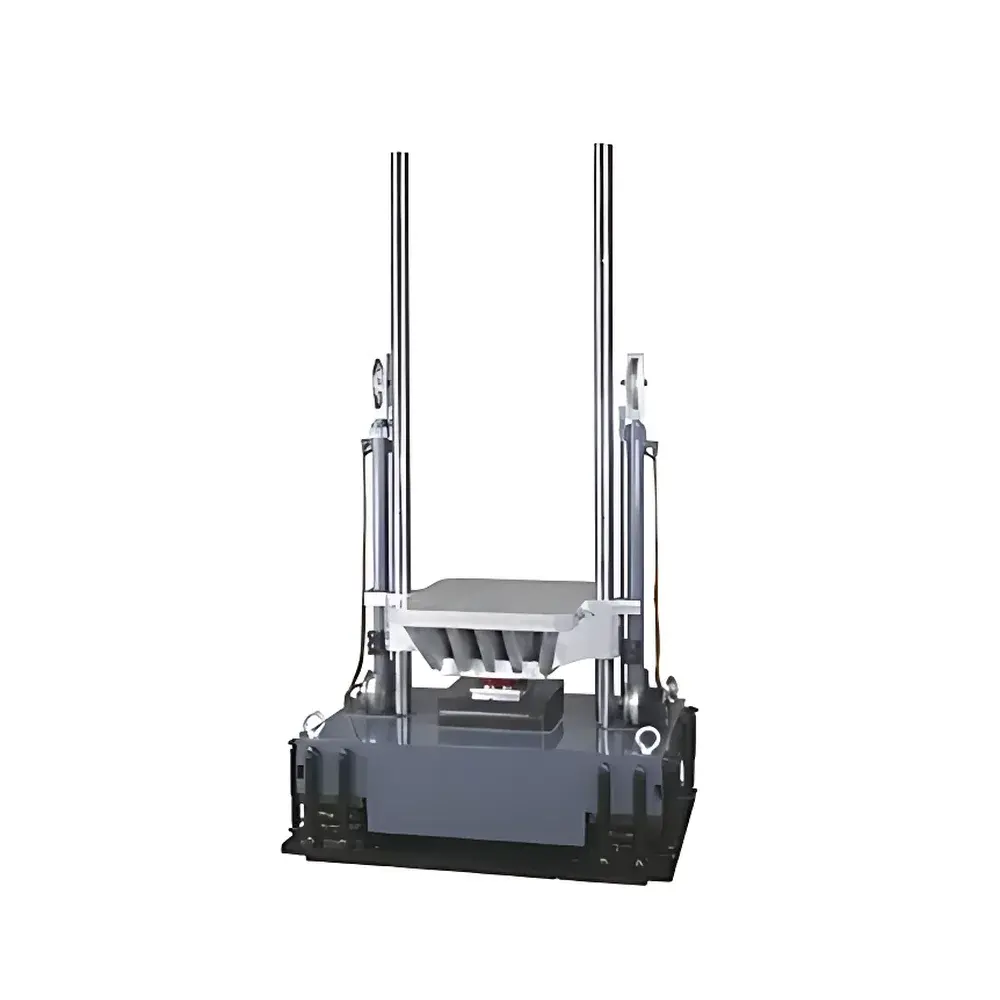
Delta DELTA-gs001 High-Acceleration Shock Test Stand
| Brand | Delta Instruments (delta17) |
|---|---|
| Origin | Guangdong, China |
| Manufacturer Type | Authorized Distributor |
| Country of Origin | China |
| Model | DELTA-gs001 |
| Price Range | USD 2,800 – 7,200 |
| Platform Dimensions | 700 mm × 800 mm |
| Max Load Capacity | 100 kg (customizable) |
| Peak Acceleration | Half-Sine: 30–600 g |
| Post-Peak Sawtooth | 30–100 g |
| Square Wave (optional) | 30–120 g |
| Pulse Duration | Half-Sine: 1–30 ms |
| Post-Peak Sawtooth | 6–18 ms |
| Square Wave (optional) | 6–18 ms |
| Acceleration Tolerance | ≤ ±10% |
| Velocity Change Tolerance | ≤ ±10% |
| Lateral Motion Ratio | ≤ 10% |
| Overall Dimensions | 1300 mm × 1200 mm × 2650 mm |
| Mass | 1800 kg |
| Data Acquisition Channels | 2 |
| Sampling Rate | 500 kHz |
| Max Measurable Acceleration | 5000 g |
| Input Voltage Range | ±10 V<sub>PEAK</sub> |
| Sensor Type | Piezoelectric Charge Output |
| Sensor Model | B&W 22100 |
| Sensitivity | 3.93 pC/g |
| Frequency Range | 0.5–12 kHz |
| Acceleration Range | ±2500 g |
| Operating Environment | −40 °C to +160 °C |
| Power Supply | 3-phase AC 380 V ±10%, 5 kVA |
| Compressed Air | 0.5–0.8 MPa |
| Ambient Temp | RT–40 °C |
| Relative Humidity | <85% RH at 25 °C |
| MTBF | ≥5000 h |
| Half-Sine Generator Duty Cycle | ≥8000 consecutive impacts |
| Storage Life (clean, ambient conditions) | ≥5 years |
| Compliance | GB/T 2423.5–1995, GJB 150.18A–2009, GJB 360B–2009, IEC 60068-2-27, MIL-STD-810H, MIL-STD-202G, GB/T 18287, GB 31241, JG 541–2005 |
| Software Functions | Shock Response Spectrum (SRS), Pulse Analysis, Damage Boundary Analysis, Time-Domain Impact Response Calculation, FFT, Force–Deformation Correlation (auxiliary) |
Overview
The Delta DELTA-gs001 High-Acceleration Shock Test Stand is a precision-engineered free-fall impact system designed for controlled, repeatable mechanical shock simulation in laboratory and industrial quality assurance environments. It operates on the principle of gravity-driven drop mass impact, combined with hydraulic lifting and high-pressure fluid braking to ensure precise control over impact velocity, pulse shape, and energy delivery. The system generates standardized half-sine, post-peak sawtooth, and optional square-wave acceleration pulses—each traceable to international test standards including IEC 60068-2-27, MIL-STD-810H, and GB/T 2423.5–1995. Its primary function is to evaluate structural integrity, mounting reliability, and functional survivability of electronic components, battery packs, portable devices, and their packaging under transient high-g loading conditions typical of transportation, handling, and operational shock events.
Key Features
- Hydraulic lift mechanism with pressure-regulated release ensures consistent drop height and impact velocity repeatability across thousands of cycles.
- Integrated pneumatic–hydraulic friction brake system eliminates secondary rebound and suppresses residual oscillation—critical for accurate pulse fidelity and device-under-test (DUT) safety.
- Dual-channel, 500 kHz sampling data acquisition system supports simultaneous measurement of orthogonal acceleration vectors, enabling full vectorial shock characterization.
- Modular elastomeric pulse shapers (rubber-based anvil inserts) allow empirical tuning of half-sine pulse duration (1–30 ms) and amplitude without hardware modification.
- Robust steel frame construction (1800 kg total mass) minimizes base motion coupling and maintains platform stability during high-energy impacts up to 600 g peak.
- Compliance-ready architecture: preconfigured test templates, audit-trail logging, and calibration certificate management aligned with ISO/IEC 17025 requirements for accredited laboratories.
Sample Compatibility & Compliance
The DELTA-gs001 accommodates specimens up to 100 kg on its 700 mm × 800 mm rigid aluminum test platform, with optional custom fixtures for battery modules (including cylindrical, prismatic, and pouch cells), consumer electronics enclosures, PCB assemblies, and shipping cartons. It satisfies mandatory shock testing clauses in GB 31241 (Lithium-ion batteries for portable applications), UN 38.3 Section 5 (transport safety), and MIL-STD-810H Method 516.8 (Shock). All generated waveforms adhere to defined tolerance envelopes per IEC 60068-2-27: peak acceleration ±10%, velocity change ±10%, and lateral motion ≤10% of axial component. Calibration verification follows JG 541–2005 (Chinese national metrological verification regulation for shock machines), with traceability to NIM (National Institute of Metrology, China).
Software & Data Management
The embedded Windows-based control and analysis suite supports real-time waveform preview, trigger synchronization (internal or external TTL), multi-frame burst capture, and post-test parametric reporting. Core analytical modules include Shock Response Spectrum (SRS) generation per MIL-STD-810H Appendix C, damage boundary plotting against industry-standard fragility curves, time-domain convolution for equivalent static load estimation, and FFT-based spectral decomposition for resonance identification. All raw and processed datasets are stored in SQL-compatible structured format with timestamped metadata, user ID, calibration status, and environmental logs—enabling full GLP/GMP compliance and 21 CFR Part 11–ready electronic signatures when deployed with validated configuration.
Applications
- Functional and structural validation of lithium-ion battery packs subjected to drop-induced mechanical stress (per GB 31241 Clause 7.4.1 and UN 38.3 Subsection 5.1).
- Qualification testing of avionics housings, inertial sensors, and MEMS accelerometers under MIL-STD-810H Shock Method 516.8.
- Package integrity assessment for e-commerce logistics, including ISTA 3A and ASTM D4169–22 simulated drop profiles.
- Material-level impact resistance evaluation of polymer casings, solder joint fatigue thresholds, and interconnect robustness in handheld devices.
- Calibration reference for field-deployed shock recorders and pyroshock sensors used in aerospace and defense platforms.
FAQ
What waveform types does the DELTA-gs001 support, and how are they generated?
The system natively produces half-sine and post-peak sawtooth pulses via controlled mass impact onto tunable elastomeric anvils; square-wave capability is available as an optional add-on using electromagnetic pulse shapers.
Is the system compliant with FDA or ISO 13485 requirements for medical device testing?
While not certified as a Class II medical device itself, the DELTA-gs001 meets ISO 13485:2016 clause 7.6 (monitoring and measuring equipment) when operated within validated procedures and calibrated per JG 541–2005.
Can the test stand be integrated into an automated production line?
Yes—USB 2.0 and optional Ethernet interfaces support SCADA integration, PLC handshaking, and programmable test sequencing via LabVIEW or Python APIs.
What maintenance intervals are recommended for long-term reliability?
Hydraulic oil replacement every 2,000 operating hours, air filter inspection quarterly, and annual sensor recalibration are advised per the manufacturer’s maintenance logbook.
Does the system include NIST-traceable calibration documentation?
Each unit ships with a factory calibration certificate referencing national standards (NIM); third-party NIST-traceable calibration services are available upon request.



