
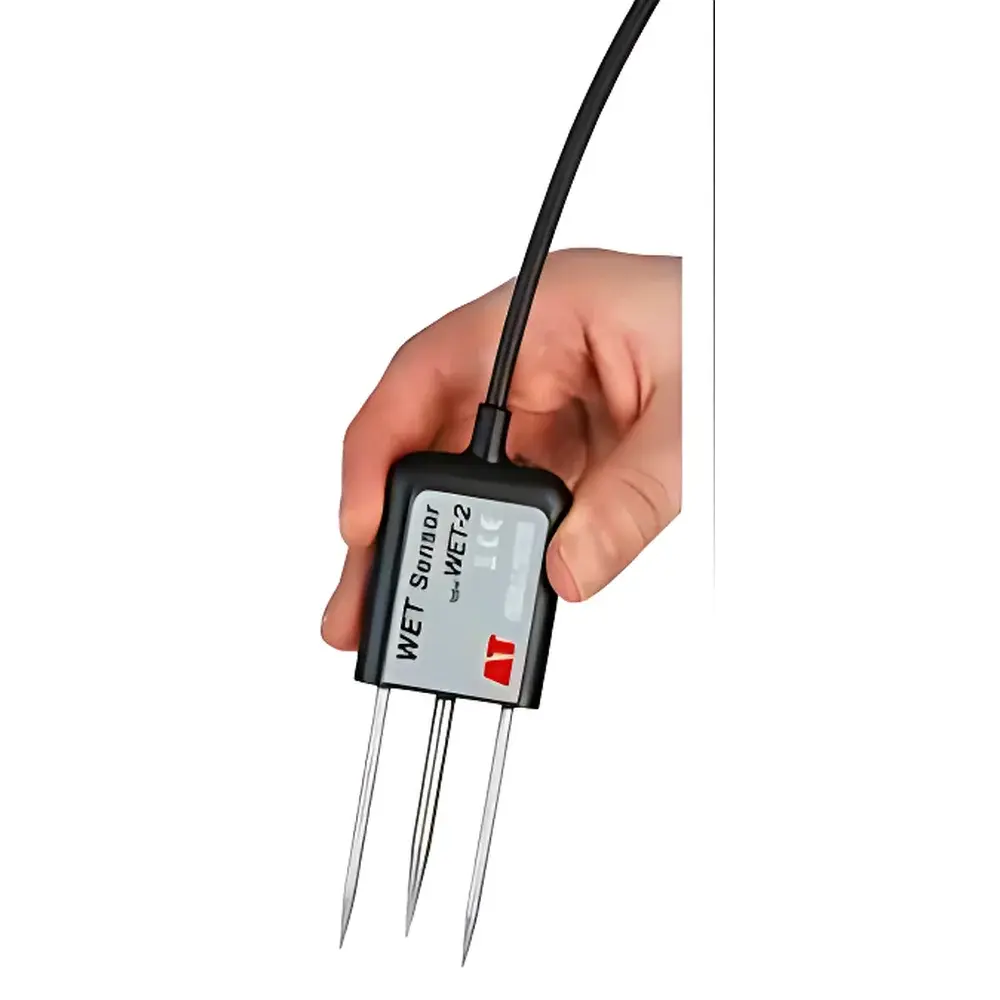
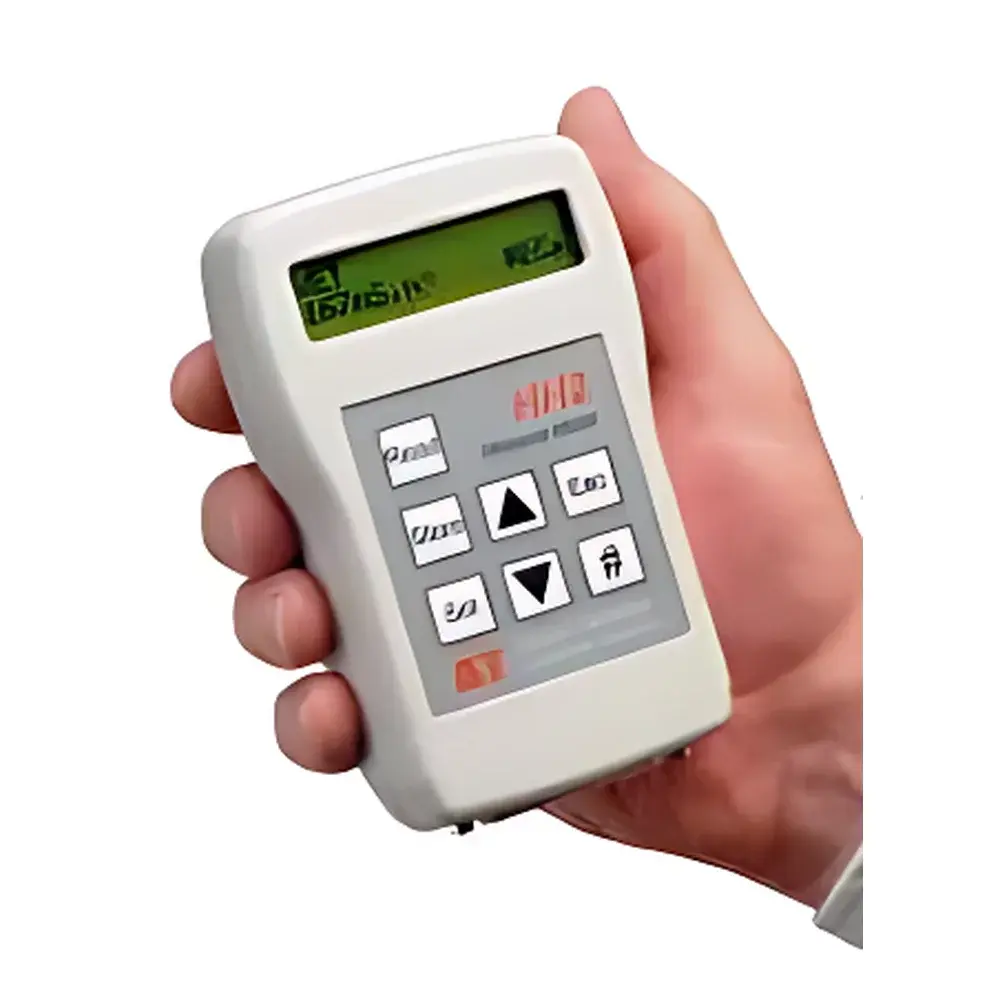
Delta-T Devices WET Soil Tri-Parameter Field Meter
| Brand | Delta-T Devices |
|---|---|
| Origin | United Kingdom |
| Model | WET |
| Instrument Type | Multifunctional Soil Analyzer |
| Measurement Principle | Frequency Domain Reflectometry (FDR) |
| IP Rating | IP68 (connector housing) |
| Operating Temperature | 0–50 °C |
| Probe Dimensions | 3 mm Ø × 68 mm L (central electrode: 5 mm × 60 mm) |
| Sample Volume | ~500 mL |
| Power Supply | 6–10 V DC, ~38 mA |
| Output | TTL Serial Data |
| Operating Frequency | 20 MHz |
| Response Time | 2.5 s |
| Temperature Range | –5 to 50 °C, ±1.5 °C accuracy, 0.1 °C resolution |
| Dielectric Permittivity Range | 1–80, ±2.5 units accuracy, 1 unit resolution |
| Bulk Electrical Conductivity (EC<sub>b</sub>) | 0–200 mS·m<sup>−1</sup>, ±10 mS·m<sup>−1</sup> accuracy, 1 mS·m<sup>−1</sup> resolution |
| Volumetric Water Content (θ<sub>v</sub>) | 0–100%, ±3% absolute accuracy, 0.1% resolution |
| Pore Water Electrical Conductivity (EC<sub>p</sub>) | derived parameter, up to 1500 mS·m<sup>−1</sup>, 1 mS·m<sup>−1</sup> resolution |
Overview
The Delta-T Devices WET Soil Tri-Parameter Field Meter is a field-deployable, FDR-based sensor system engineered for simultaneous, in-situ measurement of volumetric water content (θv), soil temperature, and bulk electrical conductivity (ECb). Its distinguishing capability lies in the real-time derivation of pore water electrical conductivity (ECp)—a critical indicator of soluble salt concentration in the soil solution—calculated from θv and ECb using empirically validated mixing models embedded in the HH2 readout unit firmware. Unlike single-parameter probes or time-domain reflectometry (TDR) systems requiring complex calibration and high-power pulses, the WET operates at a stable 20 MHz frequency with low energy consumption (<40 mA), enabling extended battery-powered operation in remote locations. The probe’s compact, stainless-steel construction and IP68-rated connector ensure mechanical durability and resistance to corrosion in diverse soil textures—from sandy loams to clay-rich profiles—without compromising measurement integrity.
Key Features
- Frequency Domain Reflectometry (FDR) technology for robust, temperature-compensated dielectric permittivity sensing
- Integrated triple-parameter measurement: θv, temperature, and ECb—all acquired within a single 2.5-second response cycle
- On-device calculation of ECp using the Rhoades–Hilhorst model, supporting salinity stress assessment in agronomic and ecological studies
- HH2 handheld meter with 2100-point internal memory, real-time data logging, and configurable sampling intervals
- Probe geometry optimized for minimal soil disturbance: 3 mm-diameter outer electrodes and a 5 mm central electrode, ensuring representative 500 mL sampling volume
- TTL serial output compatible with third-party dataloggers (e.g., Campbell Scientific CR series) and PC-based acquisition via optional USB adapter
- Low-voltage DC operation (6–10 V) suitable for solar-charged field stations or standard alkaline battery packs
Sample Compatibility & Compliance
The WET probe demonstrates consistent performance across mineral soils with bulk densities ranging from 1.1 to 1.7 g·cm−3 and organic matter contents up to 15%. It is not recommended for use in highly conductive substrates (>200 mS·m−1 ECb) without empirical recalibration, nor in saturated peat or pure sand where dielectric calibration deviates significantly from standard mineral soil curves. All hardware complies with CE marking requirements for electromagnetic compatibility (EMC Directive 2014/30/EU) and low-voltage safety (LVD Directive 2014/35/EU). While the system does not carry formal ISO/IEC 17025 accreditation, its measurement traceability aligns with ASTM D5084 (in-situ hydraulic conductivity estimation) and ISO 11276 (soil water content determination by dielectric methods). Field validation protocols follow GLP-compliant documentation standards for environmental monitoring programs.
Software & Data Management
Data retrieval and configuration are managed through Delta-T’s proprietary WETView software (Windows-compatible), which supports firmware updates, calibration coefficient import, and batch export to CSV or Excel formats. The HH2 meter stores timestamps, probe ID, and measurement metadata—enabling audit-ready data lineage. For regulated environments, users may integrate WET data into LIMS platforms via ASCII serial parsing; while the system itself does not implement FDA 21 CFR Part 11 electronic signature controls, its deterministic output protocol and timestamped logging support ALCOA+ data integrity principles when deployed within validated workflows. Optional Bluetooth-enabled HH2 variants allow wireless synchronization with mobile tablets running custom field data capture applications.
Applications
- Irrigation scheduling and deficit irrigation trials in horticultural research stations
- Salinity mapping in reclaimed coastal farmland and arid-zone agriculture
- Soil moisture–temperature–conductivity coupling studies in biogeochemical cycling experiments
- Long-term edaphic monitoring in ecological restoration projects and protected natural areas
- Validation of satellite-derived soil moisture products (e.g., SMAP, Sentinel-1) at ground-truth sites
- Calibration and verification of numerical hydrological models (e.g., HYDRUS-1D, SWAP)
FAQ
How is pore water conductivity (ECp) calculated?
ECp is derived algorithmically from measured ECb and θv using the Hilhorst approximation: ECp = ECb / (θv × εs), where εs is the dielectric constant of the solid phase (~4.5 for mineral soils). The HH2 applies soil-specific calibration coefficients during computation.
Can the WET probe be installed permanently?
Yes—when used with Delta-T’s GP2 logger or third-party systems, the probe supports continuous buried deployment. A desiccant-filled junction box and UV-stabilized cable sheathing are recommended for multi-season installations.
Does the WET require factory recalibration?
No routine recalibration is required under normal operating conditions. However, users working with atypical soils (e.g., volcanic ash, high-clay vertisols) should perform site-specific calibration using gravimetric water content and saturated paste EC measurements.
Is the HH2 readout compatible with SDI-12 networks?
No—the WET system uses TTL-level serial communication only. SDI-12 integration requires an external level-shifting interface module.
What is the maximum cable length between probe and HH2?
Standard cable is 2 m; extension cables up to 10 m are available with signal integrity maintained via twisted-pair shielding and impedance matching.







