
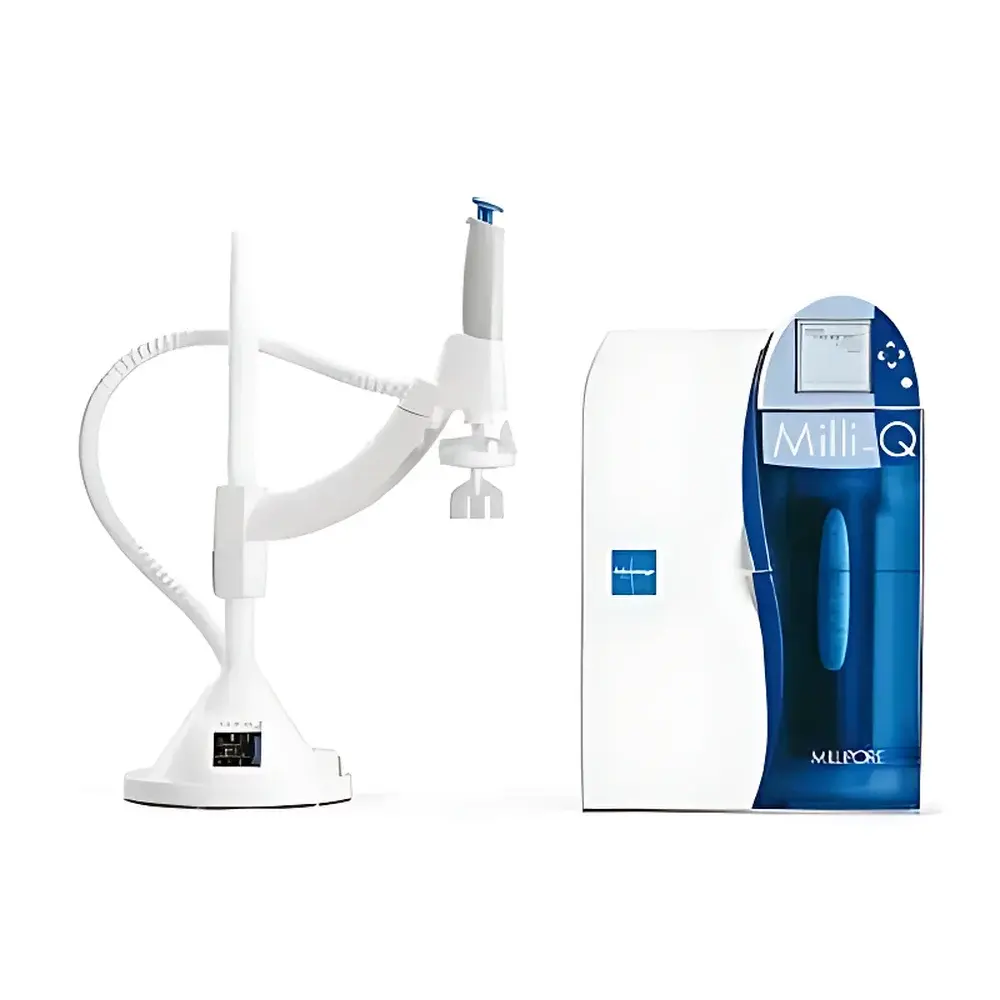
Millipore Sigma Milli-Q Advantage A10 Ultra-Pure Water System
| Brand | Millipore |
|---|---|
| Origin | France |
| Model | Milli-Q Advantage A10 |
| Certification | ISO 9001, ISO 14001, CE Marked |
| Compliance | Meets ASTM D1193 Type I, ISO 3696 Grade 1, CLSI EP22-A, and USP <1231> water quality specifications |
| Water Quality | Resistivity ≥18.2 MΩ·cm at 25 °C, TOC ≤5 ppb, Particles <1/mL (>0.22 µm), Bacteria <0.1 CFU/mL, Endotoxins <0.001 EU/mL, RNases <0.01 ng/mL, DNases <4 pg/mL |
| Flow Rate | Up to 2 L/min (dependent on Q-POD™ terminal filter configuration) |
| UV Oxidation | Dual-wavelength (185/254 nm) lamp |
| Purification Stages | Pre-treatment (Q-Gard®), UV oxidation, final polishing (Quantum™), optional end-point filtration (Millipak®, BioPak®) |
| eSure™ Technology | Real-time consumable tracking and water quality traceability |
| Display | Color touchscreen on both产水 unit and Q-POD™ interface |
| Connectivity | USB port for data export |
| Validation Support | IQ/OQ documentation packages, calibration certificates for resistivity sensor, TOC analyzer, and temperature probe |
Overview
The Millipore Sigma Milli-Q Advantage A10 Ultra-Pure Water System is an engineered solution for laboratories requiring consistent, traceable, and application-grade Type I ultrapure water in compliance with ASTM D1193, ISO 3696, CLSI EP22-A, and USP . Designed around a modular architecture, the system separates water production and point-of-use delivery into two physically independent units: the Milli-Q Advantage A10 production unit and one or more Q-POD™ (Quality-Point-of-Delivery) dispensing units. This decoupled design enables flexible installation—on benchtop, under bench, or wall-mounted—while maintaining full hydraulic and electrical isolation between purification and distribution. The core purification pathway integrates Elix®-generated feed water (or equivalent pretreated source), dual-wavelength UV oxidation (185/254 nm), Quantum™ final polishing cartridges, and low-leaching recirculation tubing. All critical water quality parameters—including resistivity, total organic carbon (TOC), temperature, and flow—are continuously monitored at the point of delivery via integrated sensors within each Q-POD™ unit, ensuring real-time assurance of water integrity before use.
Key Features
- Modular Two-Unit Architecture: Independent production and dispensing units allow spatial flexibility without compromising water quality or system integrity.
- Q-POD™ Dispensing Interface: Full-color graphical display shows real-time resistivity (≥18.2 MΩ·cm), TOC (≤5 ppb), temperature, volume dispensed, and cartridge life status; supports quantitative dispensing (programmable volumes from 1 mL to 99.9 L) and manual operation.
- eSure™ Cartridge Intelligence: Embedded RFID tags in Q-Gard® and Quantum™ cartridges automatically register installation date, usage time, and cumulative water volume, enabling full audit trail compliance per FDA 21 CFR Part 11 and GLP/GMP requirements.
- Dual-Wavelength UV Oxidation: Simultaneous 185 nm (photolysis of organics) and 254 nm (microbial inactivation) irradiation ensures robust reduction of TOC and viable microorganisms prior to final polishing.
- Terminal Filtration Options: Interchangeable end-point filters—including Millipak® (0.22 µm sterilizing grade) and BioPak® (0.22 µm + 50 kDa ultrafiltration)—enable application-specific control of particles, bacteria, endotoxins, RNases, and DNases.
- Validation-Ready Design: Factory-provided calibration certificates for resistivity sensor, TOC analyzer, and temperature probe; optional IQ/OQ documentation kits support laboratory qualification under ISO/IEC 17025 and GxP frameworks.
Sample Compatibility & Compliance
The Milli-Q Advantage A10 is validated for continuous generation of ASTM Type I ultrapure water from pretreated feed sources (e.g., reverse osmosis or deionized water). It meets or exceeds international standards for analytical reagent water, including ISO 3696 Grade 1, CLSI EP22-A, and USP . When configured with BioPak® terminal filtration, the system delivers water compliant with molecular biology applications—specifically, endotoxin levels <0.001 EU/mL, RNase <0.01 ng/mL, and DNase <4 pg/mL—as verified by independent third-party testing. All sensors undergo annual factory calibration traceable to NIST standards, and the system supports electronic record retention for audit readiness in regulated environments.
Software & Data Management
The system operates without proprietary software dependencies: all operational data—including daily resistivity/TOC logs, cartridge usage history, alarm events, and maintenance timestamps—are stored locally on the production unit’s internal memory and accessible via USB export in CSV format. Q-POD™ units retain 30 days of local water quality history, synchronized upon connection to the production unit. For networked labs, optional Ethernet connectivity enables integration into centralized laboratory information management systems (LIMS) via Modbus TCP or HTTP API protocols. Audit trails comply with ALCOA+ principles (Attributable, Legible, Contemporaneous, Original, Accurate, Complete, Consistent, Enduring, Available) and support 21 CFR Part 11 electronic signature workflows when paired with validated identity management infrastructure.
Applications
This system serves high-sensitivity applications where water purity directly impacts experimental validity: HPLC and UHPLC mobile phase preparation, LC-MS and GC-MS solvent formulation, atomic absorption spectroscopy (AAS), inductively coupled plasma mass spectrometry (ICP-MS), cell culture media preparation, PCR/qPCR reagent dilution, electrophysiology buffer preparation, and nanomaterial synthesis. Its ability to deliver stable resistivity >18.2 MΩ·cm and TOC <5 ppb ensures minimal baseline drift in chromatographic analyses and low background interference in elemental detection techniques. The BioPak®-equipped configuration is routinely deployed in stem cell labs and oligonucleotide synthesis facilities requiring ultra-low nuclease and endotoxin content.
FAQ
What feed water quality is required for optimal performance?
The system requires pretreated feed water meeting ASTM D1193 Type III specifications (resistivity ≥0.05 MΩ·cm, TOC ≤200 ppb, silica ≤500 ppb). Elix®-generated water is recommended as the preferred input source.
Can multiple Q-POD™ units be connected to a single production unit?
Yes—up to three Q-POD™ units may be daisy-chained to one Milli-Q Advantage A10 production unit, each configurable with distinct terminal filtration and dispensing parameters.
Is the system compatible with GLP/GMP validation protocols?
Yes—the eSure™ cartridge tracking, calibrated sensor suite, and optional IQ/OQ documentation packages are designed to support formal laboratory validation under ISO/IEC 17025, FDA 21 CFR Part 11, and EU Annex 11 requirements.
How often do consumables require replacement?
Q-Gard® prefilter cartridges typically last 6–12 months depending on feed water quality; Quantum™ polishing cartridges last 6–9 months under typical lab usage (≈1,500 L); Millipak®/BioPak® terminal filters are replaced after 1,000 L or upon pressure drop exceeding 0.5 bar.
Does the system provide remote monitoring capabilities?
Remote monitoring is supported via optional Ethernet module and Millipore Sigma’s LabManager™ cloud platform (subscription-based), enabling real-time alerts, predictive maintenance scheduling, and cross-site fleet analytics.



