
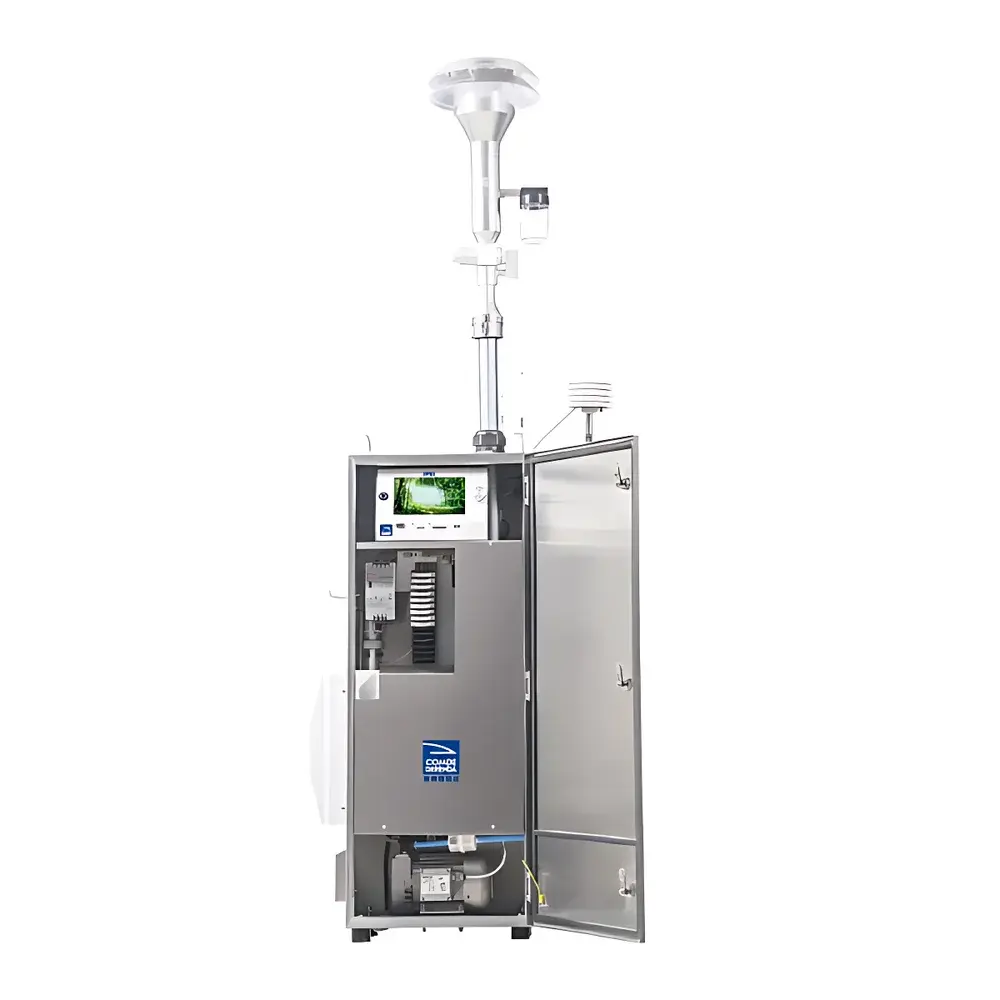
Derenda PNS 16T Integrated Automated Filter-Changing Particulate Matter Sampler
| Brand | Derenda |
|---|---|
| Origin | Germany |
| Model | PNS 16T |
| Flow Range | 1.5–3.5 m³/h (adjustable) |
| Vacuum Pressure | 800 hPa |
| Flow Stability | ≤2.0% deviation over 24 h |
| Maximum Flow Error | ≤±2.0% |
| Operating Duration at Max Flow & Load | 1 min to 999 h |
| Rated Lifetime at Max Flow & Load | 50,000 h |
| Filter Diameter | 47 mm |
| Dimensions | 460 × 270 × 1100 mm |
| Weight | 44.5 kg |
| Power Supply | 220 V ±10%, 50 Hz |
| Max Power Consumption | 420 W |
| Noise Level | <62 dB(A) (per DIN 2058, at 8 m) |
| Operating Temperature | −30°C to +50°C |
| Operating Humidity | 0–100% RH |
| Ingress Protection | IP55 |
Overview
The Derenda PNS 16T Integrated Automated Filter-Changing Particulate Matter Sampler is a high-precision, field-deployable environmental monitoring instrument engineered for long-term, unattended gravimetric sampling of airborne particulate matter—including PM1, PM2.5, and PM10—in compliance with international regulatory frameworks. Based on the principle of isokinetic low-pressure filtration under controlled volumetric flow, the system draws ambient air through standardized 47 mm diameter filters at user-defined flow rates between 1.5 and 3.5 m³/h. Its core architecture integrates a robust mechanical filter exchange mechanism, thermally stabilized filter storage, and real-time environmental parameter logging—enabling traceable, metrologically sound mass concentration measurements essential for regulatory reporting, source apportionment studies, and health-related aerosol research.
Key Features
- Purely mechanical 16-position filter magazine with spring-loaded stainless-steel retention—eliminates pneumatic or servo-driven failure modes and ensures consistent, jam-free filter positioning across extended deployments.
- Integrated Peltier-cooled filter storage compartment maintaining internal temperature ≤20°C, minimizing loss of semi-volatile organic compounds (SVOCs), nitrates, and ammonium salts during multi-day sampling cycles.
- Optional RFID-enabled filter cassette identification system: reads unique identifiers from pre-programmed filter holders to auto-log sampling start/stop times, filter ID, gravimetric batch numbers, and operator metadata—supporting full chain-of-custody documentation.
- Dual GNSS positioning (BeiDou + GPS) with sub-5 m CEP accuracy under open-sky conditions; supports geotagging of every sample event for spatial data integrity in networked monitoring applications.
- Real-time on-device visualization of critical operational parameters—including ambient temperature, relative humidity, barometric pressure, and filter differential pressure—via high-contrast graphical LCD interface with trend plotting capability.
- Modular expansion support for co-located meteorological sensors (wind speed, wind direction, temperature, humidity, atmospheric pressure), enabling synchronized analysis of PM mass loading against local dispersion dynamics.
Sample Compatibility & Compliance
The PNS 16T is validated for use with standard quartz fiber, Teflon-coated glass fiber, and polytetrafluoroethylene (PTFE) membrane filters compliant with ISO 9060:2018 and ASTM D1739. It meets the performance requirements specified in HJ 618–2011, HJ 656–2013, and HJ 93–2013 for manual reference-grade PM2.5/PM10 samplers. Its flow control system achieves ≤±2.0% full-scale accuracy over 24 h and maintains stability under variable backpressure up to 800 hPa—ensuring adherence to US EPA Reference Method PS-1 and EU EN 12341:2014 for equivalent calibration traceability. The system’s IP55-rated enclosure enables outdoor operation across climatic zones from −30°C to +50°C, with humidity tolerance up to 100% RH non-condensing.
Software & Data Management
Data acquisition and remote supervision are managed via embedded Linux-based firmware supporting dual-mode telemetry: optional 3G/4G LTE module enables encrypted MQTT or HTTPS transmission of status logs, alarm events, and real-time sensor streams to centralized cloud platforms. Firmware supports configurable sampling schedules, conditional start/stop triggers (e.g., based on PM threshold crossing or meteorological thresholds), and audit-trail generation compliant with GLP/GMP principles. All time-stamped events—including filter changes, power interruptions, and environmental excursions—are recorded with SHA-256 hashed integrity signatures. Optional integration with LIMS-compatible APIs allows direct ingestion into laboratory information management systems for automated gravimetric result correlation.
Applications
- Regulatory ambient air quality monitoring networks requiring long-term, multi-filter sequential sampling per national reference methods.
- Source characterization campaigns involving speciation analysis—e.g., ion chromatography for anions/cations, ICP-MS for elemental composition, and GC-MS for organic carbon fractions—where sample integrity and thermal stabilization are critical.
- Health impact studies investigating size-resolved particle toxicity, requiring parallel collection of PM1, PM2.5, and coarse fractions on separate substrates within a single deployment cycle.
- Industrial fence-line monitoring where continuous,无人值守 operation and tamper-resistant data provenance are mandated by permitting authorities.
- Research-grade field laboratories conducting aerosol hygroscopicity, volatility, and optical property investigations requiring precisely timed, temperature-controlled filter archives.
FAQ
Does the PNS 16T support automated gravimetric weighing integration?
No—the system does not include an integrated balance; however, its RFID-enabled filter cassettes export unique identifiers compatible with external analytical balances equipped with barcode/RFID readers, enabling automated sample tracking in post-sampling workflows.
Is the cooling unit capable of sub-ambient operation?
The Peltier-based storage module maintains ≤20°C internally but is not designed for sub-ambient temperatures; it functions as a passive thermal buffer against diurnal heating in sun-exposed enclosures.
Can the device operate on battery or solar power?
While rated for 220 V AC input, the PNS 16T’s 420 W peak draw permits integration with appropriately sized off-grid power systems (e.g., 2.5 kVA inverter + deep-cycle battery bank) when deployed in remote locations without grid access.
What communication protocols are supported for remote configuration?
The embedded controller supports Modbus TCP, HTTP RESTful API, and custom JSON-over-MQTT for bidirectional command-and-control—including dynamic flow setpoint adjustment, filter position selection, and firmware update initiation.
How is calibration traceability maintained across long-term deployments?
Each unit ships with NIST-traceable flow calibrator certificate (valid for 12 months); field verification is supported via built-in orifice plate test ports and optional handheld primary standards per ISO 5167.







