
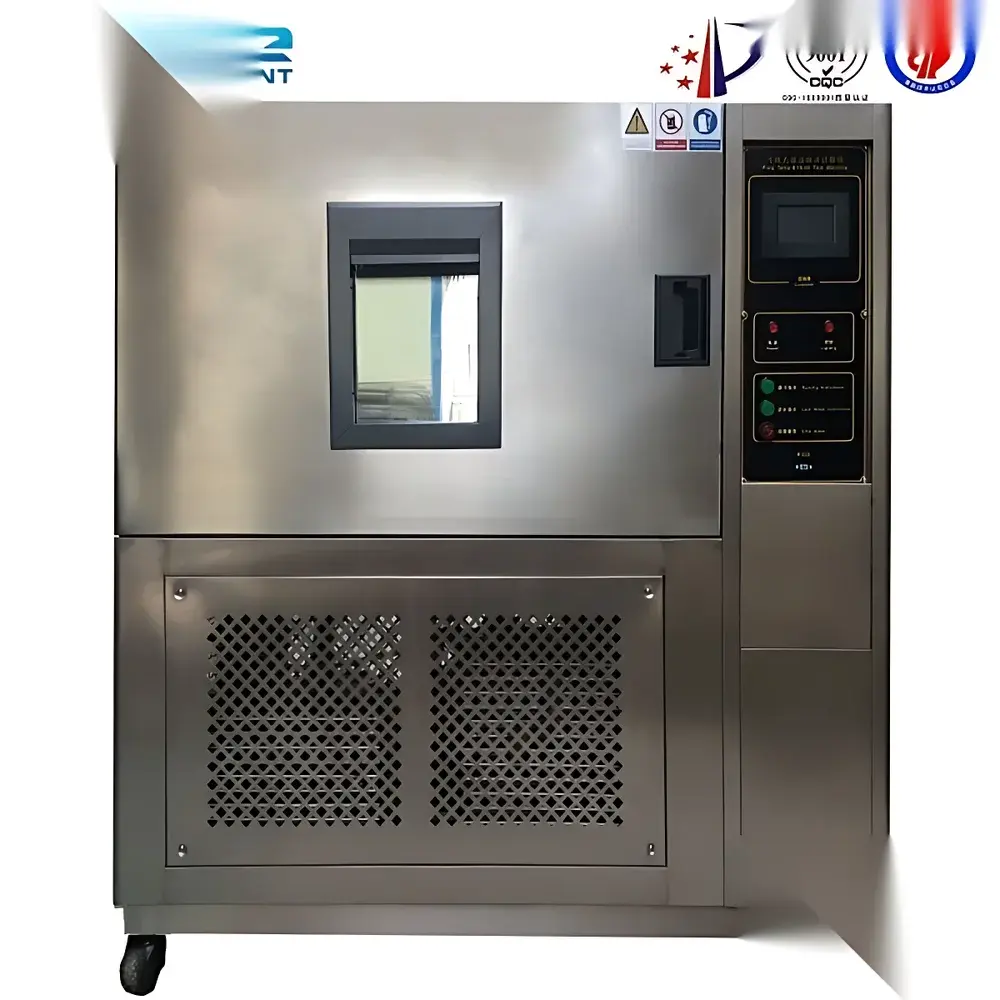
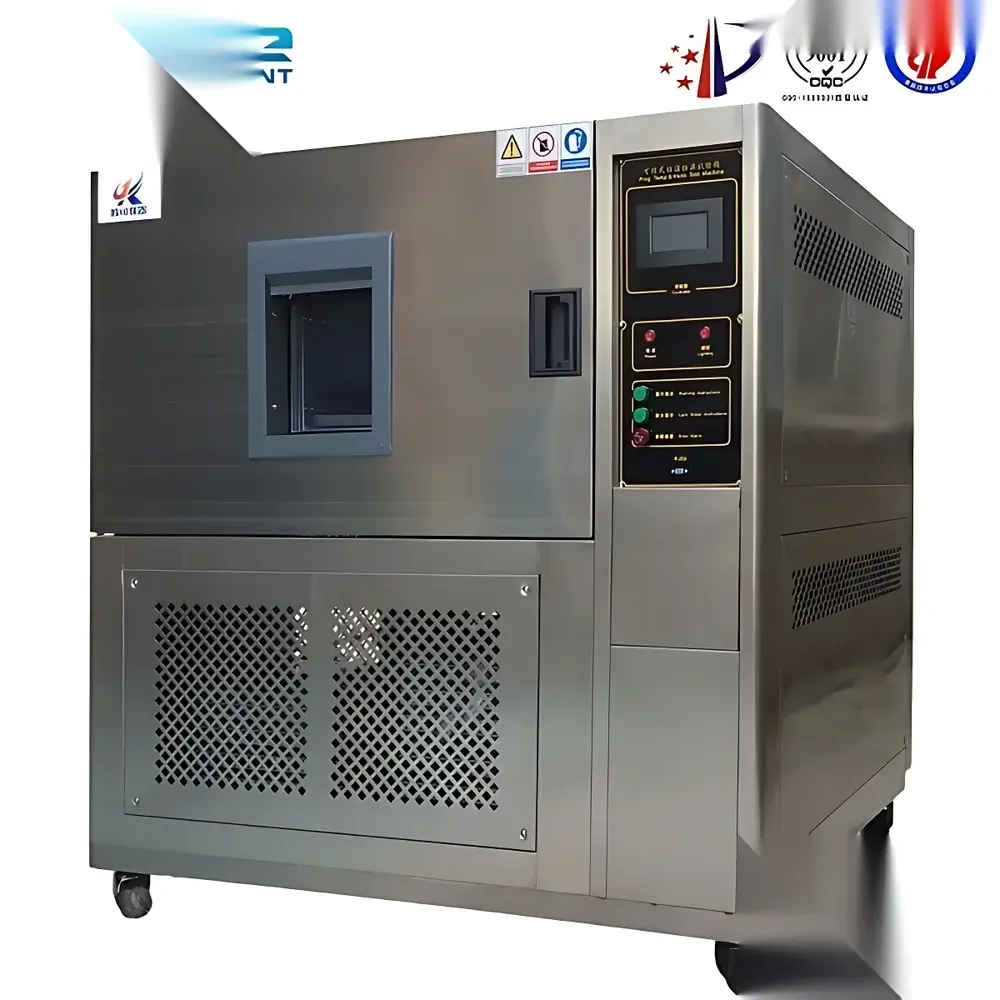
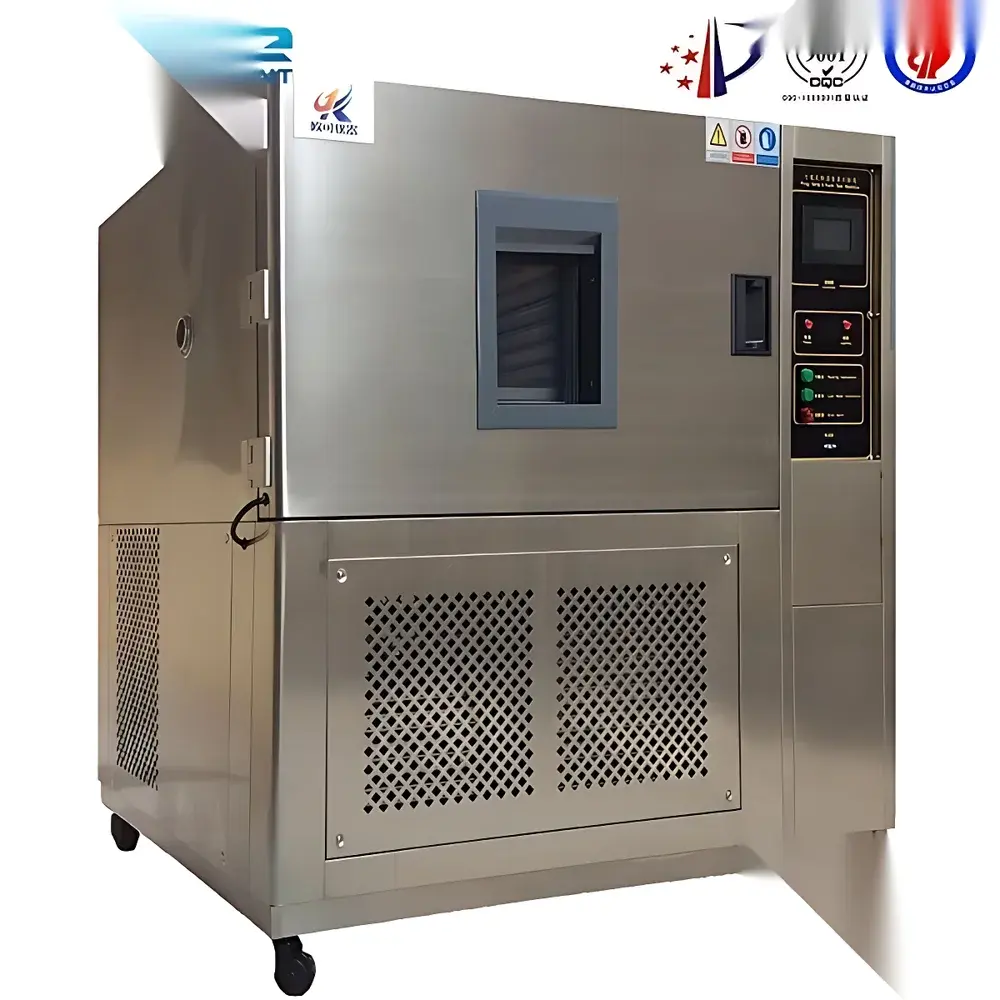
Desktop Temperature and Humidity Controlled Environmental Test Chamber
| Key | Temperature Range: –40 °C to +150 °C (standard) |
|---|---|
| Humidity Range | 30–98% RH (standard) |
| Temperature Resolution | 0.01 °C |
| Humidity Resolution | 0.1% RH |
| Temperature Uniformity | ±0.5 °C |
| Temperature Deviation | ≤±2 °C |
| Humidity Deviation | ≤±2.5% RH |
| Heating Rate | 2.0–3.0 °C/min |
| Cooling Rate | 0.7–1.0 °C/min |
| Control System | TEMI880 color LCD touchscreen programmable controller |
| Power Supply | 380 V ±5%, 50 Hz, 3P+N+G (customizable to 220 V) |
| Interior Material | SUS304 stainless steel |
| Exterior Material | SUS304 stainless steel or A3 steel with electrostatic powder coating |
Overview
The Desktop Temperature and Humidity Controlled Environmental Test Chamber is an engineered precision instrument designed for laboratory-scale environmental simulation and reliability testing of materials, components, and electronic assemblies under tightly regulated thermal and hygrothermal conditions. Based on forced-air convection and dual-refrigeration circuit architecture (with cascade refrigeration for sub-zero operation), the chamber delivers stable, repeatable control across wide temperature and humidity ranges. It operates in accordance with fundamental thermodynamic principles—utilizing PID-controlled heating elements, high-efficiency compressors, and ultrasonic or steam-based humidification systems—to maintain setpoint accuracy while minimizing spatial gradients and temporal drift. This chamber is not intended for industrial process control but rather for standardized qualification testing, pre-compliance screening, and R&D validation where reproducibility, traceability, and audit-ready operation are essential.
Key Features
- Compact desktop footprint optimized for benchtop integration in QC labs, university research facilities, and small-volume electronics validation environments
- Standard operating range of –40 °C to +150 °C with optional extension to –120 °C via cascade refrigeration system; humidity range 30–98% RH (optional 5–98% RH)
- TEMI880 programmable controller featuring 7-inch color LCD touchscreen, multi-segment ramp-soak profiles, real-time trend logging, and USB data export capability
- SUS304 stainless steel interior chamber construction ensures corrosion resistance, cleanability, and long-term dimensional stability under cyclic thermal stress
- High-precision sensor suite: PT100 temperature sensors (Class A tolerance) and capacitive humidity sensors calibrated per ISO/IEC 17025-accredited procedures
- Compliant airflow design with adjustable air baffles and uniform distribution plenum to minimize vertical/horizontal gradients (≤±0.5 °C uniformity at steady state)
- Integrated safety interlocks including overtemperature cutoff, compressor high-pressure protection, and door-open alarm with automatic power cutoff
Sample Compatibility & Compliance
This chamber accommodates a broad spectrum of non-hazardous test specimens—including PCBs, polymer films, lithium-ion battery cells, optical lenses, pharmaceutical packaging, and automotive connectors—within its standard internal volume (typically 80–220 L, configurable per OEM specification). All operational parameters conform to internationally recognized test standards, including IEC 60068-2-1 (cold), IEC 60068-2-2 (dry heat), IEC 60068-2-30 (damp heat, cyclic), and ASTM D4332 (conditioning of plastics). The system supports GLP-compliant documentation through optional audit trail modules and meets foundational requirements for ISO/IEC 17025 laboratory accreditation when operated with documented calibration intervals and environmental monitoring records. While not inherently 21 CFR Part 11 compliant, the TEMI880 controller supports external data archiving systems that may be validated for regulated GxP workflows.
Software & Data Management
Data acquisition and profile management are handled exclusively through the embedded TEMI880 controller firmware. Users can define up to 100 programmable test cycles, each comprising multiple ramp/soak segments with independent temperature and humidity setpoints. Real-time graphs display chamber status, deviation from setpoint, and alarm history. Logged data (timestamped temperature/humidity values at user-selectable intervals from 1 sec to 60 min) is stored internally and exportable via USB flash drive in CSV format. For enterprise integration, optional RS485 Modbus RTU or Ethernet TCP/IP interfaces enable connection to SCADA or LIMS platforms. Calibration certificates for integrated sensors are issued with NIST-traceable references and include uncertainty budgets per ISO/IEC 17025 guidelines.
Applications
- Pre-screening of electronic components for thermal shock susceptibility and moisture ingress resistance prior to accelerated life testing
- Evaluation of packaging barrier performance under controlled humidity cycling (e.g., blister packs, desiccant-lined pouches)
- Material property characterization: coefficient of thermal expansion (CTE) estimation, glass transition detection via dimensional change monitoring
- Stability testing of adhesives, coatings, and elastomers under combined thermal-hygric stress
- Qualification of medical device sterilization packaging per ISO 11607-1 Annex B protocols
- Validation of sensor drift behavior in environmental monitoring instruments across defined climatic zones
FAQ
What is the typical calibration interval recommended for this chamber?
Annual calibration is advised for ISO/IEC 17025 compliance; critical applications may require semi-annual verification using NIST-traceable reference sensors.
Can the chamber operate continuously at –70 °C without humidity control?
Yes—dehumidification is disabled below 0 °C by default; continuous operation at –70 °C is supported with appropriate cascade refrigeration configuration and ambient cooling water supply (10–28 °C, 0.1–0.3 MPa).
Is the TEMI880 controller compatible with third-party data acquisition software?
Native support is limited to USB export and Modbus RTU/Ethernet protocols; custom OPC UA or MQTT bridges require external gateway hardware and validation.
How does load mass affect temperature stabilization time?
Thermal inertia increases proportionally with specimen mass and specific heat capacity; full-load stabilization times may extend by 20–40% versus empty-chamber specifications, as noted in GB/T 5170.2–1996.
Are replacement parts and service manuals available internationally?
Yes—SUS304 chamber liners, PID modules, refrigerant filters, and TEMI880 firmware updates are stocked globally through authorized technical support partners with 48-hour lead time for standard items.



