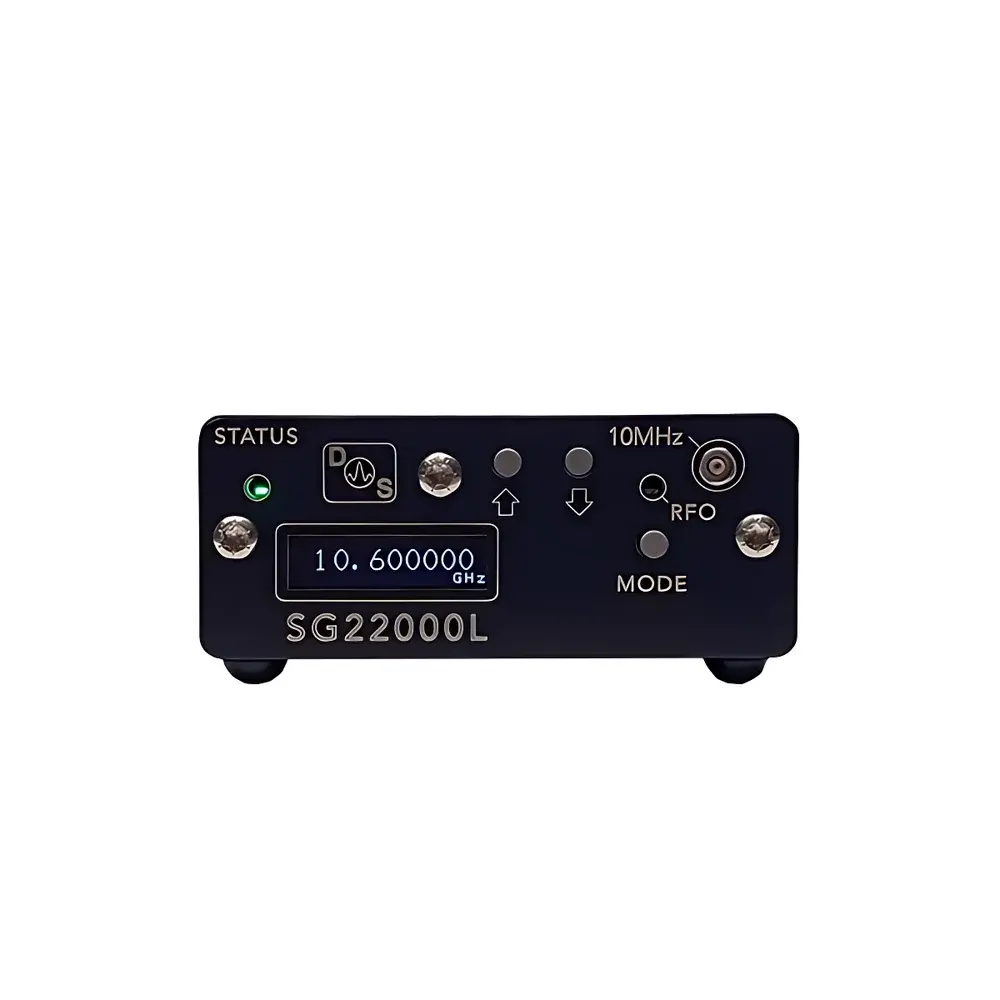
DesTest TS-SG22000 Microwave Signal Generator
| Brand | DesTest Instruments |
|---|---|
| Origin | USA |
| Model | TS-SG22000 |
| Frequency Range | 25–22,000 MHz (24 GHz at reduced power) |
| Output Power (Band 1, calibrated) | –20 to +10 dBm in 0.5 dB steps |
| Output Power (Band 2) | > +12 dBm |
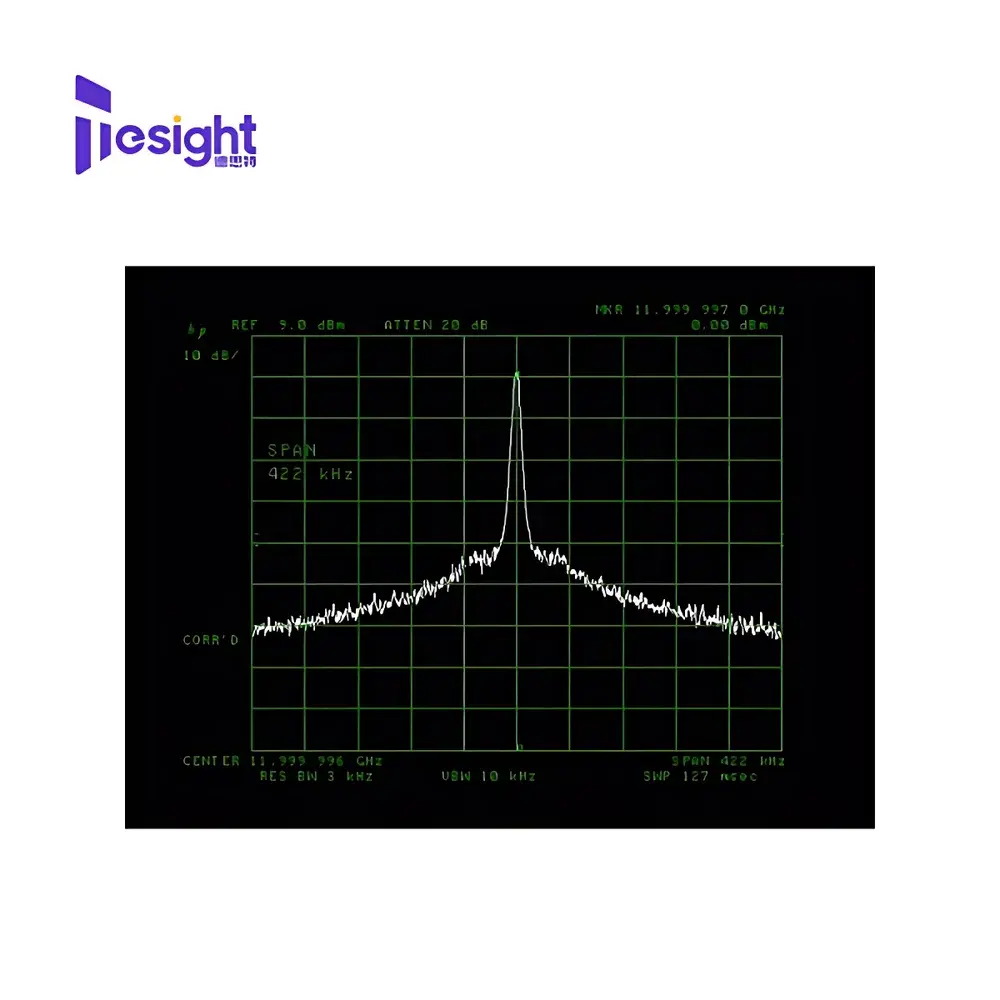
| Phase Noise | –63 dBc/Hz @ 18 GHz, 10 kHz offset |
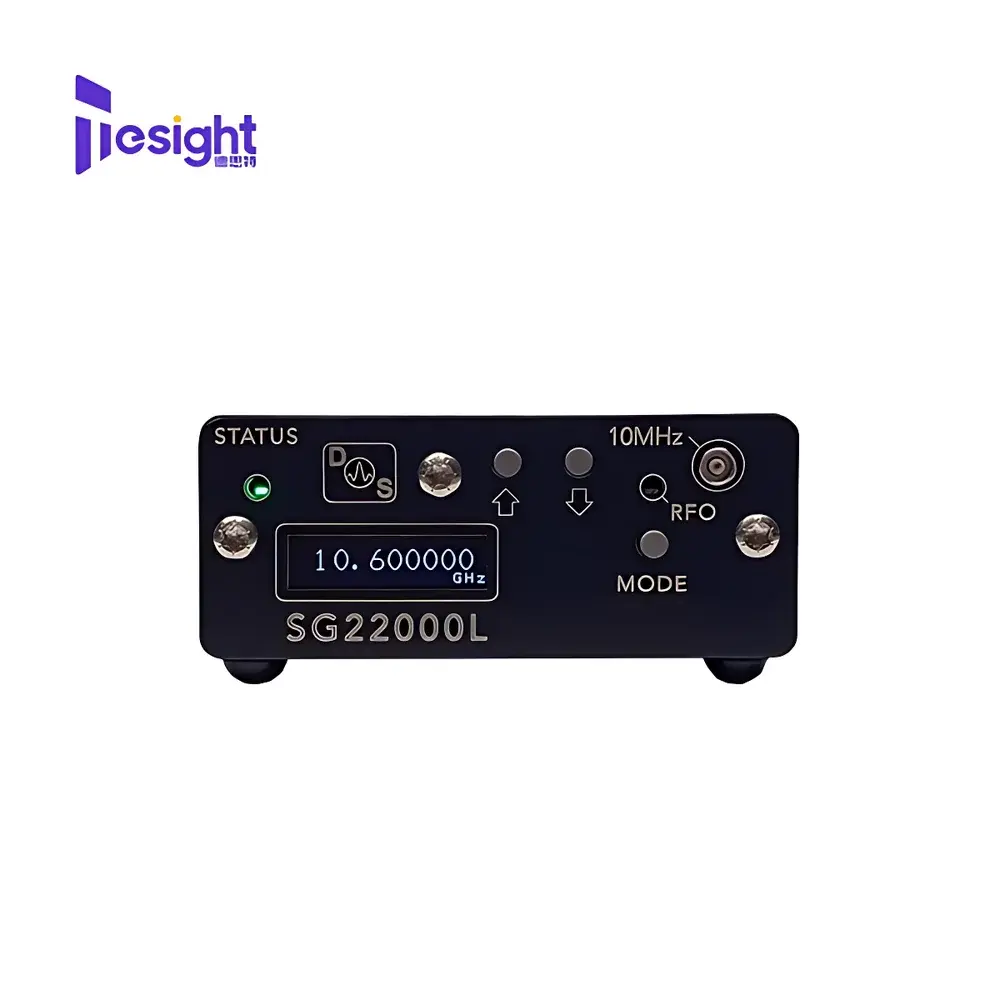
| Reference | Internal ±280 ppb TCXO or external 10 MHz via MCX |
| Resolution | Down to <40 Hz step size |
| Sweep | Local hardware-triggered sweep support |
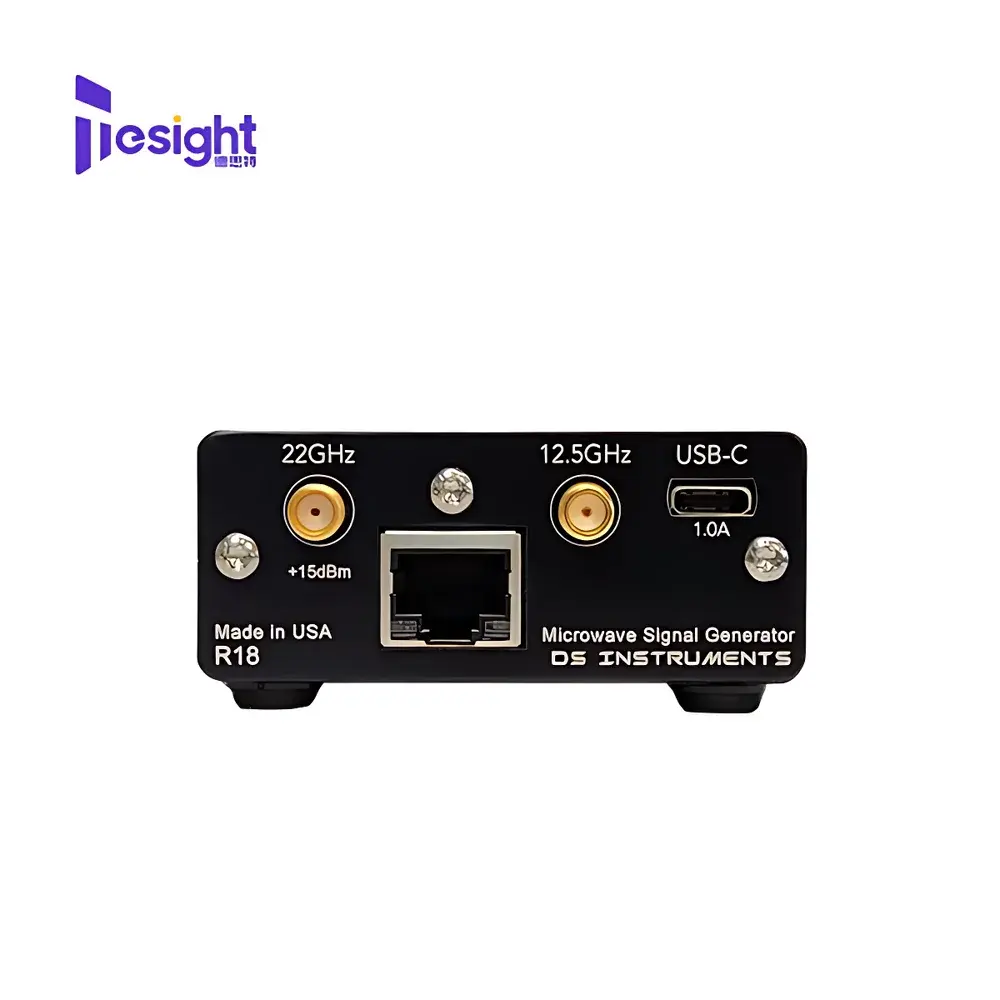
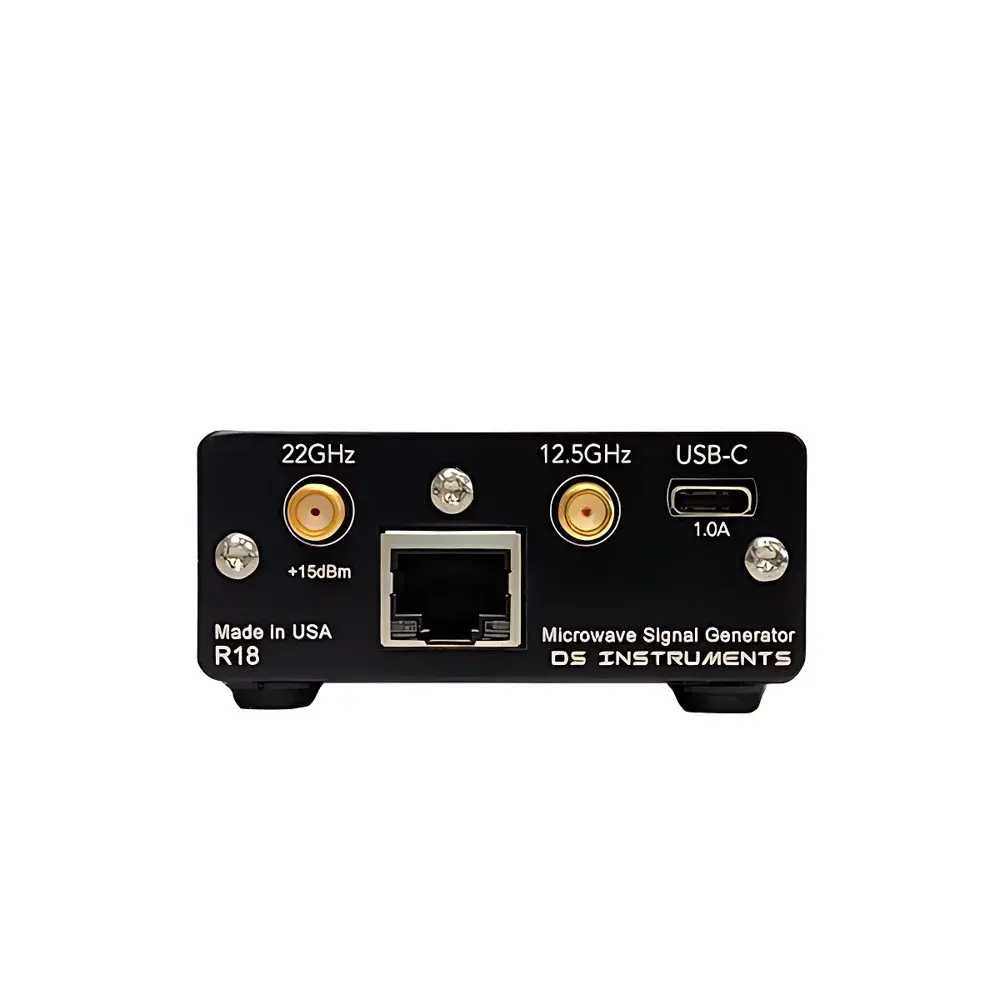
| Interface | USB-C (5 V / 0.75 A), SCPI-compliant, optional Ethernet |
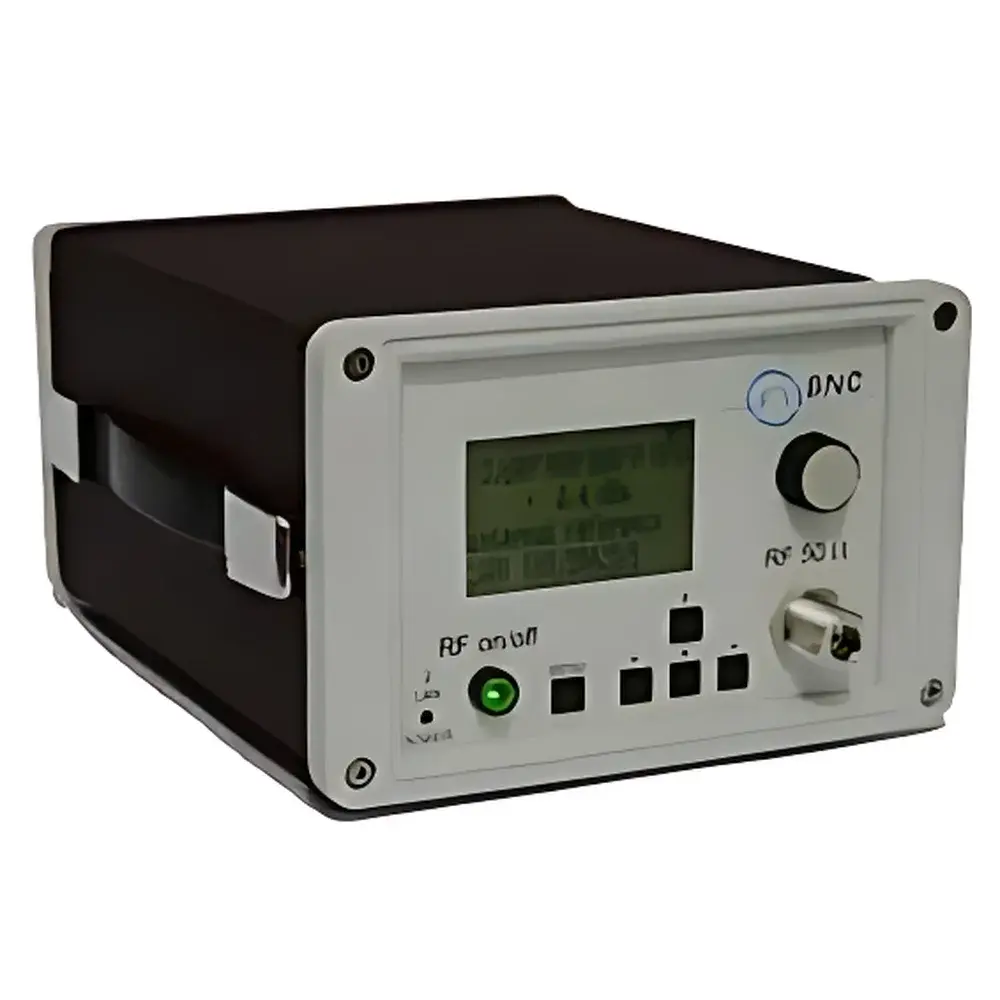
| Display | Front-panel OLED |
| Housing | Machined aluminum enclosure |
| Dimensions | 2.75″ × 1.25″ × 4.0″ |
| RF Connectors | Dual gold-plated microwave SMA |
| Impedance | 50 Ω |
Overview
The DesTest TS-SG22000 is a compact, fully synthesized microwave signal generator engineered for precision RF and microwave test applications across research, development, and production environments. Operating on fractional-N frequency synthesis architecture, it delivers stable, low-phase-noise output across three contiguous frequency bands—25–12,000 MHz (Band 1), 12,000–22,000 MHz (Band 2), and extended operation up to 24 GHz at reduced power levels. Its dual-band architecture enables seamless coverage from UHF through Ku-band without manual reconfiguration, making it particularly suited for satellite communications validation, antenna characterization, EMC pre-compliance testing, and Ku-band component evaluation. The instrument features a high-stability ±280 ppb TCXO internal reference and automatic detection of external 10 MHz references via MCX connector—ensuring traceable synchronization in multi-instrument test benches compliant with IEEE 1139 and ISO/IEC 17025 metrology practices.
Key Features
- Fully synthesized output using fractional-N PLL architecture with sub-40 Hz frequency resolution and programmable step sizes from 10 kHz down to fine-tuned increments
- Dual calibrated output bands: Band 1 (25–12,000 MHz) offers 64-step calibrated power control from –20 to +10 dBm (0.5 dB steps), plus continuous cursor-based fine adjustment (±15 dB range); Band 2 (12–22 GHz) delivers >+12 dBm typical output for driving high-power mixers and Ku-band amplifiers
- Front-panel OLED display with intuitive menu navigation and tactile push-button controls—enabling full local operation without PC dependency
- USB-C powered (5 V / 0.75 A), driverless Windows GUI included; supports industry-standard SCPI commands over USB virtual COM port for integration into automated test systems (ATE)
- Optional Ethernet interface (RJ-45) available for remote control in rack-mounted or distributed lab environments; compatible with LXI Class C specifications
- Machined black anodized aluminum housing provides EMI shielding, thermal stability, and mechanical robustness—rated for continuous operation in ambient temperatures from 0 °C to 45 °C
- Hardware-accelerated sweep functionality: frequency and power sweeps can be configured and executed autonomously via front-panel triggers or external TTL input—eliminating host PC latency in time-critical measurements
Sample Compatibility & Compliance
The TS-SG22000 is designed for direct interfacing with standard 50 Ω RF components and test fixtures used in wireless communication labs and aerospace R&D facilities. Its gold-plated microwave-grade SMA connectors ensure repeatable mating cycles and minimal insertion loss up to 22 GHz. The instrument meets FCC Part 15 Subpart B Class A emissions limits and complies with IEC 61000-4-2 (ESD), -4-3 (radiated immunity), and -4-4 (electrical fast transient) requirements for laboratory equipment. While not certified for medical or aviation safety-critical use, its traceable calibration path—including documented uncertainty budgets per ISO/IEC 17025—supports GLP and GMP-aligned validation protocols in regulated industries such as defense contracting and satellite subsystem qualification.
Software & Data Management
DesTest provides a free, lightweight Windows-based GUI that operates without device drivers—leveraging native USB CDC ACM class enumeration. The application supports real-time parameter monitoring, sweep configuration, and SCPI script playback. All firmware updates are delivered via signed binary packages verified using SHA-256 checksums. For integration into larger test frameworks, the TS-SG22000 exposes a complete SCPI command set compliant with IEEE 488.2 and IVI-C specifications—including *IDN?, :FREQ:CW, :POW:LEV, :SWE:STA, and :TRIG:SOUR. Audit trail logging (enabled via optional Ethernet firmware) records all remote command executions with timestamps and source IP addresses—supporting FDA 21 CFR Part 11 electronic record requirements when deployed in regulated QA/QC workflows.
Applications
- Satellite transceiver chain verification and LNB/HPA linearity testing in ground station labs
- Ku-band radar component characterization—including mixer conversion loss, amplifier gain flatness, and filter passband mapping
- EMC pre-scan testing per CISPR 22/32 and MIL-STD-461G RS103 radiated emissions simulation
- Antenna pattern measurement systems requiring phase-coherent stimulus sources
- University RF engineering laboratories for hands-on microwave circuit design and modulation analysis coursework
- Aerospace avionics RF subsystem burn-in and parametric validation under controlled environmental conditions
- Production line calibration of spectrum analyzers, vector network analyzers, and RF power meters
FAQ
Does the TS-SG22000 support external frequency reference locking?
Yes—the instrument automatically detects and locks to a 10 MHz reference input via the front-panel MCX connector. No manual switching is required.
Is phase noise performance specified across the full band?
Phase noise is characterized at representative frequencies (e.g., –63 dBc/Hz @ 18 GHz, 10 kHz offset) and follows predictable degradation trends consistent with fractional-N synthesizer theory. Full noise floor data sheets are available upon request.
Can the unit perform frequency sweeps without a connected PC?
Yes—hardware-based sweep modes (linear, logarithmic, list) are configurable and executable entirely from the front panel or via external TTL trigger.
What is the calibration validity period and traceability basis?
Factory calibration is performed against NIST-traceable standards and includes full uncertainty reporting. Recommended recalibration interval is 12 months under normal laboratory use.
Is the TS-SG22000 suitable for pulsed RF applications?
While not a dedicated pulse modulator, the instrument supports externally gated RF output via TTL-compatible blanking input (optional accessory), enabling basic on/off keying for radar simulation and duty-cycle testing.